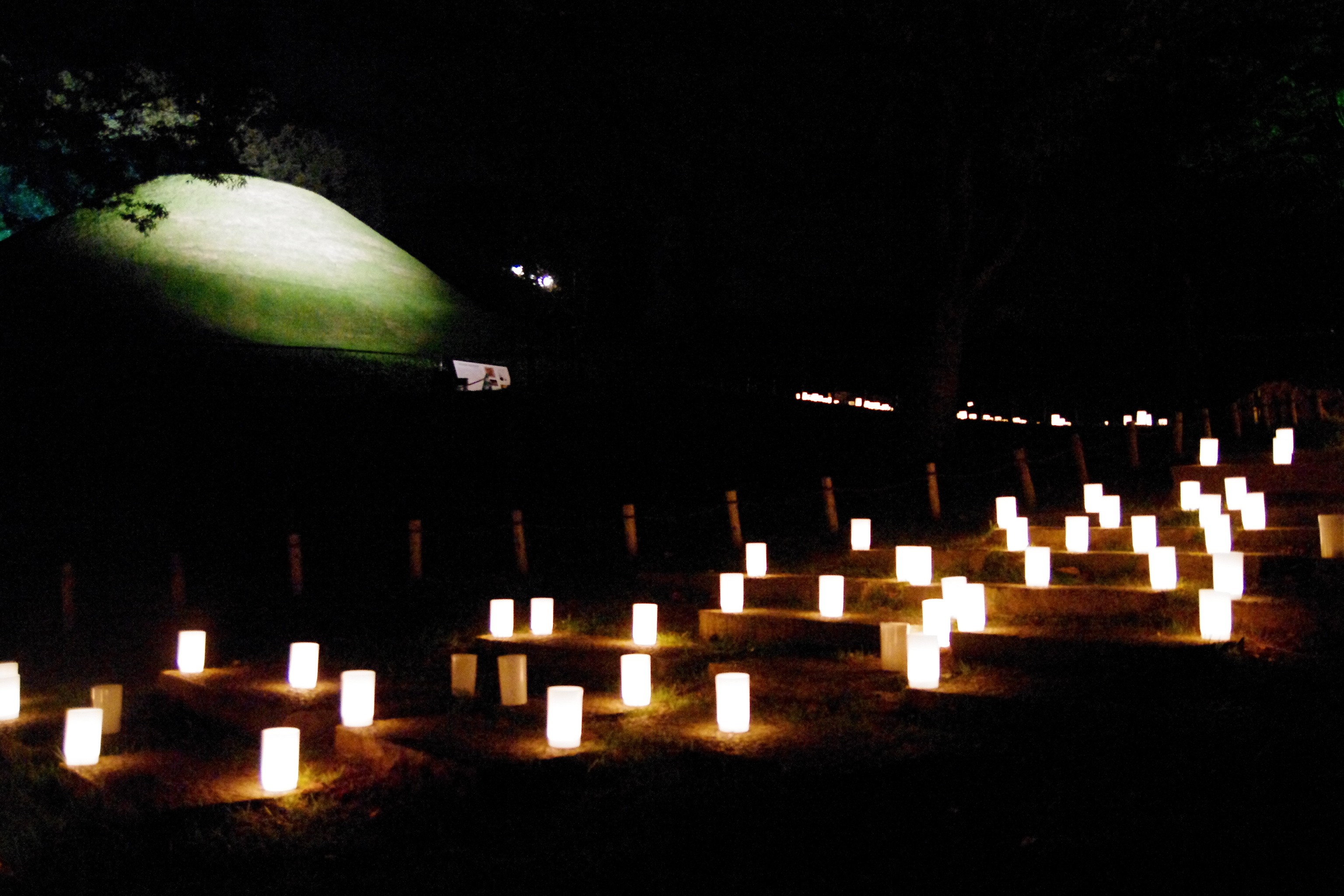
Takamatsuzuka Tomb
In October 1970, villagers in Asuka, Nara Prefecture, dug a hole in a small earthen mound to store ginger. They hit cut stone. Nobody paid much attention -- the mound was unremarkable, barely worth a footnote -- until archaeologists from the Nara Prefectural Kashihara Archaeological Institute opened the horizontal entry stone burial chamber in March 1972. Inside, painted in vivid red, blue, gold, and silver on a thin layer of plaster, were figures in Goguryeo-style court dress, celestial guardians, constellations rendered in gold leaf, and a cosmological ceiling map that had been sealed in darkness since the end of the seventh century. The Takamatsuzuka Tomb became a national sensation overnight, a reminder that the Japanese countryside still holds secrets beneath its rice paddies.
A Cosmos in a Coffin
The burial chamber is astonishingly small -- 2.65 meters north to south, just over one meter wide, and 1.13 meters high. You cannot stand in it. You can barely turn around. Yet its walls contain a complete cosmological program. The east wall bears a group of four male courtiers, the Azure Dragon, and the sun. The west wall mirrors it with another group of male figures, the White Tiger, and the moon. Female attendants in colorful garments flank both sides, carrying tools, weapons, and musical instruments that match the belongings of officials in the New Year's morning greeting ceremony described in the Jogan Ceremony text. On the north wall crouches the Black Tortoise. The ceiling maps the heavens: gold leaf stars connected by vermilion lines trace the 28 constellations, with the five stars of the North Pole at their center inside a purple enclosure. The Vermilion Bird, which would have guarded the south wall, was lost -- likely destroyed when tomb robbers punched through that wall during the Kamakura period.
Beautiful Women on Crumbling Plaster
The most celebrated image in the tomb is the group of female figures on the west wall, known as the Asuka Bijin -- the 'beautiful women of Asuka.' Painted in full polychrome, they wear layered robes in the continental Goguryeo style, their faces serene and composed. The paintings are fresco, applied onto plaster only a few millimeters thick that was spread directly over the cut tuff stones. This technique produced extraordinary vibrancy but also extraordinary fragility. The murals were designated a National Treasure on April 17, 1974, just two years after their discovery. But almost immediately, the race to save them began. Mold spread through the chamber. The plaster developed networks of tiny cracks. Unlike the nearby Kitora Tomb, where conservators successfully detached wall plaster sections for preservation, the Takamatsuzuka plaster proved too damaged to remove intact. Japan's Agency for Cultural Affairs ultimately took the drastic measure of disassembling the entire stone chamber in 2007, with conservation work now conducted in a purpose-built facility near the site.
An Unknown Occupant
For all its artistic glory, the tomb keeps its most basic secret. No inscription identifies who was buried here. The decorations indicate someone of the highest rank -- a member of the imperial family or a powerful nobleman. Dating evidence from bronze mirrors and further excavations in 2005 narrow the construction window to between 694 and 710, the Fujiwara-kyo period. Scholars have proposed five candidates: Prince Osakabe (died 705) and Prince Yuge (died 699), both sons of Emperor Tenmu; Prince Takechi (died 696), another son of Tenmu who served as a general in the Jinshin War; Isonokami Ason Maro (640-717), a descendant of the Mononobe clan; and Kudara no Konikishi Zenko (617-700), a son of the last king of Baekje in Korea. The tomb robbers who broke through the south wall during the Kamakura period took whatever identifying artifacts may have existed. The few surviving grave goods -- coffin fittings, copper nails, a sword fitting, a bronze mirror, glass and amber jewels -- hint at wealth but not identity.
Continental Currents
The Takamatsuzuka murals are not merely Japanese -- they are a crossroads of Asian artistic traditions. The Goguryeo-style garments worn by the court figures, the Four Gods motif, and the overall cosmological program closely parallel tomb paintings found near Pyongyang in Korea. During this period, Prince Shotoku himself was said to have been tutored by a Goguryeo scholar, and the cultural exchange between the Korean kingdoms and the Japanese court was intense. In 2011, strikingly similar murals were discovered in the Shoroon Bumbagar tomb in Mongolia, a seventh-century Gokturk burial featuring the same Azure Dragon and White Tiger motifs alongside processions of Chinese and Sogdian traders. The Takamatsuzuka Tomb is not an isolated masterwork. It belongs to a mural tradition that stretched across the breadth of Asia, from the Mongolian steppe to the hills of Nara, carried by monks, diplomats, and artists moving along the ancient trade and pilgrimage routes.
From the Air
Located at 34.46N, 135.81E in the village of Asuka, Nara Prefecture, Japan. The tomb is a small earthen mound in the Asuka historical district, an area rich with kofun burial mounds, temple ruins, and rice paddies spread across a gentle valley south of the Yamato plain. Nearest major airport: Kansai International Airport (RJBB) approximately 30nm to the west-southwest. Osaka Itami (RJOO) lies approximately 25nm to the north-northwest. The nearby Kitora Tomb is visible less than 1km to the south. The Asuka area sits in a basin bordered by low mountains to the east and south, with good visibility in clear conditions. Look for the distinctive green mound shape amid cultivated fields along the Asuka River valley.