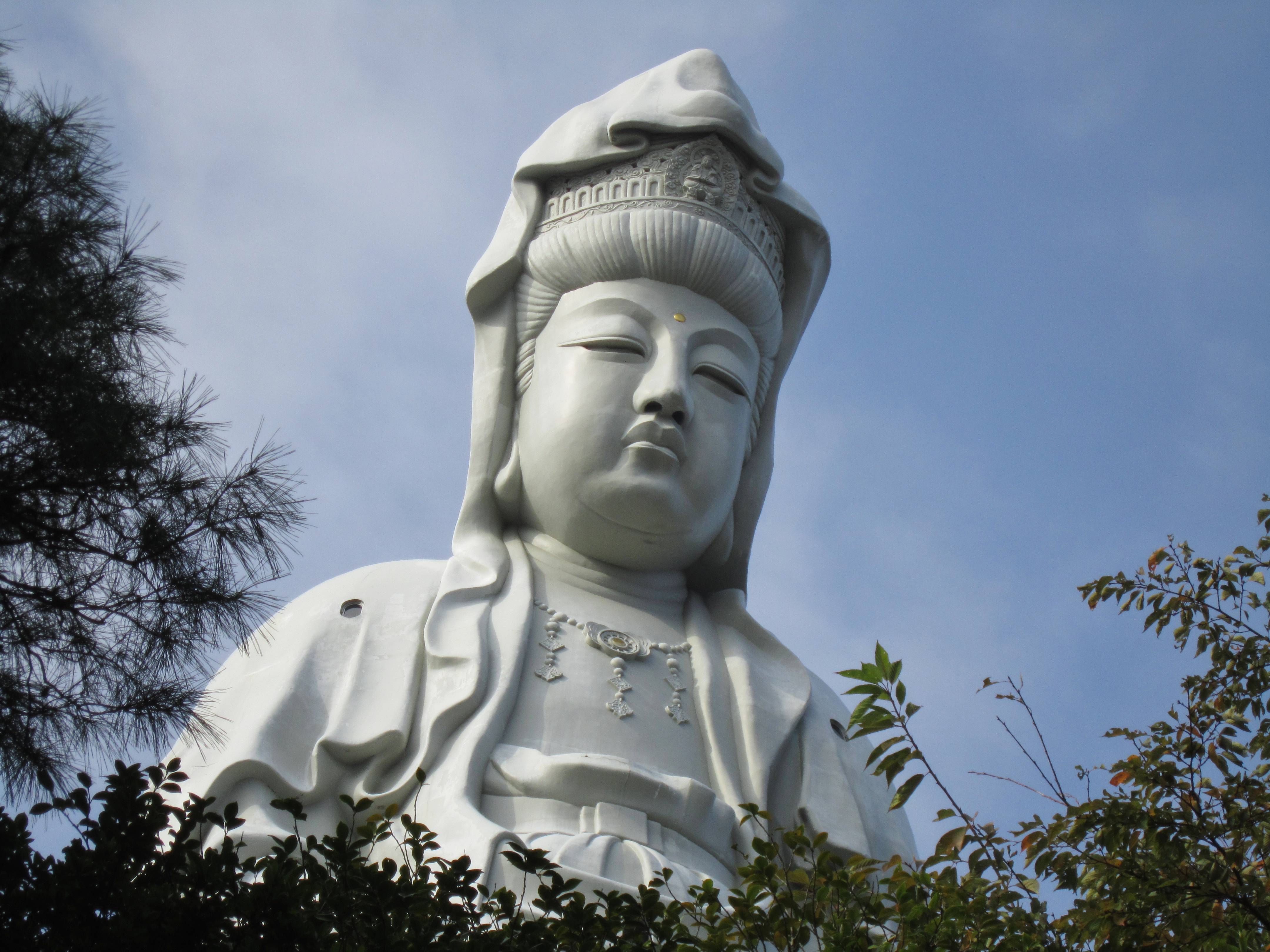
Takasaki Byakue Daikannon
Every Valentine's Day, a giant red string is tied to the finger of a 41.8-meter concrete goddess standing on a hilltop in Gunma Prefecture. Couples climb the winding path to Kannonyama Park, press their palms together in prayer, and ask the White-Robed Kannon for blessings on their love. It is a thoroughly modern ritual attached to an ancient figure -- Kannon, the Bodhisattva of Mercy, who has watched over this city since 1936, her white silhouette visible from every corner of Takasaki and from the windows of passing Shinkansen trains.
A Soldier's Memorial, A City's Landmark
The statue owes its existence to a businessman named Yasusaburo Inoue and a desire to remember the dead. In the 1930s, Inoue commissioned the Byakue Daikannon as a memorial for fallen soldiers of the Imperial Japanese Army's 15th Infantry Regiment, which had been stationed in Takasaki. But Inoue had a second, more forward-looking ambition: he wanted to transform Takasaki into a destination. The Takasaki Tourism Association began promoting the statue in 1937, and the gamble paid off. Weighing nearly 5,985 tons and standing 41.8 meters tall atop 190-meter Mount Kannonyama, the reinforced concrete figure became the defining image of the city. Inside, visitors climb 146 steps through nine floors, passing 20 Buddhist figures arranged at each level. From the statue's shoulders -- the highest accessible point -- the panorama stretches across Takasaki City to the Jomo Sanzan, Gunma's three sacred peaks: the volcanic slopes of Mount Akagi, the craggy ridges of Mount Myogi, and the broad dome of Mount Haruna.
Seasons at the Goddess's Feet
The grounds around the statue have had their own evolution. An amusement park called Kappapia once occupied the hillside, drawing families with rides and attractions for decades. When it closed in 2003, the site was reborn as Kannonyama Park, trading mechanical thrills for quieter pleasures. Nature trails thread through the hillside forest, and a botanical dye garden cultivates the plants once used to color traditional Japanese textiles. In spring, the slopes erupt in cherry blossoms, and the statue rises above a sea of pale pink petals -- one of Gunma's most photographed scenes. Since 2011, the Valentine's Day red string tradition has added a new layer to the site's appeal, drawing young couples who tie their wishes to the Kannon's outstretched finger, a gesture rooted in the Japanese belief that an invisible red thread connects destined lovers.
The Kannon Godzilla Couldn't Destroy
In 1962, the special effects team working on King Kong vs. Godzilla filmed a sequence in which Godzilla rampages through Takasaki and topples the Byakue Daikannon. The miniature was built, the destruction was staged, but the scene was ultimately cut from the final film. The statue survived its encounter with the King of the Monsters -- at least on celluloid. The episode is an endearing footnote in both Takasaki's and Toho Studios' history, a reminder that the Kannon had grown iconic enough to merit destruction by Japan's most famous fictional creature. The statue also appears on the 'hi' card of Jomo Karuta, a traditional card game unique to Gunma Prefecture that teaches children about local landmarks, cementing the Daikannon's place in regional identity.
Mercy in Concrete
The name says everything. Byakue Daikannon means 'The Great White-Robed Kannon,' and the figure's identity reaches back centuries before she was poured in concrete on a Gunma hilltop. Kannon -- known as Guanyin in China -- is the Bodhisattva of Mercy, a figure of infinite compassion who hears the cries of the suffering. Visitors come to pray for protection from natural disasters, for peace, and for the wellbeing of loved ones. Though the Takasaki statue now ranks as the tenth largest Kannon in Japan, her significance has never been measured in meters. She is simultaneously a war memorial, a tourist attraction, a pop culture footnote, a Valentine's Day destination, and a spiritual landmark -- all contained in one white silhouette against the Gunma sky.
From the Air
Located at 36.18N, 138.59E atop Mount Kannonyama (190m elevation) in Takasaki, Gunma Prefecture. The 41.8-meter white statue is visible from moderate altitude against the green hillside. Look for it northwest of central Takasaki, with the Jomo Sanzan peaks (Akagi, Haruna, Myogi) forming the backdrop. The Shinkansen line passes through Takasaki below. Nearest major airports: RJAH (Ibaraki Airport, ~166km southeast) and RJTT (Tokyo Haneda, ~143km south). Recommended viewing altitude: 3,000-5,000 feet AGL for the statue in context with the surrounding city and mountains.