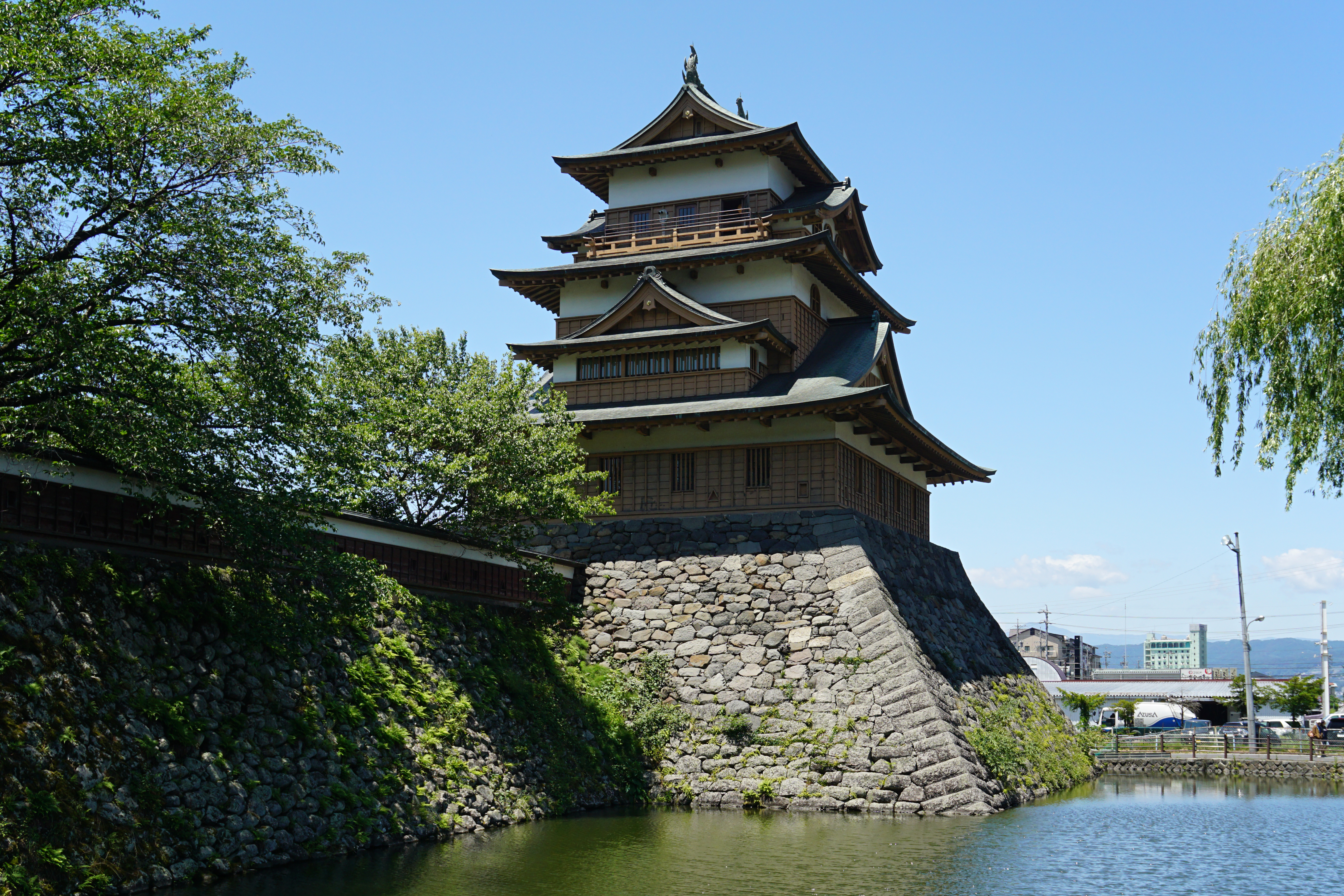
Takashima Castle
The lake stole the castle's best trick. When Takashima Castle was first built on a narrow peninsula jutting into Lake Suwa, the water itself served as the fortress's moat on three sides, making it nearly impregnable from every direction but the shore. Defenders only needed to fortify a single landward face. It was an elegant solution, the kind of strategic thinking that kept the Suwa clan in power for centuries. But Lake Suwa had plans of its own. Over the course of the Edo period, sedimentation slowly filled in the water around the castle until the fortress found itself marooned in the middle of dry land, surrounded not by lapping waves but by the streets and houses of what would become the modern city of Suwa in central Nagano Prefecture.
A Castle Between Water and Stone
The original layout of Takashima Castle exploited its lakeside position with ruthless efficiency. The Main Bailey, or Honmaru, connected to the Second and Third Baileys by bridges, creating a layered defense where attackers would need to cross open water or narrow causeways under fire. The Main Bastion, called the Koromo-no-nami kuruwa, contained the main gate facing the only vulnerable approach from shore. The castle's nickname, Suwa no Ukishiro, or the "floating castle of Suwa," captured the way its walls seemed to rise directly from the lake surface. Today, only the moat on the north and east sides survives as a reminder of the water fortress that once commanded this stretch of shoreline. The castle park now serves as a peaceful green space in central Suwa, its reconstructed towers reflected in what remains of its watery defenses.
Warlords at the Crossroads
The Suwa clan held this territory from at least the early Heian period, but the Sengoku era's convulsions brought a parade of Japan's most famous figures to these shores. Takeda Shingen conquered the Suwa in the mid-1500s and installed a succession of his own generals as castle lords, beginning with Itagaki Nobukata. Their grip lasted until the Takeda clan's catastrophic defeat at the Battle of Nagashino in 1575. Control then passed to Oda Nobunaga, who handed the castle to his general Kawajiri Hidetaka. When Nobunaga was assassinated in the Honno-ji incident of 1582, the region shifted yet again to Toyotomi Hideyoshi, who appointed Hineno Takayoshi as lord of Suwa Domain. Hineno began a complete reconstruction of the castle, a project his son Yoshiakira finished. When the Hineno were reassigned in 1601, Tokugawa Ieyasu returned the domain to the Suwa clan, who finally held their ancestral seat in peace until the Meiji Restoration ended the feudal era entirely.
Dismantled, Then Reborn
The Meiji government's abolition of the feudal han system in 1871 sealed Takashima Castle's fate as a working fortress. By 1875, the remaining structures were systematically dismantled, leaving only the stone foundations as silent testimony to four centuries of military architecture. A Shinto shrine dedicated to war dead was established within the grounds in 1900, and the areas of the Second and Third Baileys were gradually absorbed into the surrounding residential district. The castle might have vanished entirely from public memory had the city not undertaken a reconstruction project in 1970. The present donjon, yagura watchtowers, and gates are all modern rebuilds, and while not historically precise reproductions, they give visitors a sense of the castle's former silhouette against the Nagano sky. In 2017, Takashima Castle earned a place on the Continued Top 100 Japanese Castles list, recognizing its historical significance even in reconstructed form.
The Lake That Shaped Everything
Lake Suwa dominates the geography and history of this region. At 759 meters above sea level, it is the largest lake in Nagano Prefecture and has shaped human settlement patterns for millennia. The same body of water that made Takashima Castle a floating fortress also hosted the Suwa Grand Shrine, one of Japan's oldest religious complexes, on its opposing shores. The lake's gradual sedimentation, which stranded the castle on dry land, was part of natural geological processes driven by the rivers feeding the basin. From above, the lake still reads as the defining feature of the Suwa valley, a roughly circular sheet of water hemmed in by mountains, with the city of Suwa clustered along its southern shore. The castle grounds sit just a few hundred meters inland from the current waterline, a distance that once was nothing but open water.
From the Air
Coordinates: 36.040°N, 138.112°E. Takashima Castle sits in the center of Suwa city, on the southern shore of Lake Suwa in central Nagano Prefecture. The lake is clearly visible from 3,000 feet AGL as the dominant water feature in the valley. The reconstructed castle tower is identifiable near the lakeshore in the city center. Nearest airport: Matsumoto Airport (RJAF), approximately 35 nm northwest. Approach from the east along the Chuo Expressway corridor, which follows the valley floor. The Yatsugatake range rises to the southeast, and the Northern Alps are visible to the northwest in clear conditions.