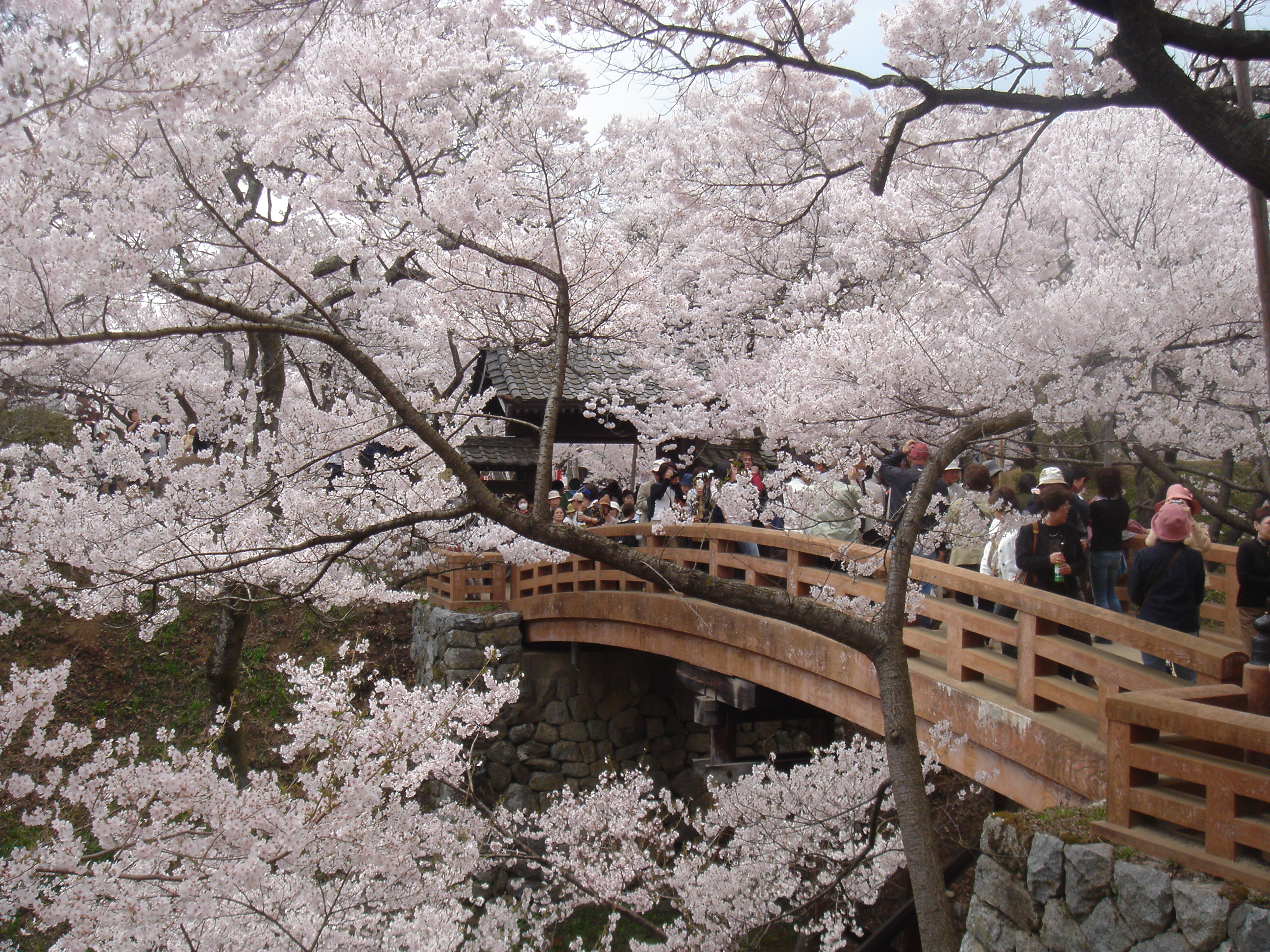
Takatō Castle
Every April, 1,500 cherry trees of a variety found nowhere else in the world burst into bloom across the hilltop ruins of a castle that once anchored Takeda Shingen's control of southern Shinano. The blossoms of Takato-kohigan-zakura are smaller and more intensely pink than the common Somei-yoshino, and the oldest trees on these grounds have been flowering for over 140 years. Takato Castle itself is largely gone -- dismantled after the Meiji Restoration, its gates sold off to temples and private owners -- but the park that replaced it is considered one of Japan's three finest cherry blossom destinations, alongside Hirosaki Castle in Aomori and Mount Yoshino in Nara. The castle that could not survive politics has been preserved by petals.
A Strategist's Masterwork
Takato Castle sits on a hill overlooking the confluence of the Mibugawa and Fujisawa rivers at the eastern edge of the Ina Valley in southern Nagano Prefecture. A fortification occupied this site long before the castle's current form, controlled by the Takato clan, retainers of the Suwa clan who had dominated the region since the Kamakura period. In 1545, Takeda Shingen broke his alliance with Suwa Yorishige and seized the position during his campaign to conquer southern Shinano Province. He ordered a complete rebuild, entrusting the design to his legendary military strategist Yamamoto Kansuke. The result was a masterpiece of Sengoku-era defensive architecture: deep trenches, earthen ramparts, and stone walls arranged in concentric rings around a central bailey, with the natural river gorges forming a moat on two sides. The box-shaped gates forced attackers into killing zones. It was a fortress built to hold.
The Last Stand of the Takeda
Shingen used Takato as his launchpad for the invasion of Mino Province, a move that brought the Takeda into direct conflict with Oda Nobunaga. It was from this castle that Shingen departed on his final campaign toward Kyoto in 1572. After his death, the castle passed to Nishina Morinobu, a son of Takeda Shingen. In 1582, Oda Nobutada marched on Takato with 30,000 troops. Morinobu had 3,000 defenders. The siege was brutal and brief. The defenders fought to the last, with ranking samurai killing their own families before charging into the enemy in a final, hopeless assault. Morinobu himself fell in the fighting. The fall of Takato preceded the Battle of Temmokuzan, which destroyed the Takeda clan entirely, ending one of the great warrior dynasties of the Sengoku period.
Warlords and Shoguns Passing Through
After the Takeda's destruction, Takato changed hands with the velocity of the age. Mori Hideyori, one of Nobunaga's generals, received it first. When Nobunaga was assassinated in the Honno-ji Incident, Tokugawa Ieyasu seized control and installed Hoshina Masanao. Toyotomi Hideyoshi's consolidation of power in 1590 shifted it again, to the general Ogasawara Sadayoshi. After Sekigahara in 1603 and the establishment of the Tokugawa shogunate, Takato finally settled into stability as the center of Takato Domain, a 30,000 koku holding. The Hoshina clan governed, then the Torii from 1636 to 1689, and finally the Naito clan, whose descendants held the domain until the Meiji Restoration. The castle's front gate was reoriented from east to west during the Edo period, facing the castle town that grew up around it.
Dismantled, Scattered, Returned
When the Meiji government abolished the feudal domains, Takato Castle was dismantled like hundreds of others across Japan. Its gates were donated to temples or sold into private hands, where several survive today. The site fell quiet. Very little remains in place beyond sections of the moat and stone ramparts. One yagura watchtower has been reconstructed. The Otemon, the castle's main gate, had an unlikely journey: it was relocated to serve as the entrance to a high school north of town, where it stood for decades before being moved back to its original position in 1984. The oldest surviving building on the grounds is the former han school, built in 1860 by the last daimyo of Takato, Naito Yorinao, a reminder that the castle served education as well as war.
Pink Snow Over the Ruins
Today Takato Castle Ruins Park draws enormous crowds during cherry blossom season, typically in early to mid-April. Festival stalls line the paths. Night illuminations run from sunset to ten o'clock, casting warm light upward through the dense canopy of pink blossoms. The Takato-kohigan-zakura variety creates a distinctly different atmosphere than the pale Somei-yoshino found at most Japanese cherry blossom sites: the color is deeper, richer, and the petals are smaller, creating a denser visual texture. The park has been designated one of Japan's top 100 cherry blossom viewing sites. Walking the old castle grounds during peak bloom, with the moat reflecting blossoms and the reconstructed yagura rising above the trees, it is easy to forget that this was once a place of siege warfare and desperate last stands. The cherry trees have written their own history over the ruins.
From the Air
Located at 35.833°N, 138.063°E on a hilltop at the eastern edge of the Ina Valley in southern Nagano Prefecture. The castle ruins sit at the confluence of the Mibugawa and Fujisawa rivers, which are visible as converging watercourses. The Ina Valley runs roughly north-south between the Central Alps to the west and the Southern Alps (Akaishi Mountains) to the east, making it a dramatic corridor to fly through. During cherry blossom season (early-mid April), the hilltop park shows as a distinctive pink mass. Nearest airport: Matsumoto Airport (RJAF, ~40 nm north). Chubu Centrair International (RJGG) is approximately 90 nm southwest.