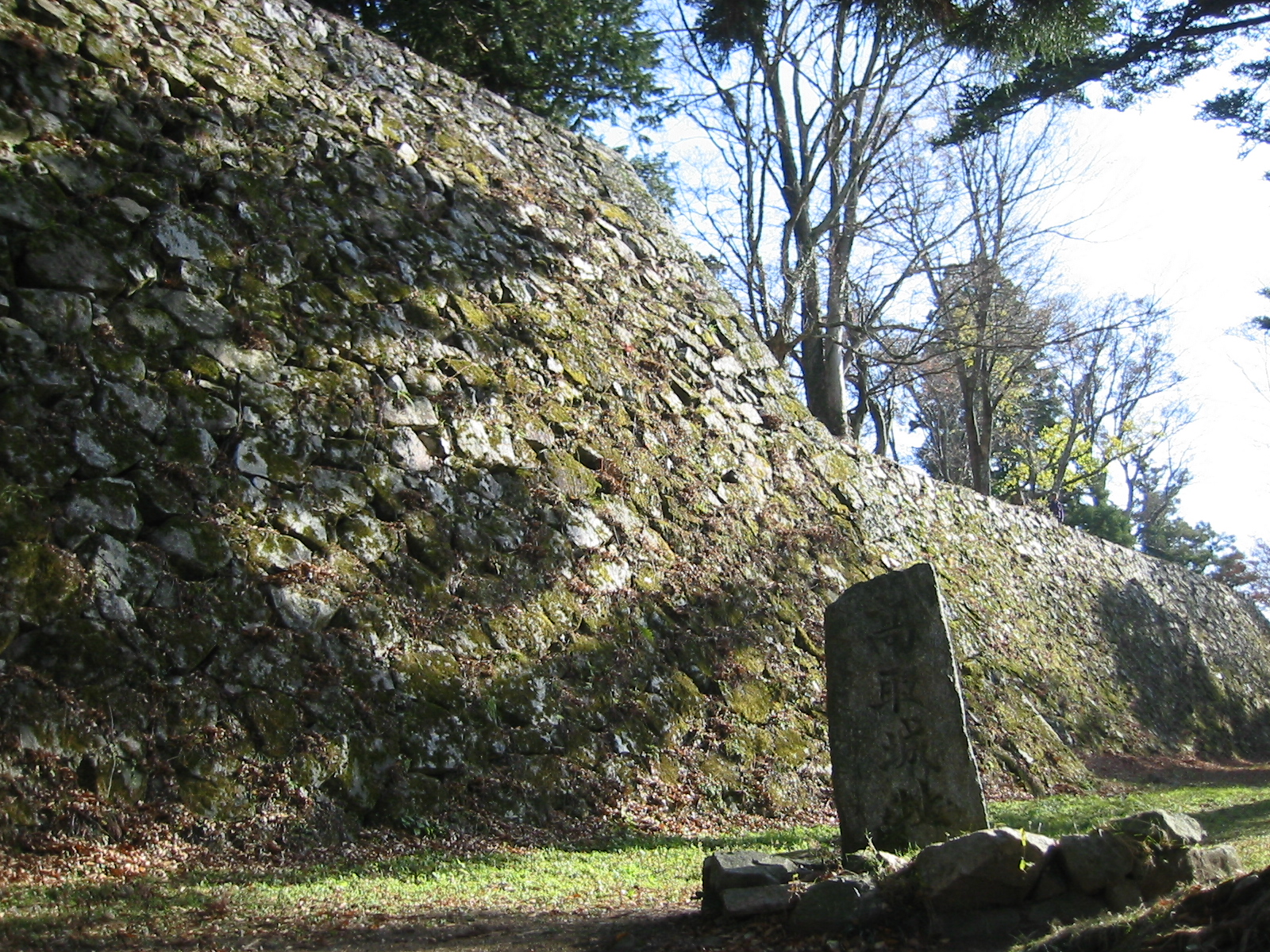
Takatori Castle
The folk song says it plainly: look up at Takatori, and what appears to be snow on the mountaintop is actually a castle. Twenty-nine white-plastered turrets once lined the ridges of Mount Takatori, 583 meters above the Nara basin, creating the illusion of a perpetual winter summit visible from the town below. This was Japan's largest Sengoku-period mountain castle, a fortress so vast that its outer fortifications stretched for 30 kilometers, encompassing 60,000 square meters of baileys, walls, and gateways draped across a mountain that most armies would consider impossible to attack. Listed as one of Japan's Top 100 Castles and protected as a National Historic Site since 1953, Takatori today stands as a ruin -- but its stone walls remain in near-perfect condition, untouched by human hands since the castle was abandoned.
Built for a Clan War
Ochi Kunizumi raised the first fortification on Mount Takatori in 1332, during a period when two rival clans divided the Nara basin between them. The Ochi controlled the southern half; the Tsutsui clan held the north. Both fought constantly for supremacy over Yamato Province. When Japan's imperial house split into Northern and Southern Courts, the Ochi backed the Southern cause, and Takatori Castle served initially as a subsidiary fort to their main stronghold at Kaibukiyama Castle. But geography told a different story. Mount Takatori's sheer elevation and natural defenses made it the more formidable position, and by the Sengoku period it had quietly overtaken Kaibukiyama as the clan's primary fortress. The castle proved its worth in June 1532, when the Ikko-ikki -- bands of militant Buddhist peasants -- invaded Yamato Province and crushed the armed monks of Kofuku-ji temple. The surviving monks fled uphill to Takatori, where the castle withstood the siege until the Tsutsui clan arrived to drive off the attackers.
Warlords and Survivors
Takatori Castle changed hands with each shift in Japan's violent politics. In 1580, Oda Nobunaga conquered Yamato Province and ordered every castle except Koriyama destroyed. Takatori was abandoned -- but not for long. After Nobunaga's assassination, Tsutsui Junkei reoccupied it in 1584. When his heir was transferred to Iga Province the following year, the castle passed to Toyotomi Hidenaga, brother of the great unifier Toyotomi Hideyoshi. Hidenaga's vassal Honda Toshihisa took residence and in 1589 ordered a complete reconstruction. It was during the chaos surrounding the Battle of Sekigahara in 1600 that the castle faced its most dramatic test. Honda Toshimasa, who had sided with Tokugawa Ieyasu, was away fighting when Ishida Mitsunari's forces attacked the fortress. Takatori held firm. After Tokugawa's victory, Toshimasa was rewarded with an additional 10,000 koku, becoming the first daimyo of Takatori Domain with a total holding of 25,000 koku.
Fourteen Generations on the Mountain
The Honda clan's rule ended abruptly in 1637 when Toshimasa's son Masatake died without an heir. Three years later, the hatamoto Uemura Iemasa was elevated to daimyo status and given the castle. His family would hold it for 14 consecutive generations, an unbroken tenure that stretched from the early Edo period through to the Meiji Restoration. Despite the Tokugawa shogunate's 1615 edict of 'One Castle per Province' -- which should have meant Takatori's demolition -- the fortress was largely spared. Its remote mountaintop location made it strategically useful and administratively inconvenient to tear down. The Uemura clan maintained a residence at the mountain's base for daily governance, and it was this lowland compound that bore the brunt of violence during the Tenchuguimi incident of the Bakumatsu period, when loyalist samurai attacked the domain administration.
A Castle Sold for Parts
When Japan abolished the feudal domains in 1873, Takatori Castle was formally abandoned. What happened next was less demolition than dispersal. The castle's buildings -- particularly its gates -- were auctioned off to nearby institutions. The Ninomon Gate became the entrance to Kojima-dera temple in Takatori town. The front gate of the daimyo residence was purchased by what is now Ishikawa Clinic. The Matsunomon Gate traveled to Takatori Elementary School in 1892, survived the school's destruction by fire in 1942 thanks to the Kongoriki Sake Brewery, which preserved it, and in 2004 was restored as the entrance to a children's park. The main buildings, including the castle tower, lingered on the mountaintop until roughly 1887. But 583 meters above the nearest town, with no one to maintain them, they simply collapsed under their own weight and the weather.
Stone Walls in the Clouds
What survives at Takatori is, paradoxically, the most enduring part of any Japanese castle: the stone walls. Because the mountaintop was so remote and so difficult to reach, no one bothered to quarry the ramparts for building material. The walls remain in nearly original condition, tracing the outlines of baileys and fortifications across a site that covers 10,000 square meters of interior space. The 60-minute uphill hike from Tsubosakayama Station on the Kintetsu Yoshino Line discourages casual visitors but rewards those who make the climb with one of the most atmospheric castle ruins in Japan. Standing among walls that once supported 29 white turrets, surrounded by forest and silence at 583 meters, it is easy to understand why the people below once looked up and mistook this fortress for snow.
From the Air
Located at 34.43N, 135.83E on Mount Takatori in Nara Prefecture, Japan. The castle ruins sit at 583 meters elevation, making them visible as a cleared summit area amid dense forest. From the air, look for the distinctive mountaintop approximately 4 kilometers southeast of Takatori town center. The Nara basin spreads to the northwest. Nearest airports: Osaka Yao Airport (RJOY) approximately 35nm northwest, Nara Heliport, Kansai International Airport (RJBB) approximately 50nm west. The mountainous terrain creates turbulence; approach with caution at lower altitudes.