Takayama Jin'ya
Twenty-five men governed from this building. For 177 years, from 1692 until the Meiji Restoration swept away the old order in 1868, the shogun's appointed administrators walked these corridors, collected taxes in rice, dispensed justice, and managed one of the most resource-rich provinces in all of Japan. Takayama Jin'ya is the only surviving example of a daikansho -- a combined residence and administrative headquarters -- from the entire Edo period. Every other building of its kind was demolished, repurposed, or simply crumbled away. This one endured, tucked into the mountain city of Takayama in Gifu Prefecture, because it never stopped being useful.
The Shogun's Mountain Treasury
The story begins with a transfer order. After the Battle of Sekigahara in 1600, Tokugawa Ieyasu awarded Hida Province to the Kanamori clan, who built Takayama Castle and governed a 38,000-koku domain. But in 1692, the Kanamori were abruptly relocated to distant Kaminoyama in Dewa Province. The reason was not punishment -- it was greed. Hida's mountains held gold, silver, and copper, and its forests produced timber so prized that the shogunate wanted direct control. The entire province became tenryo, territory administered personally on behalf of the shogun. Takayama Castle was deliberately destroyed to prevent any future lord from using it as a power base, but the shimoyashiki at its foot -- the lower residence -- was converted into the daikansho. From this building, the shogun's representative would oversee not just Hida but, after 1777, parts of the neighboring provinces of Mino, Echizen, and Etchu as well.
Timber, Snow, and Wooden Shingles
The architecture of Takayama Jin'ya tells the story of its landscape. In a region buried under heavy snowfall each winter, clay roof tiles crack and crumble. The builders turned instead to what the mountains offered in abundance: wood. The roofs are covered in wooden shingles laid in several traditional styles -- noshi-buki, kokera-buki, and ishiokinagakure-buki -- each a variation on the same principle of letting the region's own timber shield against the region's own weather. The earthen storehouses, massive kura originally built for Takayama Castle, were relocated to the jin'ya grounds in 1695. These long warehouses stored the rice collected as tax from local farmers, and their thick walls kept the grain dry through months of snow. The main building itself was reconstructed in 1725 and again in 1816, the latter version forming the core of what visitors see today.
A Building That Refused to Retire
Most historical sites become relics. Takayama Jin'ya became an office. When the Meiji government dissolved the feudal system in the 1870s, the building simply changed occupants. It served as the Takayama branch of Gifu Prefecture's administration. In 1883, one of the original storehouses was demolished to make room for the city prosecutor's office. The Gifu District Court held sessions here until 1969 -- meaning this Edo-period complex was in continuous government use for 277 years. Even its 1929 designation as a National Historic Site did not interrupt its bureaucratic function. It was only after the courts finally vacated in 1969 that preservation could begin in earnest. The comprehensive restoration completed in 1996, based on a detailed architectural drawing from 1830, cost two billion yen and returned the complex to its early-nineteenth-century appearance.
Morning Light on the Market Grounds
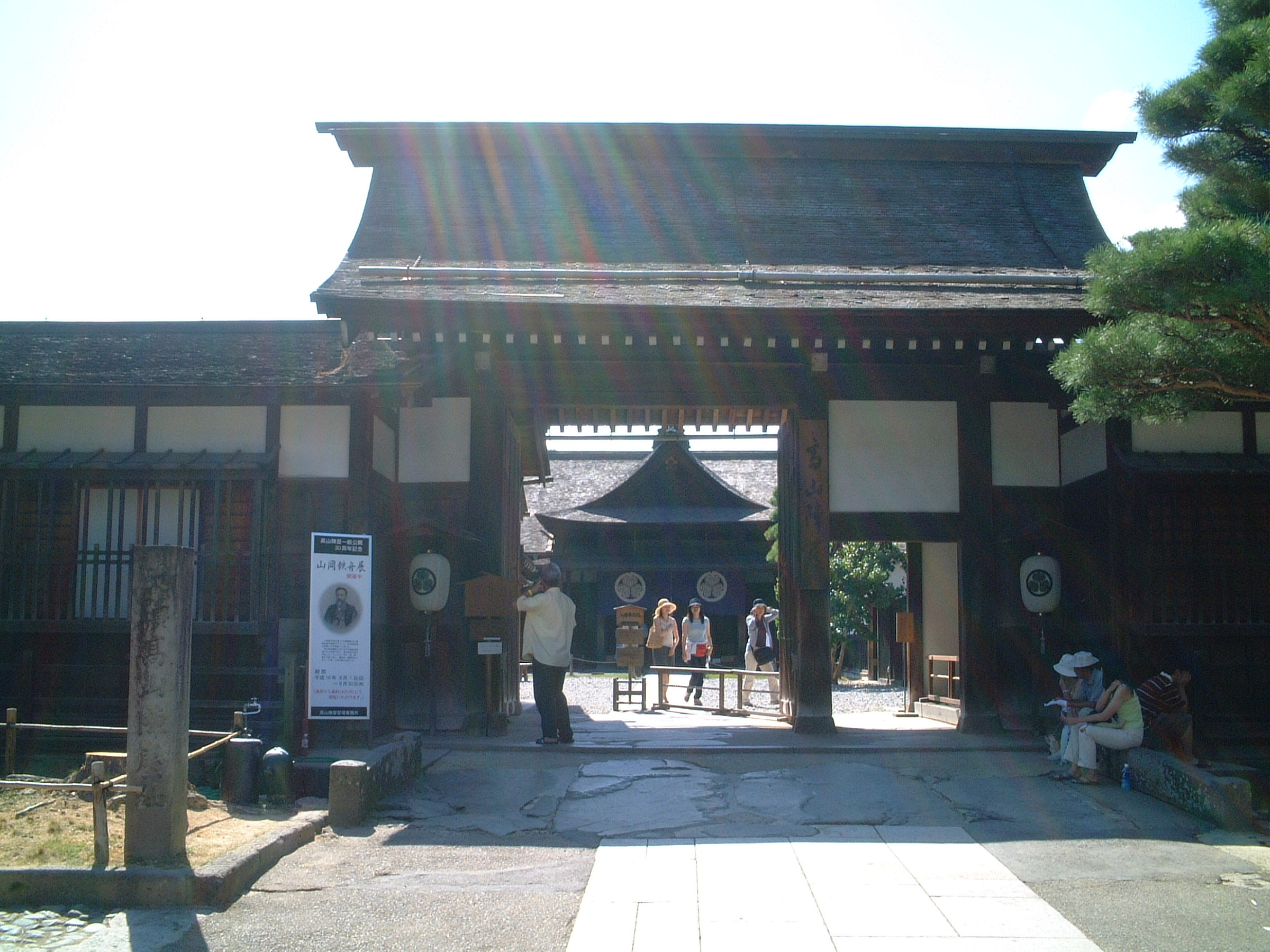
Every morning, the open ground in front of Takayama Jin'ya transforms into one of the city's signature experiences. The Miyagawa Morning Market draws farmers and craftspeople who set up stalls selling pickled vegetables, local miso paste, handmade crafts, and seasonal produce from the surrounding valleys. The market has become inseparable from the jin'ya itself -- a living reminder that this was always a place where governance and daily life intertwined. Inside, the museum halls display documents, administrative tools, and artifacts that trace the daily workings of shogunal government: how taxes were assessed, disputes resolved, and a mountainous province kept connected to the distant capital of Edo. A ten-minute walk from Takayama Station on the Takayama Main Line brings visitors to the entrance, where the building's formal gate still frames the same view that greeted administrators centuries ago.
The Last of Its Kind
Japan once had dozens of jin'ya scattered across its provinces -- local seats of power where the shogunate maintained its grip on distant territories. All of them are gone except this one. That singular status makes Takayama Jin'ya more than a museum; it is the only physical space where visitors can stand in the actual rooms where Edo-period governance happened. The tatami-floored audience chambers, the administrative offices, the kitchens, the interrogation rooms -- each space reveals a different facet of how power was exercised in feudal Japan. The garden, carefully maintained within the compound walls, offered the administrators a measure of tranquility amid the demands of ruling a mountain province. Protected as a National Historic Site since 1929 and meticulously restored, the jin'ya stands as proof that sometimes the most enduring buildings are the ones that keep finding new reasons to exist.
From the Air
Located at 36.14°N, 137.26°E in the mountain city of Takayama, Gifu Prefecture, in the Japanese Alps region of central Honshu. The jin'ya complex sits in the historic center of town along the Miyagawa River. From the air, Takayama is identifiable as a concentrated urban area in a narrow mountain valley. The nearest airport is RJNG (Gifu Air Base) approximately 100 km to the south. Matsumoto Airport (RJAF) lies about 85 km to the east. Best viewed at lower altitudes where the traditional dark-roofed architecture of the old town contrasts with surrounding mountain terrain.