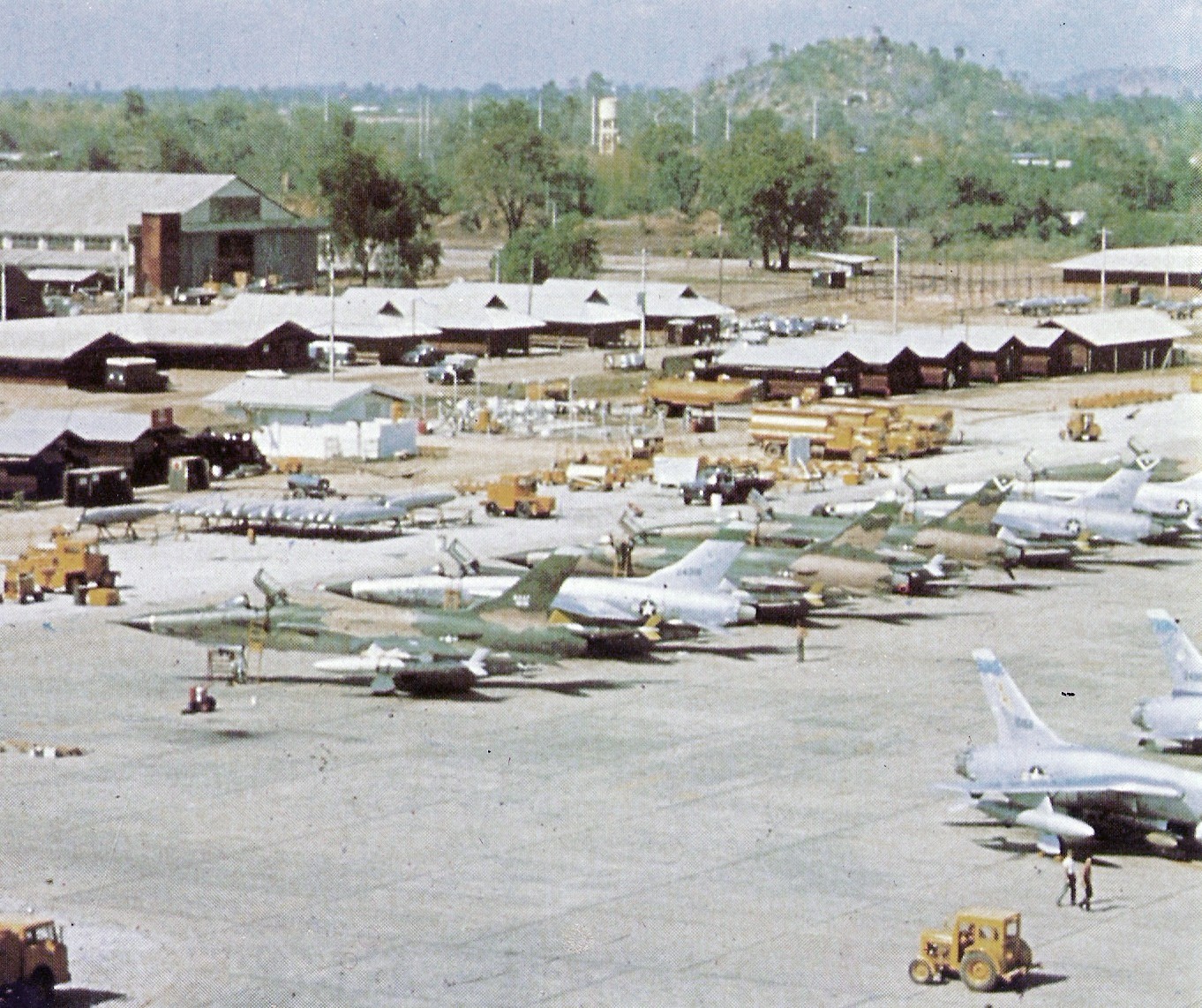
Takhli Royal Thai Air Force Base
Before the first F-105 Thunderchief ever rolled down its runway toward North Vietnam, Takhli was already keeping secrets. In the late 1950s, CIA-operated C-130 Hercules transports lifted off from this Thai air base on missions that few people knew existed: resupply flights for Tibetan resistance fighters, threading over Indian airspace with Prime Minister Nehru's quiet consent, dropping men and materiel into Chinese-occupied Tibet. That a Royal Thai Air Force facility 240 kilometers northwest of Bangkok would become one of the most consequential military airfields of the Cold War era was not, at that point, part of anyone's plan.
The Gentleman's Agreement
When Communist forces began tearing Laos apart in the early 1960s, Thailand allowed the United States to use five of its air bases under a diplomatic arrangement that was deliberately informal. The "gentleman's agreement" let Thai officers nominally command the facilities, with Thai air police controlling access alongside American security forces. It was sovereignty performed for political consumption, but the arrangement worked. By 1965, all USAF personnel at Takhli carried weapons. Sentry dogs patrolled the perimeter. Machine gun bunkers dotted the fence line. The base that officially did not host American combat operations was, in every practical sense, an American combat base.
Thunder Over Hanoi
On 2 March 1965, Takhli-based F-105 Thunderchiefs joined the first airstrike of Operation Rolling Thunder, the sustained bombing campaign against North Vietnam that would define the air war for years. The 355th Tactical Fighter Wing arrived in late 1965 as the permanent host unit, ending the rotating squadron deployments from stateside bases. From Takhli's single runway, pilots flew into some of the most heavily defended airspace in history. North Vietnamese SAM sites, radar installations, and anti-aircraft batteries turned every sortie into a gamble. Douglas B-66 Destroyers, stripped of their bombing equipment and packed with electronic jamming gear, accompanied strike packages to blind enemy radar. It was technological improvisation at its most urgent, and Takhli was its forward operating hub.
Combat Lancer and the F-111 Experiment
In March 1968, six F-111A swing-wing fighters arrived at Takhli for a combat evaluation known as Combat Lancer. The program was meant to prove the revolutionary new aircraft under real conditions. By month's end, the F-111s had flown 55 night missions, but the results were devastating: two aircraft lost within three days, a third gone by late April. Combat operations were halted. The F-111s lingered at Takhli for months, rarely flying, before returning to the United States in November. When the type came back to Takhli in 1972 with the 474th Tactical Fighter Wing, the airframe had matured. During Operation Linebacker II that December, F-111s flew 154 solo night sorties into North Vietnam's most dangerous airspace, losing only two aircraft.
The Son Tay Staging Ground
In November 1970, Takhli played a quieter but no less dramatic role. Special Forces and Air Force Special Operations personnel staged at the base alongside MC-130 Combat Talon aircraft in preparation for Operation Ivory Coast, the audacious attempt to rescue American prisoners of war from the Son Tay camp in North Vietnam. The mission found the camp empty, but the raid demonstrated a level of special operations capability that shook Hanoi. When the base reopened for Linebacker operations in 1972, returning personnel found the barracks gutted: plumbing and electrical fixtures had been stripped after the 1970 drawdown.
Handover and Renewal
On 31 July 1974, the phase-down of American operations was completed ahead of schedule. The base returned to the Thai government on 12 September, and the last U.S. personnel departed two days later. The withdrawal exposed uncomfortable truths about the Royal Thai Air Force's readiness for conventional war, and in the 1980s the government invested heavily in modern aircraft. Thirty-eight F-5E and F-5F Tiger II fighter-bombers became the backbone of Thai air defense. Today, Takhli is home to RTAF Wing 4, flying F-16A/B Fighting Falcons, T-50 Golden Eagle light attack aircraft, and DA 42 reconnaissance planes. The runways that once launched Thunderchiefs toward Hanoi now train a new generation of Thai pilots.
From the Air
Takhli RTAFB is located at 15.27°N, 100.29°E in Nakhon Sawan Province, central Thailand. ICAO code VTPI. The base sits on flat terrain in the Chao Phraya basin approximately 240 km northwest of Bangkok. Nearby airports include Nakhon Sawan Airport and Don Mueang International Airport (VTBD) to the southeast. Best viewed at 3,000-5,000 ft AGL to appreciate the runway and surrounding agricultural plains. The single main runway is oriented roughly north-south.