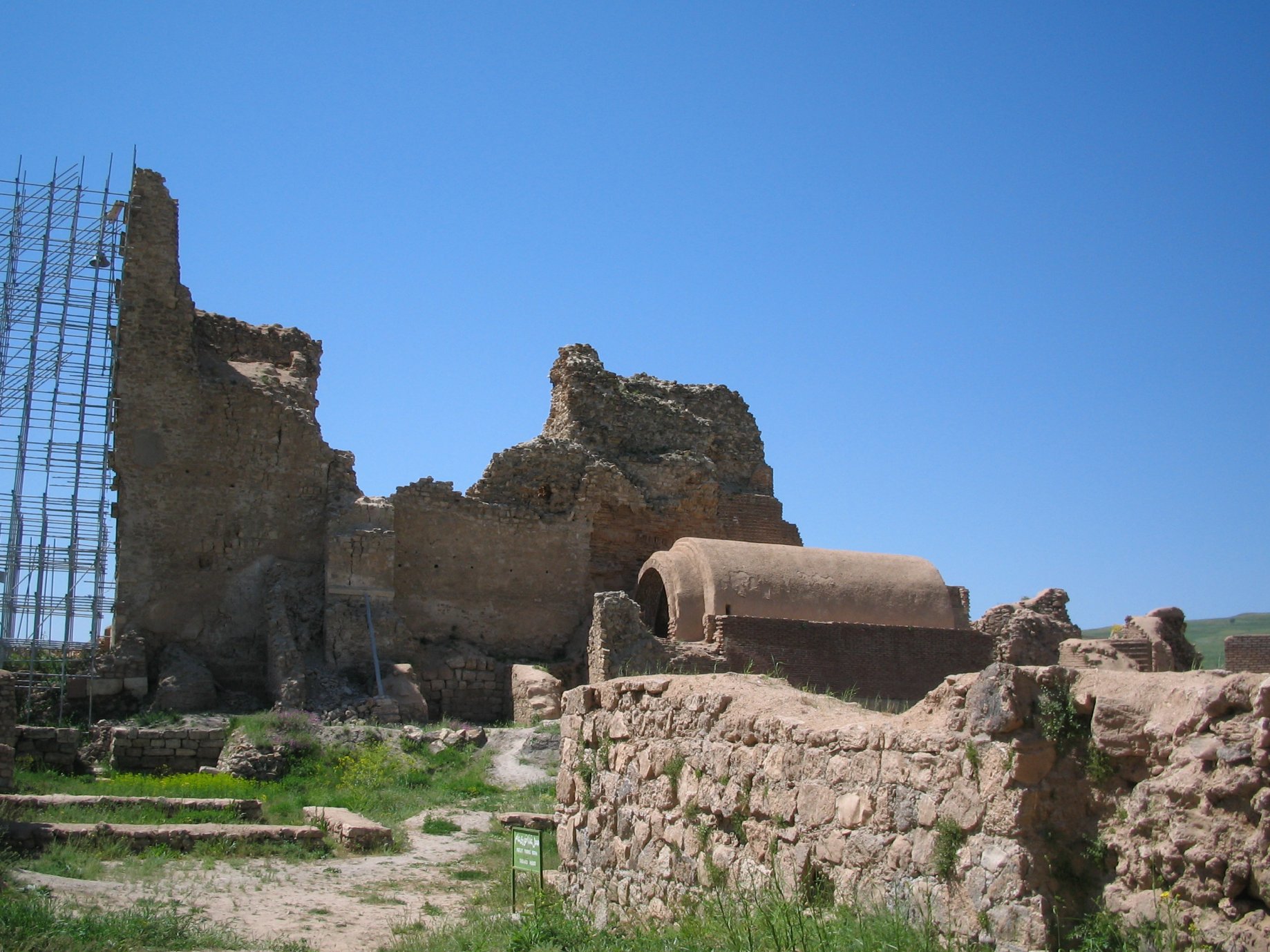
Takht-e Soleyman
Folk legend says King Solomon imprisoned monsters inside a crater here, 100 meters deep, and conjured a flowing pond within the fortress walls. The Turks called the place Sughurlukh -- "a place abounding in marmots." The Persians named it Takht-e Soleyman, the Throne of Solomon. Neither name captures what actually happened at this strange volcanic hilltop in West Azerbaijan: a Zoroastrian fire temple that legitimized the Sasanian dynasty, a Mongol palace decorated with Chinese dragons, and 2,500 years of continuous human occupation, all centered on an artesian spring that never stops flowing.
A Hill Built by Water
Takht-e Soleyman sits on a hill of its own making. A calcium-rich spring at its center has been depositing minerals for millennia, gradually raising the ground into a low plateau above the surrounding grasslands. The spring pond, still active, feeds the raised formation and gives the site its distinctive circular profile visible from altitude. Archaeological excavations have revealed traces of occupation going back to the 5th century BC, during the Achaemenid era. Parthian settlements followed. Coins from the reign of the Byzantine emperor Theodosius II, dating to AD 408-450, have been found among Sasanian artifacts. The site appears on the 4th-century Peutinger Map, one of the oldest known road maps of the Roman world, suggesting that even Western cartographers knew of this remote hilltop in the Iranian highlands.
Fire and Empire
The Sasanian kings built their most important warrior-class fire temple here, housing the sacred flame called Adur Gushnasp. This was one of three Royal Fires of Zoroastrianism, dedicated to the arteshtaran -- the warrior caste that the Sasanian dynasty claimed as its own. Kings visited the temple before military campaigns. They lavished it with Byzantine tribute money and private offerings. A fortified citadel grew around the spring and the temple, creating a site that was simultaneously religious sanctuary, royal pilgrimage destination, and strategic fortress. In 623 or 624, the Byzantine Emperor Heraclius sacked the temple during his campaign deep into Sasanian territory. The Persians saved the fire and rebuilt. After the Muslim conquest of Persia in the 7th century, the site received its current name, linking it to Solomon rather than Zoroaster.
Mongol Dragons on Persian Walls
In the 13th century, the Ilkhanid ruler Abaqa Khan -- son of Hulagu and great-grandson of Genghis Khan -- chose the ruins of the Sasanian complex as the site for his summer palace. The massive remnants of the old fire temple and fortification walls made an irresistible foundation. The Mongol palace followed cardinal orientation, as Mongol tradition required, with four iwan complexes pointing to the compass directions and a courtyard centered on an artificial lake. An audience hall with a great dome rose where the fire temple had stood. But the most remarkable legacy of this phase is the tilework. Six distinct types of tiles were produced, from simple unglazed hexagons to elaborate luster-painted pieces. Their designs fused an astonishing range of traditions: Chinese dragons and phoenixes from ceramics popular with Iranian merchants, lotus flowers borrowed from Buddhism, cranes symbolizing longevity from Chinese mythology, and Quranic inscriptions from the Shi'a tradition.
Where Cultures Collided
The tiles of Takht-e Soleyman are a physical record of the medieval world's cultural crossroads. Deep Mongol blue, representing sky and eternity, dominates the palette. Horsemen hunting scenes express the nomadic military culture the Ilkhanids carried from the steppe. Alongside these, the name Ali -- the Prophet Muhammad's cousin, revered in Shi'a Islam -- appears around the borders of hexagonal exterior tiles, repeated six times. Buddhist lotus flowers and Taoist dragons sit beside geometric patterns traceable to Baghdad's ceramic workshops. The highly skilled blue-and-white glazing technique would later influence ceramics across the Islamic world. A stucco plate excavated from the west iwan preserves one of the earliest known architectural plans for a muqarnas vault -- the honeycomb-like ceiling decoration that became a signature of Islamic architecture. In 1889, British explorers Theodore and Mabel Bent dug at the site and carried at least one tile fragment back to London. Today the ruins are a UNESCO World Heritage Site, recognized in 2003. A small museum on the grounds displays artifacts from across the hilltop's long, layered history.
From the Air
Coordinates: 36.605N, 47.234E, in West Azerbaijan Province, Iran. The site lies midway between Urmia and Hamadan, near the town of Takab, approximately 400 km west of Tehran. From altitude, the distinctive circular hilltop with its spring pond is identifiable against the surrounding grassy plateau. The nearby volcanic crater of Zendan-e Soleyman (Prison of Solomon), approximately 100 m deep, is a dramatic geological feature. The landscape is semi-arid volcanic highland surrounded by mountains. Nearest airports: Urmia Airport (OITR) approximately 180 km northwest, Tabriz International Airport (OITT) approximately 250 km northeast. Elevation approximately 2,200 meters.