Takht Sri Damdama Sahib
Guru Gobind Singh flung a handful of reed pens over the heads of the assembled Sikhs and declared: "Here we will create a pool of literature. No one of my Sikhs should remain illiterate." It was 1705. He had just lost all four sons -- two killed in battle, two executed as children by Mughal authorities. His mother had died in captivity. His army was scattered. And here, in the quiet village of Talwandi Sabo on the Punjab plains southeast of Bathinda, the tenth Sikh Guru sat down to dictate the final, complete version of the Guru Granth Sahib. The place he chose to do it would become Damdama Sahib -- literally, the resting place -- and one of the five holiest seats of authority in the Sikh faith.
A Father's Losses, a Faith's Scripture
The events that brought Guru Gobind Singh to Talwandi Sabo read like a catalog of betrayal. A combined force of Mughals and hill chiefs had besieged the Sikh fortress at Anandpur Sahib under orders from Emperor Aurangzeb. When food ran out, the Mughals promised safe passage -- guarantees written in the margins of the Quran itself. The Guru accepted and left with his family and a small retinue. The promises were broken almost immediately. In the chaos of crossing the rain-swollen Sarsa River under Mughal pursuit, his two youngest sons, Sahibzada Fateh Singh and Sahibzada Zorawar Singh, were separated along with their grandmother, Mata Gujari. Betrayed by a former servant, all three were handed over to Wazir Khan of Sirhind. On 26 December 1705, both boys were executed. Fateh Singh was six years old.
Forty Against a Hundred Thousand
Before reaching Talwandi Sabo, Guru Gobind Singh fought a desperate last stand at the fortress of Chamkaur. In his own words, recorded in the Zafarnamah -- his Persian letter to Aurangzeb that he would later call an "Epistle of Victory" -- forty Sikhs faced a hundred thousand. His eldest son, Sahibzada Ajit Singh, 18, led a sortie from the fortress and died fighting. Sahibzada Jujhar Singh, 14, led the next and fell in turn. By nightfall, only five Sikhs remained with the Guru. They urged him to escape so that the struggle against oppression could continue. He gave his own clothes to Sangat Singh, who resembled him, and slipped through the enemy lines in darkness. From safety, he wrote the Zafarnamah, holding Aurangzeb accountable for every broken oath. He then fought a successful engagement at Muktsar before moving on to Talwandi Sabo.
A Pool of Literature
At Talwandi Sabo, the Guru chose not to rebuild an army but to build a scripture. He dictated the complete Guru Granth Sahib to his disciple Bhai Mani Singh, adding for the first time the hymns of his father, Guru Tegh Bahadur, the ninth Guru. The resulting text -- sometimes called the Damdama Wali Bir -- became the definitive version of the Sikh holy book. The Guru blessed Talwandi Sabo with the title "Guru Ki Kashi," drawing a parallel to the Hindu holy city of Varanasi (Kashi) as a center of learning. Baba Deep Singh, one of Sikhism's most revered martyrs, was installed as the first Jathedar -- the head -- of this seat of authority, and he penned additional copies of the scripture to send to the other four Takhts.
From Resting Place to Seat of Authority
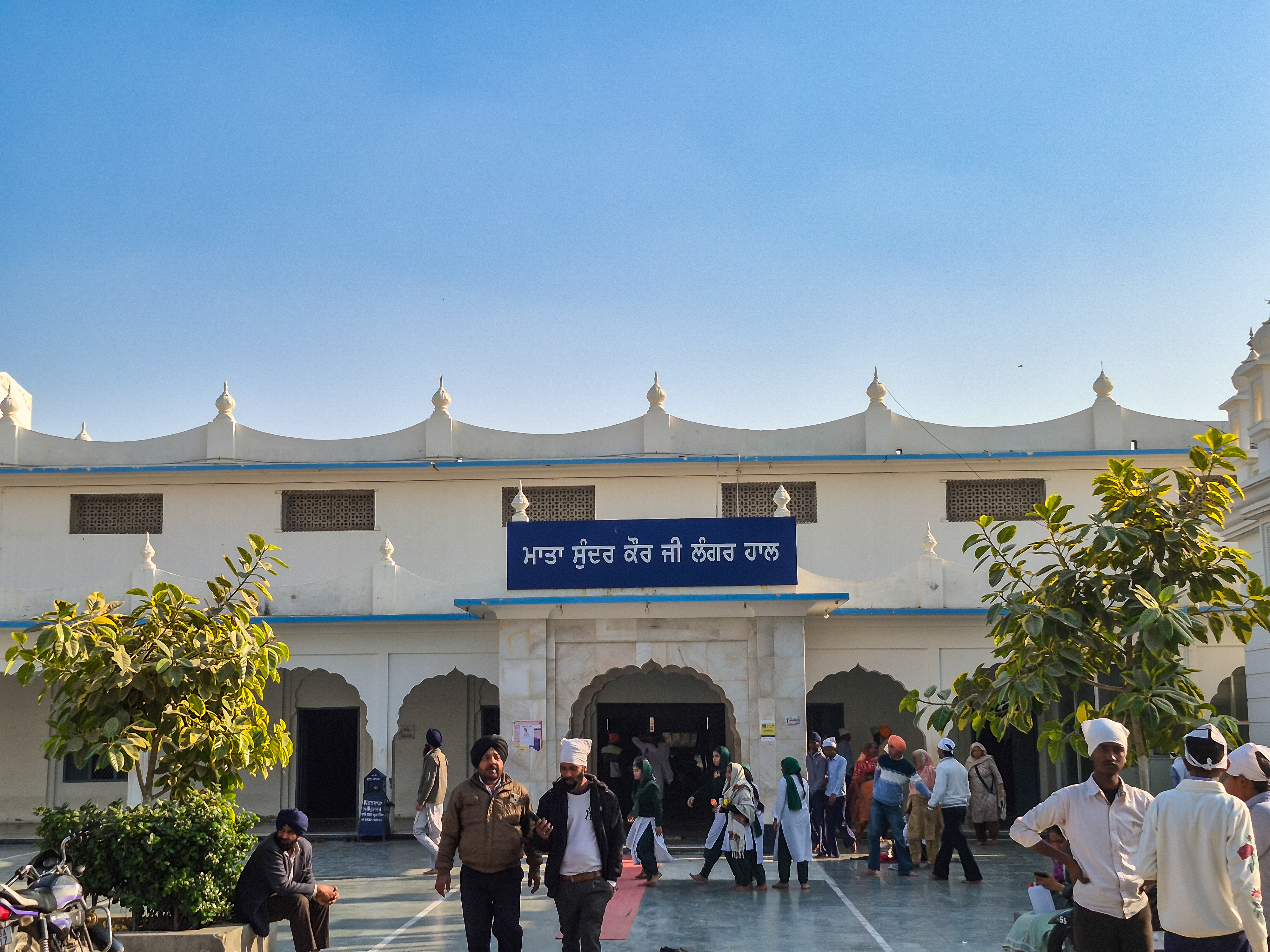
The word Damdama means resting place, and for centuries the gurdwara at Talwandi Sabo was revered but not formally ranked among Sikhism's highest institutions. That changed through a deliberate process of recognition. In 1960, the Shiromani Gurdwara Prabandhak Committee in Amritsar appointed a sub-committee to evaluate the claim. Its 183-page report made the case, and on 18 November 1966, the committee approved Resolution 32, officially declaring Damdama Sahib the fifth Takht of Sikhism. The government of India formalized the designation in April 1999, during the tricentennial celebrations of the founding of the Khalsa -- the initiated community that Guru Gobind Singh himself had established. Today the complex includes Gurdwara Likhansar Sahib and the Mata Sunder Kaur Langar Hall, where the tradition of communal meals continues.
Scripture Written in Grief
Damdama Sahib sits 28 kilometers southeast of Bathinda, on flat Punjab farmland that offers little drama to the eye. The gurdwara's white domes and golden finials rise above the surrounding fields without competition. From above, the complex is a contained island of devotion in an ocean of agriculture. What makes this place extraordinary is not its architecture but what happened within it. A man who had lost everything -- sons, mother, army, home -- responded not with vengeance but with literature. The Guru Granth Sahib compiled here would become the eternal Guru of the Sikh faith, a living scripture that would outlast every empire that tried to suppress it. Damdama Sahib is where that permanence was forged, in the quietest possible act of defiance.
From the Air
Located at 29.99N, 75.08E near Talwandi Sabo, 28 km southeast of Bathinda in Punjab, India. The gurdwara complex with white structures and golden domes is visible against flat agricultural surroundings. Nearest airport is Bathinda Airport (VIBT), approximately 28 km to the northwest. Chandigarh Airport (VICG) is roughly 250 km to the east. Best viewed at 2,000-4,000 feet AGL to appreciate the complex rising from the Punjab plains.