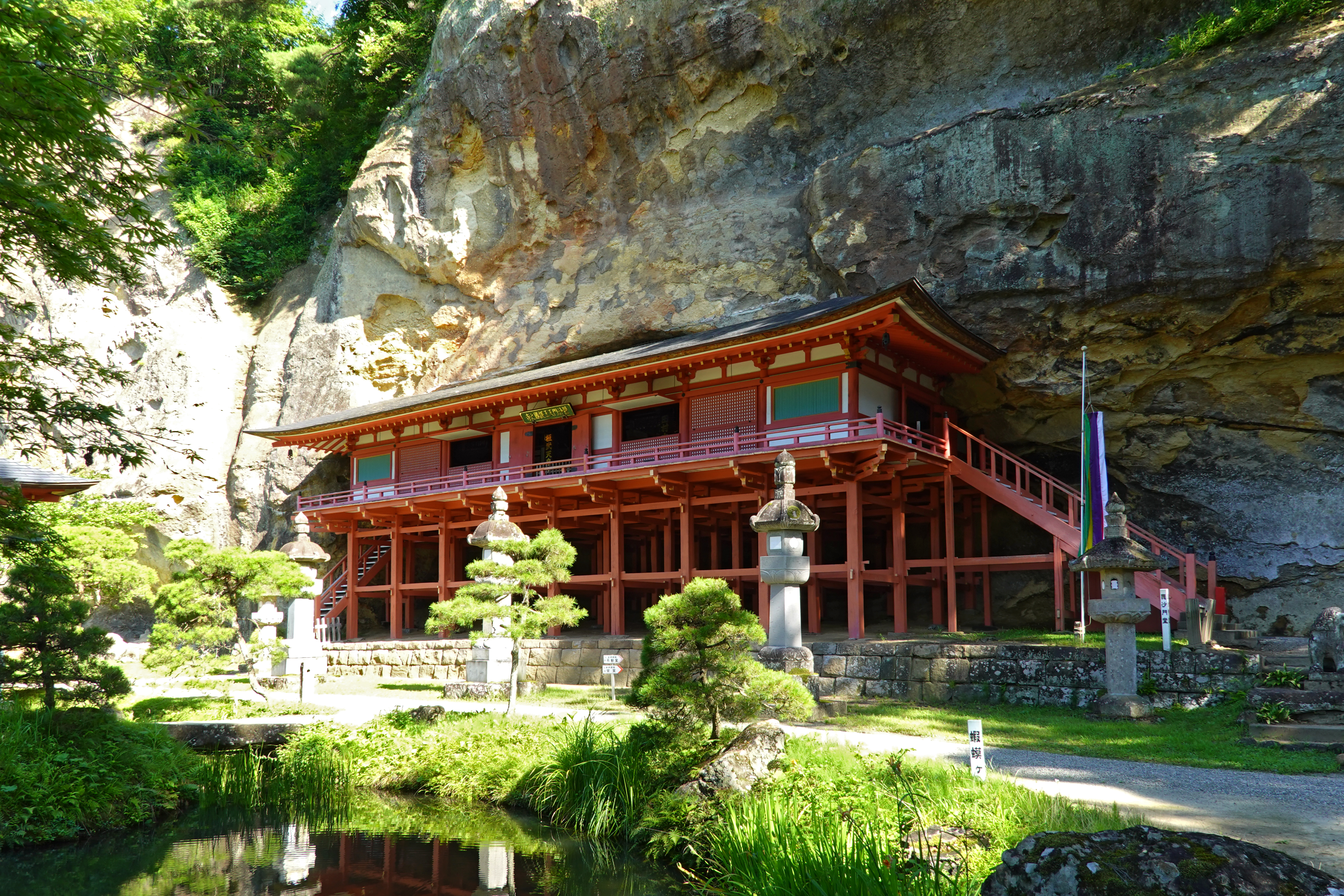
Takkoku-no-Iwaya
The building clings to the rock face like something that grew there. Wooden pillars brace a vermilion hall against an overhanging cliff six kilometers southwest of Hiraizumi, sheltering a shallow cave that holds a bas-relief statue of Bishamon-ten, the guardian deity of warriors. Takkoku-no-Iwaya Bishamondo is a temple built into the mouth of a former Emishi fortress -- a place where the conquered were commemorated by the conquerors, where a military victory was transmuted into a prayer for protection, and where twelve centuries of fire and rebuilding have never quite erased the original impulse that put a temple in a cave.
Victory Carved in Stone
In 801 AD, the imperial general Sakanoue no Tamuramaro, holding the title Chinjufu-shogun (Commander-in-Chief for the Pacification of the Emishi), pushed north through the Tohoku frontier. The Emishi tribes had used the natural cave at Takkoku as a fortification, and Tamuramaro's forces had to root them out. After his victory, Tamuramaro did something that reveals the complex relationship between conquest and devotion in early Japan: rather than simply razing the site, he ordered a temple built into the very cave the Emishi had defended. The hall was dedicated to Bishamon-ten, the Buddhist guardian of warriors and protector of the north, and originally enshrined 108 statues of the deity. The architecture was modeled after the famous Kiyomizu-dera in Kyoto -- a conscious effort to transplant the culture of the capital to the wild northern frontier.
Faces in the Cliff
The cave and its surroundings accumulated layers of sacred art over the centuries. During the Heian period, a large statue of Fudo Myoo -- the fierce, immovable wisdom king of esoteric Buddhism -- was added to the site and is now designated an Iwate Prefectural Cultural Property. To the west of the main hall, a 3.6-meter-high image of Buddha was carved directly into the rock face. This carving is attributed to Minamoto no Yoshiie, the great-grandfather of both Yoritomo and Yoshitsune, who had it made in the latter half of the 11th century to comfort the souls of warriors who had fallen in the region's persistent conflicts. The rock-carved Buddha links Takkoku-no-Iwaya to the broader saga of the Minamoto clan that would reshape Japan's entire political order within a century.
Burned and Reborn
Fire is the recurring character in Takkoku-no-Iwaya's story. The temple has burned down many times over its long history, and its original form is unknown today. Each rebuilding brought changes; each fire erased the evidence of what came before. The Kamakura-period chronicle Azuma Kagami describes the temple, confirming its significance in medieval Japan, but the building those chroniclers knew is long gone. The current structure dates from 1961 and faithfully reproduces the Kiyomizu-dera style -- a wooden platform cantilevered out from the cliff face on tall pillars, creating a veranda that seems to float between earth and rock. It is a modern building recreating an ancient idea: the sheltering overhang of the cliff as both roof and shrine, the meeting point of natural formation and human devotion.
Heritage on the Margins
Takkoku-no-Iwaya was included in the original 2006 nomination of Hiraizumi's sites for UNESCO World Heritage status under the banner of Pure Land Buddhist Cosmology. When that nomination failed in 2008, the temple was removed from the revised, successful 2011 application. It remains a National Historic Site, designated since 2005, but stands just outside the circle of international recognition that its neighbors Motsuji and Chuson-ji enjoy. Efforts continue to secure its inclusion through a future extension of the World Heritage listing. In the meantime, the temple between the Genbikei ravine and the center of Hiraizumi continues to draw visitors who come to see a building pressed against bare rock -- a structure that has existed in one form or another since the year 801, marking the place where imperial Japan first planted its flag in the north.
From the Air
Located at 38.97N, 141.06E, approximately 6 kilometers southwest of central Hiraizumi in southern Iwate Prefecture. The temple is built into a cliff face between the town and Genbikei ravine, making it difficult to spot from altitude -- look for a narrow wooded valley with exposed rock faces along the southwestern approach to Hiraizumi. The Kitakami River valley runs to the east. Nearest airport: Iwate Hanamaki Airport (RJSI), approximately 30nm north-northwest. The site is part of the broader Hiraizumi temple complex; approach from the south following the river valley for the best perspective on the cliff formations. Mountain weather is common; expect turbulence near the valley walls in strong winds.