Taleh
Somewhere in the dry Nugaal Valley of northeastern Somalia stands a compound of stone fortresses that the British called "the Mullah's fortifications" and that the people who built them called Dhulbahante garesas -- clan strongholds. Taleh was chosen as the capital of the Dervish movement not by accident but by calculation: it sat at the heart of Dhulbahante territory, far from colonial administrative centers and hostile neighboring clans. For more than a decade, it was the seat of one of the most sustained anti-colonial resistance movements in African history, led by a poet-warrior the British dismissed as the "Mad Mullah" -- Mohammed Abdullah Hassan.
A Capital Built on Tombs
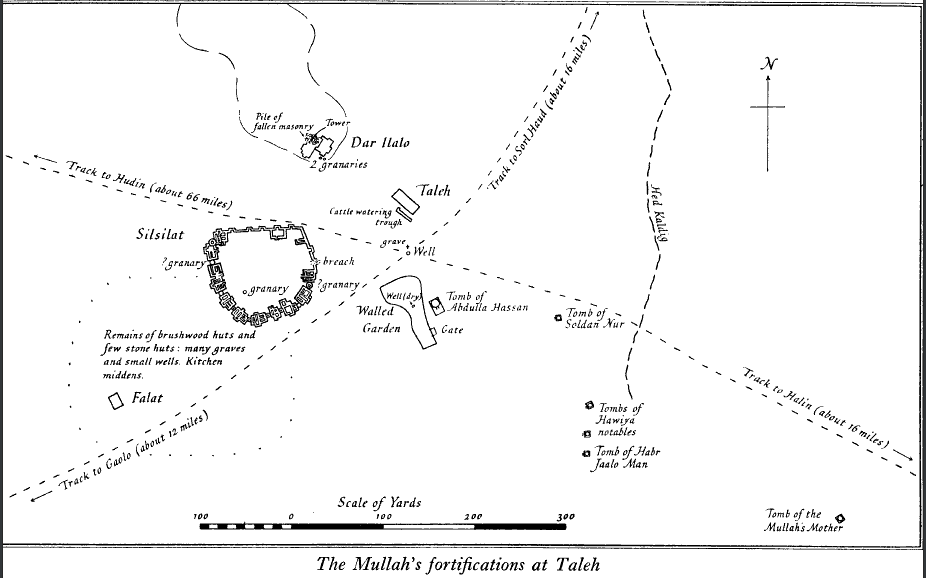
The Taleh complex was constructed between 1909 and 1910, built around a collection of Dervish tombs including those of Sultan Nur Ahmed Aman and Carro Seed Magan, mother of the Dervish sultan Diiriye Guure. According to Dervish veteran Cabdi-Yaar Cali Guuleed, the main fort was the largest of 27 Dervish-era structures spread across the Sool and Sanaag regions. The complex itself comprised four parts: Falat, Silsilad, Dar Ilaalo, and Taleh proper, though the name Taleh came to stand for the entire compound. After completing the main fort, the Dervish spent two more years building three smaller fortifications in the mountainous terrain of Sanaag. The oldest Dervish fort predated Taleh by nearly a decade -- the Ugaadhyahan Dhulbahante fort at Halin, encountered and destroyed by the British commander Eric Swayne during his second expedition in 1902.
The Dervish Resistance
Mohammed Abdullah Hassan waged a guerrilla campaign against the British, Italians, and their Somali allies for over two decades. His movement drew its core strength from the Dhulbahante clan, though it encompassed fighters from other groups as well. The Dervish operated from a succession of fortified bases -- Halin, then the castle at Illig on the coast, and finally Taleh. Colonial and Somali sources agree that the Dervish strongholds were primarily Dhulbahante-inhabited. The British War Office reported that the castle at Illig was "exclusively inhabited by the Dhulbahante clan," and historian Douglas Jardine confirmed the same. This was not merely a religious uprising; it was a clan-based political and military movement rooted in specific territory, sustained by kinship networks, and led by a figure whose poetry and rhetoric galvanized resistance across the Somali interior.
Bombed from Above
The end came from the air. In 1919 and 1920, the Royal Air Force -- deploying aircraft in one of the earliest uses of aerial bombardment against a colonial resistance movement -- struck the Dervish forts in Sanaag, driving Hassan's forces back to Taleh. On February 4, 1920, the RAF bombed Taleh itself. Days later, ground forces assisted by Somali horsemen overran the compound. Among the dead were Commander Ismail Mire, who led the defense, and Artan Boos, both Dhulbahante and among Hassan's closest lieutenants. Another Dervish leader, Muuse Dheere, was captured alive and executed by Abdi Dhere, a former Dervish who had defected in 1919. Hassan escaped to the Ogaden, where his remaining forces were scattered in a 1921 raid. The last Dervish man to leave Taleh was Maxamuud Xoosh Cigaal. The last person in the fort was six-year-old Jaamac Biixi Kidin, a child left behind in the chaos.
Contested Ground, Then and Now
Taleh's significance did not end with the Dervish defeat. The town became the symbolic capital of Khatumo State when Dhulbahante elders declared its formation in January 2012, choosing the site of their ancestors' resistance as the seat of a new political entity. Through the 2010s, Taleh changed hands repeatedly between Somaliland and Puntland forces. In April 2014, Somaliland sent hundreds of troops to occupy the town, withdrawing a day later under international pressure. In April 2019, Somaliland forces took control again, this time without a fight. The town has no hospital; during a 2019 water shortage, residents relied on traditional remedies or traveled to Las Anod or Garowe for medical care. Taleh's Dervish-era structures, including the Dalyare fort, remain among the least disfigured ruins of the resistance -- stone witnesses to a chapter of history that still shapes the politics of the region.
From the Air
Located at 9.15°N, 48.42°E in the Nugaal Valley of northeastern Somalia's Sool region. The terrain is semi-arid plateau with scattered acacia scrub. The Dervish fort complex may be visible from lower altitudes as a cluster of stone structures. The nearest airstrip is at Las Anod (HCLA), approximately 90 km to the southwest. Garowe Airport lies to the southeast in Puntland.