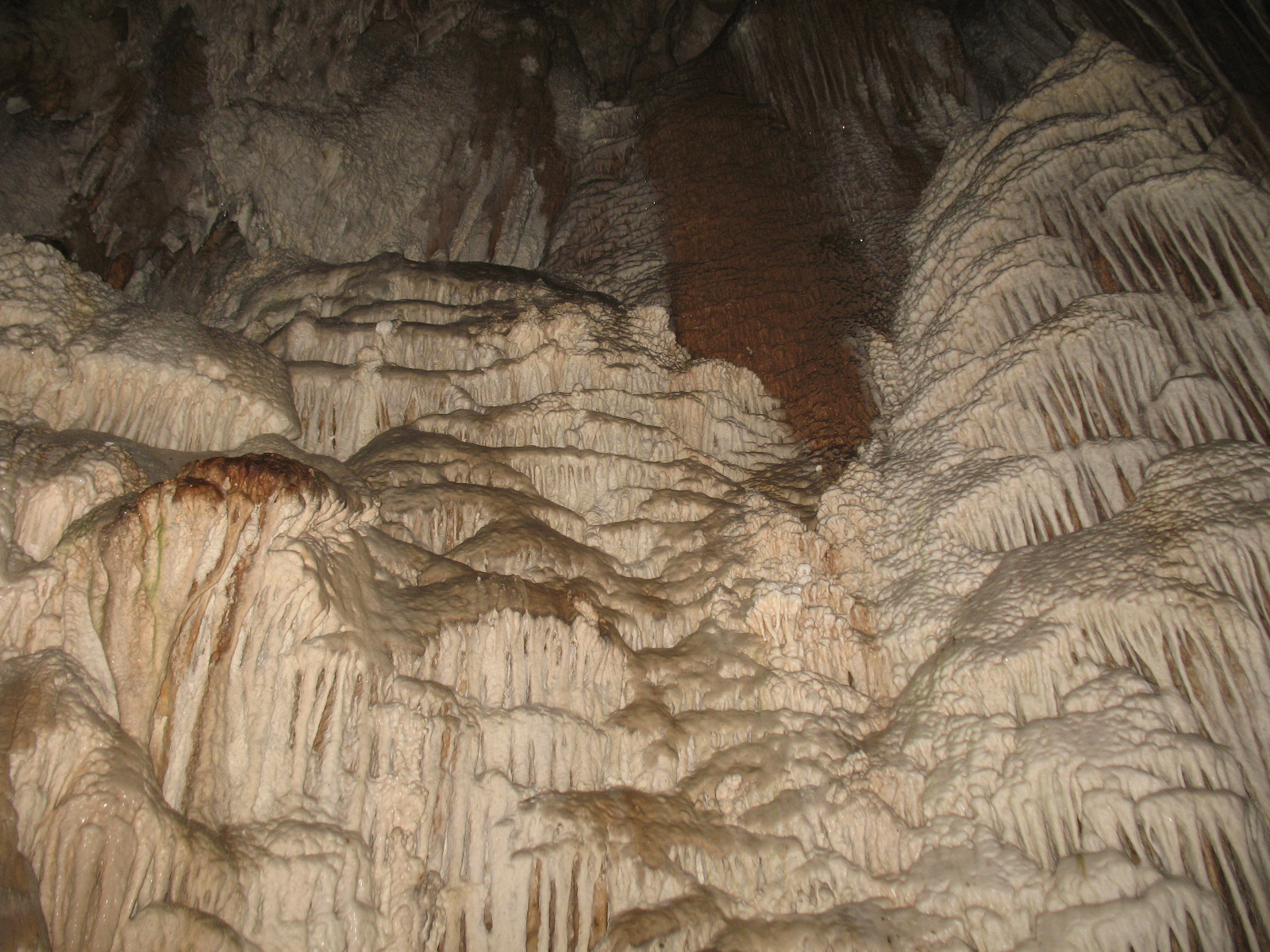
Talgua Caves
Shine a light on the skulls and they glow. Not from any supernatural force, but from centuries of calcite dripping onto bone, encasing the dead in a thin crystalline shell that catches and scatters every photon aimed at it. The effect earned Talgua Cave its popular name -- the Cave of the Glowing Skulls -- though the label is technically a misnomer. The skulls do not glow on their own. They need your flashlight, your presence, your curiosity. Six hundred meters inside a limestone mountain in northeastern Honduras, the remains of people who lived around 1000 BCE have been waiting three millennia for someone to notice.
The Discovery in the Dark
Local residents had known about the cave for generations. They explored its accessible chambers, and over the years, removed nearly every stalagmite and formation within reach. But the ossuary -- the burial chamber -- remained hidden until April 1994. Two American Peace Corps volunteers, Greg Cabe and Tim Berg, along with three Hondurans -- Jorge Yanez, Desiderio Reyes, and Mariano Rodriguez -- were exploring the cave on the east bank of the Talgua River, about six kilometers from the city of Catacamas, when they first spotted human skeletal remains deep inside. Berg and Cabe reported the find to archaeologists. James Brady from California State University, Los Angeles and George Hasemann of the Honduran Institute of Anthropology and History began investigating, and what they found changed the understanding of Pre-Columbian Honduras.
Red Ochre and Bundled Bones
Within the primary ossuary chamber and three additional passageways, investigators discovered 23 deposits of human skeletal remains -- at least 20 containing the bones of more than one individual. These were secondary burials: the flesh had been stripped, the bones painted with red ochre pigment rich in hematite and iron oxides, then bundled in cloth and carried deep into the cave through an entrance that no longer exists. Radiocarbon dating placed the burials in the Early to Middle Pre-Classic period, around 1000 BCE. That date matters enormously. Most archaeological attention in Honduras has focused on the Maya ruins at Copan, associated with the later Classic period. Talgua pushed the timeline of complex society in the region back by centuries. As principal investigator James Brady put it, the Talgua people had developed a level of civilization equal to any society known in the Maya area at that time.
Jade from the North, Gold from the South
The cave was not the only discovery. A nearby village site yielded jade and marble vessels -- prestige items indicating social stratification -- along with obsidian that had traveled from the Maya highlands. The Talgua settlement sat at a crossroads. Jade fascination flowed south from Maya territories in Guatemala, while gold fascination crept north from societies in lower Central America and Colombia. Cuyamel ceramics found in northeastern Honduras are contemporaneous with the rise of the Olmec during the Middle Pre-Classic, and their stylistic similarities hint at connections across vast distances. The Talgua people were not isolated villagers. They were intermediaries in trade networks that linked Mesoamerica to the Isthmo-Colombian world, and the items they placed with their dead reflect the reach of those connections.
What the Visitors See -- and Cannot
Today a cement and iron walkway leads from the road to the cave entrance, a far cry from the oxcart trail and jungle trek required in 1995. Visitors walk narrow elevated platforms through about 500 meters of the cave. The experience is humbling and frustrating in equal measure. Nearly all accessible cave formations were destroyed by locals long before the ossuary's discovery, and the burial chamber itself lies behind a barred steel door, roughly double the distance into the mountain that tourists are permitted to travel. The looting that followed the 1994 discovery prompted authorities to seal the site. Beyond that door, and far deeper into the mountain where human traffic could not reach, the cave recovers its beauty -- natural formations, hundreds of crawl holes, and roughly a mile of passages branching through the rock. The glowing skulls remain in the darkness, unreachable, their calcite coatings still catching whatever light finds them.
From the Air
Located at 14.91N, 85.88W in the Olancho Valley of northeastern Honduras, near the city of Catacamas. The cave entrance is on the east bank of the Talgua River, about 6 km from Catacamas. From altitude, the Olancho Valley is a broad agricultural plain flanked by forested mountains. Best viewed from 3,000-4,000 feet AGL. Nearest airport: Catacamas has a small airstrip. La Ceiba's Goloson International Airport (MHLC) is roughly 100 nm northwest.