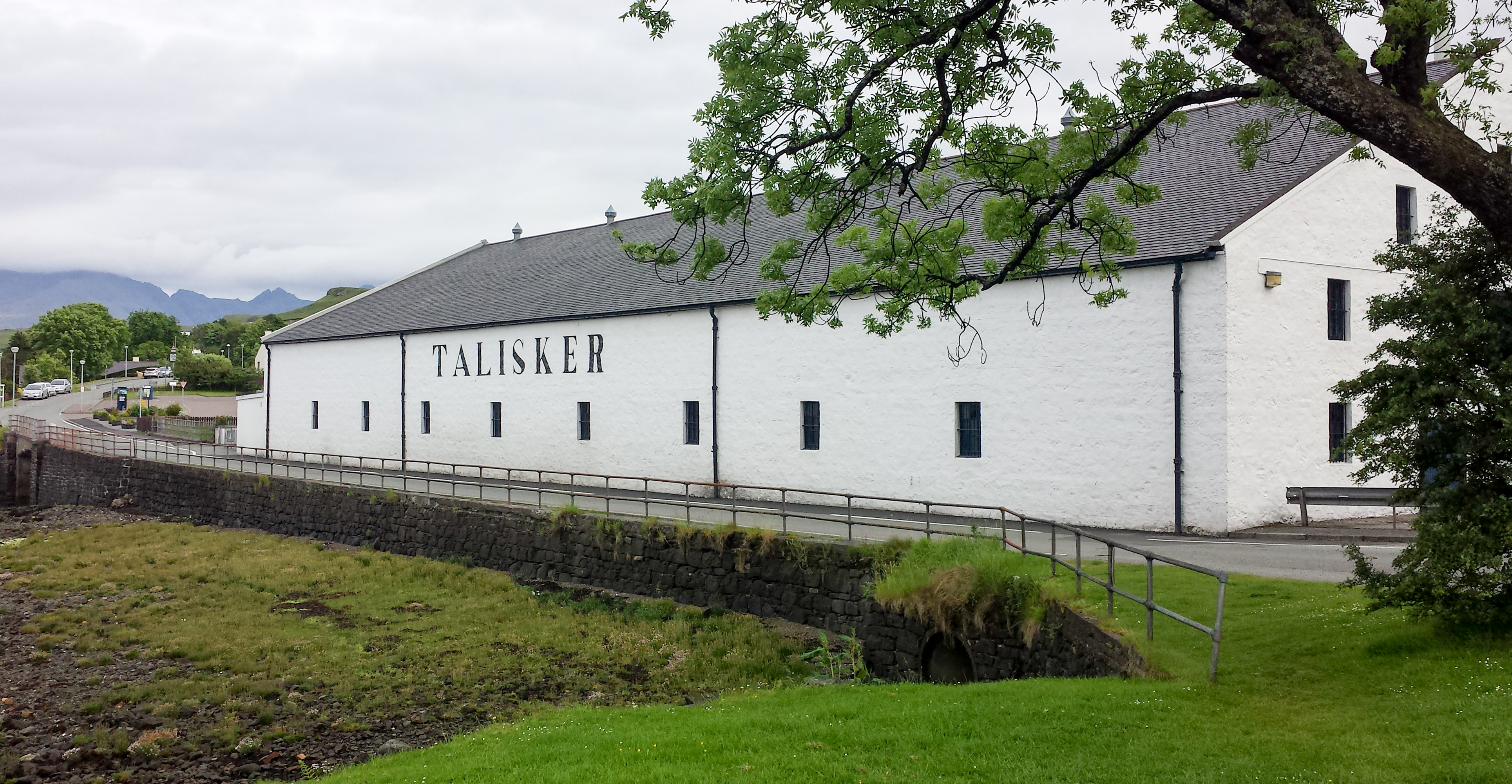
Talisker distillery
Robert Louis Stevenson called it the king of drinks. In his poem "The Scotsman's Return From Abroad," he wrote: "The king o' drinks, as I conceive it, Talisker, Islay, or Glenlivet." That Talisker came first in his list was no accident. The whisky made at this distillery on the shore of Loch Harport, on Skye's Minginish peninsula, has a character unlike any other single malt -- a maritime smokiness cut with black pepper and salt, as if the Atlantic had somehow found its way into the cask. It is the only distillery on Scotland's most famous island, and it has been making whisky in essentially the same way since 1830, through two fires, three ownership changes, and a world war.
MacAskill's Gamble
Hugh and Kenneth MacAskill founded the distillery in 1830 after raising three thousand pounds and acquiring a lease on the site from Clan MacLeod. The brothers chose to name their whisky not after the village of Carbost where it was produced but after Hugh's estate, Talisker, five miles to the west -- a decision that linked the brand forever to the wild coastline and sea cliffs of western Skye rather than to a landlocked village on a sea loch. The distillery opened at Carbost in 1831. In 1879, it was purchased for 1,810 pounds by a firm that became R. Kemp and Co., when production capacity stood at 700 gallons per week. By 1892, a new lease had been negotiated with the chief of Clan MacLeod for an annual payment of 23 pounds, 12 shillings, and a ten-gallon cask of best-quality Talisker. By 1894, output had nearly tripled to 2,000 gallons per week.
The Stills That Rose Twice
Talisker survived one fire in 1948, when a blaze in the store destroyed grain and over 100 empty barrels but spared the whisky itself. The second fire, in 1960, was not so merciful. It destroyed the entire stillhouse. The distillery was rebuilt, and five exact replicas of the original stills were constructed -- not out of sentiment but out of hard commercial logic. Whisky character is shaped by the precise geometry of the still: the angle of the lyne arm, the height of the neck, the curve of the pot. Change the still, change the spirit. Talisker's distinctive feature is an unusual loop in the swan neck lye pipes that carries vapour from the stills to the worm tubs. This loop causes some alcohol to condense before reaching the cooler, sending it back into the still for redistillation. The result is a spirit with additional complexity. The distillery uses worm tubs rather than modern condensers, a choice believed to give the whisky its fuller flavour. During its early decades, Talisker was triple-distilled, but the process switched to the more conventional double distillation in 1928.
Peat, Water, and the Atlantic
Everything about Talisker's production anchors it to its landscape. The water comes from springs above the distillery on Cnoc nan Speireag -- Hawk Hill -- flowing over peat that adds its own character before the whisky-making even begins. The malted barley, sourced from Muir of Ord on the mainland, is peated to a phenol level of 18 to 22 parts per million, a medium peating that gives smoke without overwhelming the palate. The spirit matures primarily in American oak casks. Today Talisker produces three and a half million litres of spirit annually. The 18-year-old expression won Best Single Malt in the World at the 2007 World Whiskies Awards. The 10-year-old took a Double Gold Medal at the San Francisco World Spirits Competition in 2015. HV Morton, the travel writer who explored Scotland between the wars, shared Stevenson's admiration. Both men understood what the distillery's position on Skye's western coast gives to the whisky: a sense of place so strong you can taste the sea in the glass.
From the Air
Talisker Distillery sits at 57.303N, 6.356W on the shore of Loch Harport on the Minginish peninsula, Isle of Skye. The distillery buildings are visible on the loch shore near the village of Carbost. Nearest airfield is Broadford Airstrip on Skye (no ICAO code), approximately 15 nm east-southeast, or the mainland airfield at Plockton (no ICAO code). Oban Airport (EGEO) lies approximately 60 nm south. The Cuillin ridge is visible to the east-southeast, rising to over 990 m.