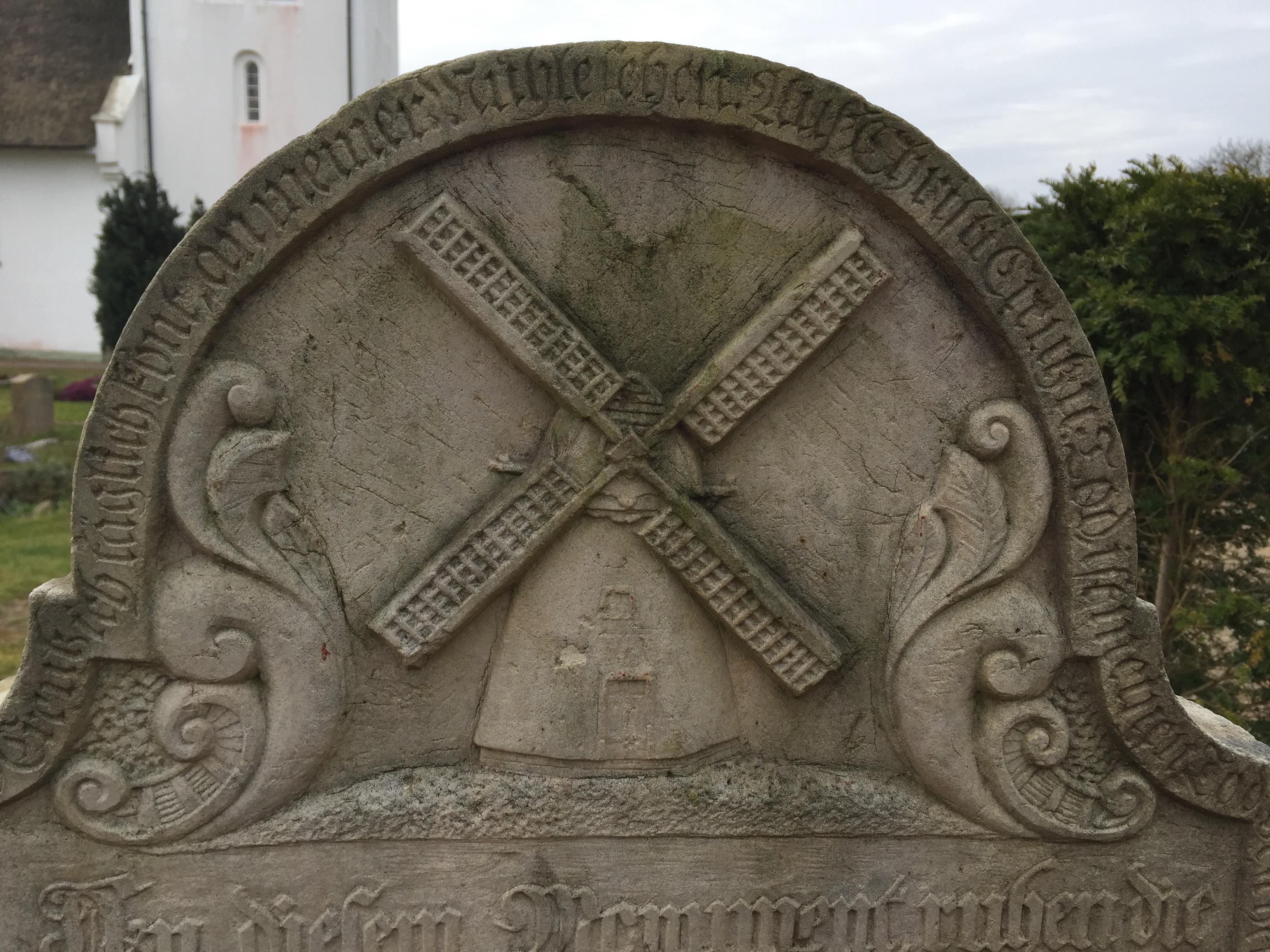
Talking Gravestones of Amrum
The graveyard has 152 voices. They were carved between 1678 and 1858, mostly in red and grey sandstone, mostly by men who were not trained stonemasons. The lettering tells you not only who is buried beneath - name, dates, parents, spouse, children - but what they did with the years between. It tells you which voyages they survived and which ones killed them. Whether they were captains or carpenters or shipwrecked. How many children they fathered. Which children went before them. Some inscriptions run so long that the stonecutter had to turn the slab over and continue on the back. In Nebel, on Amrum, the dead are still talking.
Whaling Money, Carved in Stone
The earliest of the Erzaehlende Grabsteine - the story-telling gravestones - date to the last decades of the seventeenth century. That timing is not accidental. Amrum's standard of living was rising sharply on the proceeds of whaling. Frisian crews shipped out of Dutch and German ports each spring for the Arctic, and a successful season could make a sea captain rich for life. Wealth bought sandstone instead of wooden crosses. Wealth also bought time on the stone - the more prosperous the family, the more elaborate the inscription. By the early nineteenth century, when whaling collapsed and the Frisian fleets disbanded, the talking gravestones thinned out. Poor families went back to red sandstone slabs with only birth and death dates, or to plain wooden crosses. The economy of grief tracked the economy of the sea.
The Stonemasons Who Weren't
Most of the men who carved these stones were ships' carpenters or coastal craftsmen, not trained stonemasons. Tai Hirichs (1718 to 1759) came from the tiny coastal islet of Nordstrandischmoor and cut the markers of Oluf Jensen and his son Hark Olufs - the most famous gravestones in the whole churchyard. Jens Payen (1711 to 1787) and Arfst Hanken (1735 to 1826) worked on the neighbouring island of Foehr, ferrying finished slabs across the tideflats. Jan Peters (1768 to 1855) lived on Amrum itself and cut 36 of the surviving stones - nearly a quarter of the entire collection. The carving is uneven, the lettering sometimes wanders, the proportions are not always classical. But the work has a directness that trained mason hands often lack. These men knew the families. They were carving for neighbours.
Flowers and Broken Stalks
The visual language of the gravestones is dense with code. A flower carved into the stone represents a full life. A broken stalk - the same flower, but with its stem snapped - means a child or sibling who died before the person commemorated. Ships appear constantly: square-rigged whaling barks, fluyts, the small fishing smacks that worked the Wadden Sea. The compass rose appears too, and anchors, and occasionally a depiction of the moment of death - a whaler crushed by ice, a captain at the wheel. The text is mostly in High German, the language of the Lutheran services held inside the church, even though Amrum belonged politically to Denmark for most of the period. The oldest inscriptions are deeply cut and still legible after three centuries. The newest, ironically, are often the most faded.
Walked Off the Wall
The collection nearly did not survive. After Prussia absorbed the duchy of Schleswig in 1864 and the German Empire was founded in 1871, the new Wilhelmine administration disliked the old cemetery's apparent disorder. Many of the talking gravestones were pulled out of the ground and embedded in the cemetery walls along straight new pathways, where wind and rain attacked them at angles the original carvers never anticipated. Some weathered to illegibility within a generation. In the twentieth century, the parish reversed course. The 152 surviving stones were lifted out of the walls and arranged in thematically related sections along a walking path through the churchyard, the Allee der Steine - the Way of the Stones. Lichen and moss still threaten the carvings. Conservation is slow, expensive, and ongoing.
The Slave Prince
The most-visited stone belongs to Hark Olufs. Olufs was born in nearby Suddorf in 1708, captured by Barbary corsairs in 1724 at sixteen, sold in Algiers, and rose over eleven years to become commander in chief of the cavalry of the Bey of Constantine before returning home in 1736. He died in 1754. Tai Hirichs carved his marker. The inscription survives well enough to read - the dates, the voyages, the elevation to a rank no one in Amrum had imagined a Frisian boy could reach. Tourists who come for one stone usually leave having read a dozen. The whole point of a talking gravestone is that you cannot listen to just one. Each life leads to the next - shipmates, fathers, sons, the men who drowned together on a single voyage and now lie in a single row.
From the Air
The Talking Gravestones stand at approximately 54.653 N, 8.355 E in the churchyard of St. Clement's Church, Nebel, on Amrum. Nearest airport is Sylt (EDXW), 25 km north. From cruise altitude in clear weather, the location is identifiable by the copper-roofed church tower of St. Clement at the centre of Amrum's east-coast village cluster. The cemetery walls and the curving paths of the Allee der Steine are visible from low overflight.