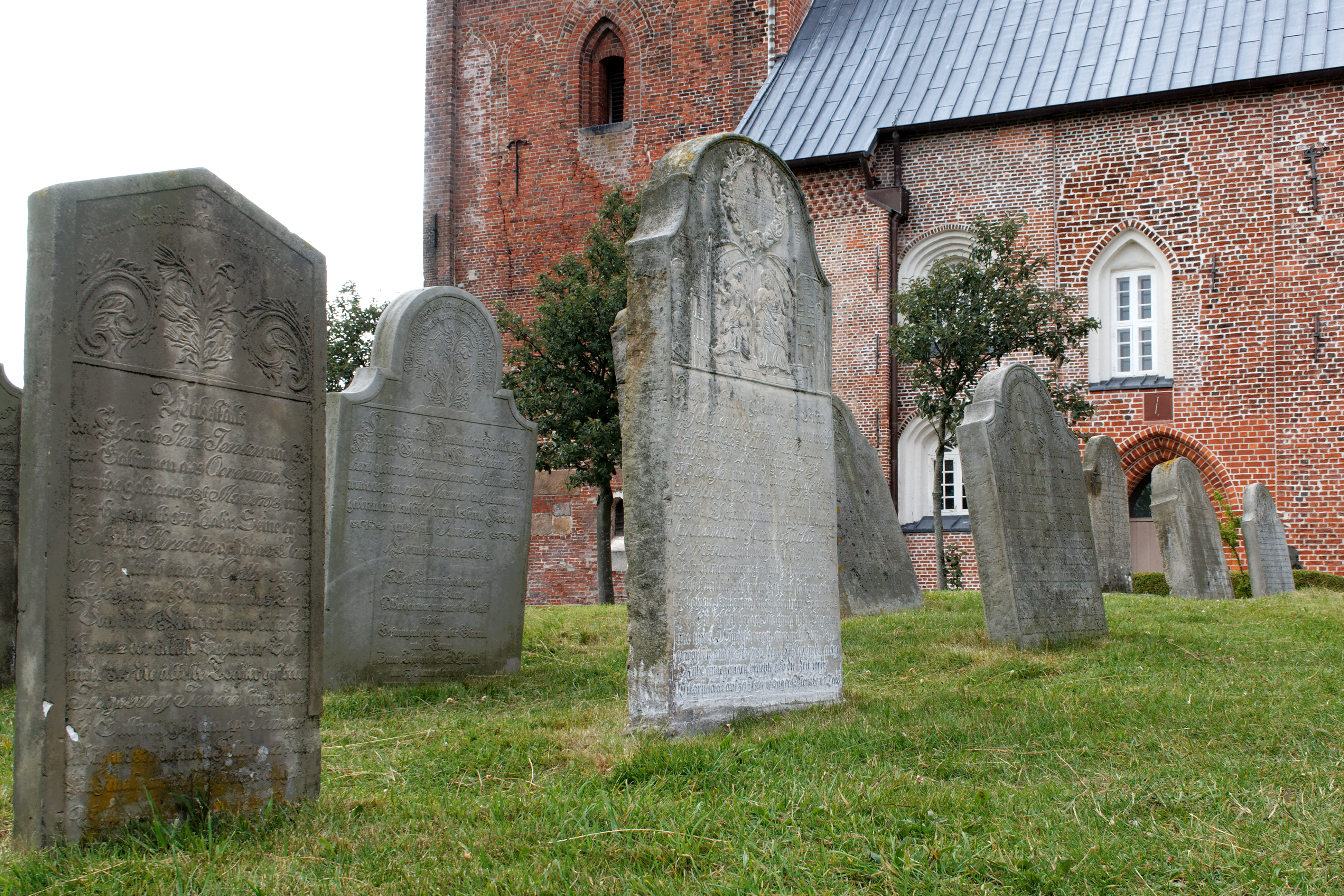
Talking Gravestones of Föhr
The most famous gravestone in the cemetery of St. Laurentii in Süderende belongs to a man who killed 373 whales. The Latin inscription on Matthias Petersen's tomb counts them out. Above the text, in carved relief, the goddess Fortuna rides on the back of a swimming bowhead. Petersen died in 1706 and the stone has weathered three centuries of North Sea wind, but you can still read the math: a fifty-year career, sons lost to French privateers, an income converted into modern currency at more than half a million euros. The Frisians call these slabs Erzählende Grabsteine - story-telling gravestones - and Petersen's is only the most quoted. Hundreds more line the churchyards of Föhr, each one a biography in sandstone.
Why Captains Wrote Their Lives in Stone
In the seventeenth and eighteenth centuries, the men of Föhr disappeared every spring. They sailed north to Spitsbergen with the Dutch whaling fleet, hunted bowheads through the Arctic summer, and came home in autumn with blubber and oil - or did not come home at all. A successful captain returned a wealthy man on an island where most of his neighbors farmed thin sandy soil and prayed about the weather. He had stories no one else had: he had seen ice the size of cathedrals, fought storms in latitudes most Frisians could not name, commanded crews against pirates. When such a man died, a simple cross would not do. He commissioned a slab carved with the curve of his life - voyages, ships commanded, children begotten, honors received - so that anyone walking the churchyard could read him entire. The vanity is plain, but the practical purpose was different. On a small island, the gravestones became a public archive of who had lived and what they had done.
The Widow Beside the Tulip
Look closely at the floral motifs that decorate the older stones and you will see something specific. On the left, tulip-like flowers with elongated petals stand in a row - one for the dead man, more for each of his sons. On the right, star-shaped four-petaled blossoms march in parallel - one for his wife, more for each daughter. The iconography is rigid and the language is plain: husband and sons are tulips, women are stars. Read the stones with this code in mind and the cemetery fills with stories the Latin texts barely mention. A captain commemorated with seven tulips. Beside him, his widow's column shows three stars - and a fourth star whose carving stops short, marking a daughter who outlived her father and was added later. Most of the inscriptions belong to the men. The flowers belong to everyone.
The Women Who Stayed
The captain at Süderende sailed for fifty years. His wife, almost certainly, did not. Frisian whaling marriages were marriages of long absence - six months at sea, six months at home, if the husband came home at all. Women on Föhr ran farms and households and small fishing boats while their men were hunting bowheads above the Arctic Circle. The widows of lost captains kept their stones intact. The widows of returning captains commissioned new ones. When Matthias Petersen's wife was buried, her name went onto a stone that was already counting whales. Across the churchyards of Föhr, the women's biographies are usually shorter than their husbands' - fewer voyages, fewer honors, no Latin epitaphs - but they are there, in the four-petaled star on the right side of the slab, in a count of daughters baptized and daughters lost. The talking stones speak about men, but they testify, quietly, to the women who carried the island while the men were elsewhere.
Stones in Ballast
The sandstone itself made the long journey before the carvers touched it. The oldest slabs are red sandstone from the Solling hills of northern Westphalia. Later stones came from Obernkirchen in Lower Saxony, where a coarser quality of sandstone was cheaper and easier to work. The blocks reached Föhr the same way the captains did - by ship - loaded as ballast in returning whaling vessels and bartered ashore on arrival. Only the wealthy could afford a totally new slab. Less prosperous families bought used stones and had the old inscriptions ground off, layering a fresh life on top of an erased one. Because the carving was so elaborate, families often waited years between burial and the erection of the actual monument - so a stone might commemorate a captain who had been in the ground for a decade by the time his name appeared above it.
What the Stones Inherit
All gravestones on Föhr made before 1870 are now designated cultural heritage monuments. The St. Johannis cemetery in Nieblum, with 265 historical stones, holds the largest such inventory in the entire Nordfriesland district. Modern Frisian graves on the island are mostly polished granite slabs with name, dates, nothing else - the brevity of contemporary remembrance. But the old talking stones remain, weathered and tilting, sometimes legible only if you know what to look for. Stand in the cemetery at Süderende on a windy October afternoon and you can read the tulips and the stars before you read a word of Latin. The whole island, in stone, in fifty churchyards' worth of carved flowers, telling itself who it was.
From the Air
The main Talking Gravestones cemeteries are at Süderende (St. Laurentii), Nieblum (St. Johannis), and Boldixum near Wyk auf Föhr. The cluster sits at roughly 54.72N, 8.44E on the island of Föhr in the German Wadden Sea, between Amrum and Sylt. Wyk auf Föhr (EDXY) on the eastern shore is the local airstrip; Sylt (EDXW) handles regional traffic. At 2,000 feet the whole island fits in a single frame, with the three churches dotted along its long east-west axis.