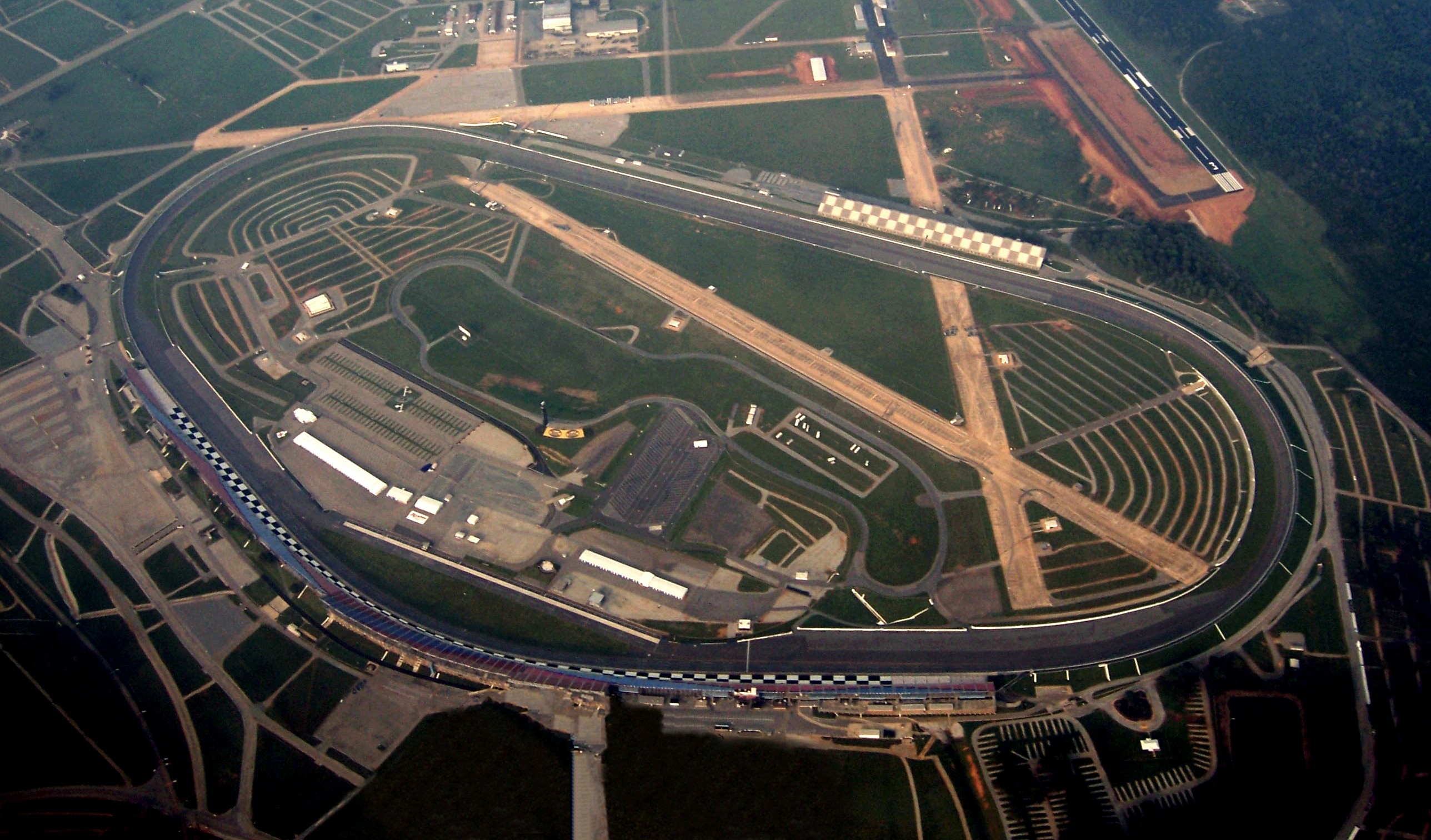
Talladega Superspeedway
LeeRoy Yarbrough punched Bill France Sr. in the face. That was how Talladega Superspeedway's first race weekend began, in September 1969, with a tire dispute escalating into a fistfight between a driver and the founder of NASCAR himself. The track surface was rough, the grandstands unfinished, Hurricane Camille had left holes in the asphalt, and most of the top drivers boycotted the inaugural Talladega 500. It was, by any reasonable measure, a disaster. It was also the perfect introduction to a venue that would spend the next half century earning a reputation as the wildest, most unpredictable track in American motorsport.
Born from Rejection
Talladega Superspeedway exists because Spartanburg, South Carolina said no. In the early 1960s, NASCAR founder Bill France Sr. planned to build a massive superspeedway near the Spartanburg Downtown Memorial Airport, a facility he touted as a "little Daytona." Local residents killed the proposal over noise concerns, a decision that longtime NASCAR driver James Hylton called the day the city "stuck a knife in their hearts." France Sr. turned his attention to eastern Alabama, where he found willing partners in Talladega city officials and 2,000 acres of land at the former Anniston Air Force Base. Groundbreaking came on May 23, 1968, and the Alabama International Motor Speedway was born. The track was designed to be longer and steeper than Daytona, with 33 degrees of banking in the turns and the promise of speeds exceeding anything stock cars had achieved. Construction involved bulldozing part of the Talladega Mountains to build grandstands. One worker, W. L. Harry, was killed when a crane struck his head.
The Curse and the Chaos
Publicity director Jim Hunter cultivated the legend of a "Talladega Curse," rooted in an urban legend that the speedway was built on indigenous land seized during the Trail of Tears. General manager Grant Lynch later admitted the whole thing was a marketing tactic to "build the mystique of Talladega." But the strange events that fed the legend were real enough. In 1973, driver Bobby Isaac abruptly retired mid-race, saying he heard voices in his head telling him to quit. That same year, Larry Smith became the first driver to die at the track. At the 1974 Winston 500, ten of the top eleven qualified cars were mysteriously sabotaged; the culprit was never found. In 1982, confidence trickster L. W. Wright swindled thousands of dollars in equipment from teams and NASCAR, attempted to race, was parked for being too slow, then vanished without a trace. He was not located until 2022, when he surfaced for a podcast interview. In 1986, a spectator stole the pace car and took it for a joyride around the track.
Pack Racing and the Big One
The event that changed Talladega forever came at the 1987 Winston 500, when Bobby Allison blew a tire on the frontstretch. His car went airborne and tore into the catchfence, injuring four spectators. NASCAR responded by mandating restrictor plates to cut speeds, a rule that endured until 2019. The unintended consequence was pack racing, with fields of forty-odd cars running nose-to-tail at nearly identical speeds. Any small disruption could trigger a chain reaction, and at Talladega it frequently did. These multi-car wrecks became known as "the Big One." A 27-car pileup in 2002 set the all-time record for cars involved in a single NASCAR incident. Carl Edwards' car flew into the catchfence on the final lap of the 2009 Aaron's 499, injuring seven spectators. A 25-car wreck closed the 2012 Good Sam 500. The crashes became as much a part of the Talladega identity as the racing itself, drawing fans who came for the spectacle of controlled chaos at 190 miles per hour.
The Infield Republic
Talladega's 270-acre infield is a world unto itself on race weekends, hosting around 2,700 RVs and a party scene that ESPN's Ryan McGee described as "full of redneck engineering and school buses and questionable decisions." By the 1980s, the infield had earned a reputation for lawlessness that made Mardi Gras look restrained. Journalist Mike Hembree summarized the priorities as "beer, liquor, racing, boobs and, somewhat down the list, college football." Track officials eventually installed a makeshift jail and worked to civilize the scene, but the reputation endures. The track complex sprawls across 3,000 acres, making it the largest facility on the NASCAR circuit. Its grandstand capacity peaked at 143,000 in 2003, when nearly 190,000 packed the facility for the Aaron's 499. The Great Recession carved attendance down sharply, and by 2013 the backstretch grandstands were demolished, reducing seating to 80,000.
Speed's Monument
Despite the chaos, or perhaps because of it, Talladega has been the stage for some of motorsport's landmark achievements. In March 1970, Buddy Baker became the first person to break 200 miles per hour on a closed course. Bobby Isaac, A. J. Foyt, and Mark Donohue each pushed the closed-circuit record higher. Lyn St. James shattered the women's record in the late 1980s, becoming the first woman to exceed 200 mph on an oval. The track was renamed Talladega Superspeedway in 1989, because as publicity director Jim Freeman put it, "it's shorter, and everybody called it 'Talladega' anyway." A $50 million infield renovation completed in 2019 modernized the garages and media facilities. Through it all, the tri-oval has remained NASCAR's fastest and most feared stage, a place where the line between triumph and catastrophe is measured in fractions of a second.
From the Air
Located at 33.57N, 86.07W in Lincoln, Alabama, approximately 45 nm east of Birmingham. The 2.66-mile tri-oval is unmistakable from the air, its banked turns and vast infield visible from well above cruising altitude. The complex covers roughly 3,000 acres along Interstate 20. Talladega Municipal Airport (ASN) is nearby. Birmingham-Shuttlesworth International Airport (KBHM) lies to the west. Best viewed at 3,000-6,000 feet AGL to appreciate the full scale of the facility and the foothills of the Talladega Mountains surrounding it.