Tallinn Town Hall
Old Thomas has been standing on top of Tallinn Town Hall since 1530, a thin copper warrior with a sword and a flag, his bowed head fixed forever on the merchant town below. The story tradition gives him is this: as a peasant boy he won a noble crossbow contest by shooting down the wooden parrot that all the Baltic German aristocrats had failed to hit. His low birth meant he was disqualified from the prize, but the mayor of Reval (as Tallinn was then called) gave him something better, a job as city watchman. The figure on the spire is supposedly modeled on him, and Old Thomas has watched over Tallinn through 500 years of fires, sieges, occupations, and air raids.
The Oldest in the North
Tallinn Town Hall is the oldest surviving town hall in northern Europe and the entire Baltic Sea region, a long, narrow Gothic building of grey limestone topped with red clay tiles and a single 64-meter tower. The earliest documentary mention dates to 1322, when a town hall here was already noted as having a meeting room (consistorium) and a giant warehouse cellar (cellarium civitatis). The building you see today rose between 1402 and 1404, the work of stonemason Ghercke, who probably came over from Toompea hill where the cathedral and fortress walls had recently been completed. The Easter celebration of 1402 was the last in the old building; construction started right after the holiday. By 1404 the new town hall was up: 36.8 meters long, two storeys high over a spacious basement, faced on the market square by a nine-arched arcade where merchants could shelter from rain and dragon-headed gargoyles spat rainwater off the parapet.
Hanseatic Power in Stone
Tallinn became a member of the Hanseatic League in 1285 and grew rich on the trade between Western Europe and Novgorod and Muscovy. The town hall was both seat of government and statement of wealth. Its Citizens' Hall on the second floor measures 16.2 meters by 12 meters, with a 7.5-meter vaulted ceiling held up by two octahedral pillars in late-Gothic style. The herringbone-patterned painted decoration on the consoles was restored from a single surviving fragment. Behind the Citizens' Hall is the Parlour, the most important room in the building, where the aldermen voted and ruled. They were chosen on St. Thomas' Day, 20 December, which may be why the figure on the spire ended up named Thomas. Elections were held with the town hall doors closed, the burgermeister announcing two candidates per position, the council voting by absolute majority, and only afterwards were the doors thrown open and the new aldermen's names called out from the windows to the citizens waiting on the square below.
The Tapestries That Almost Got Sold
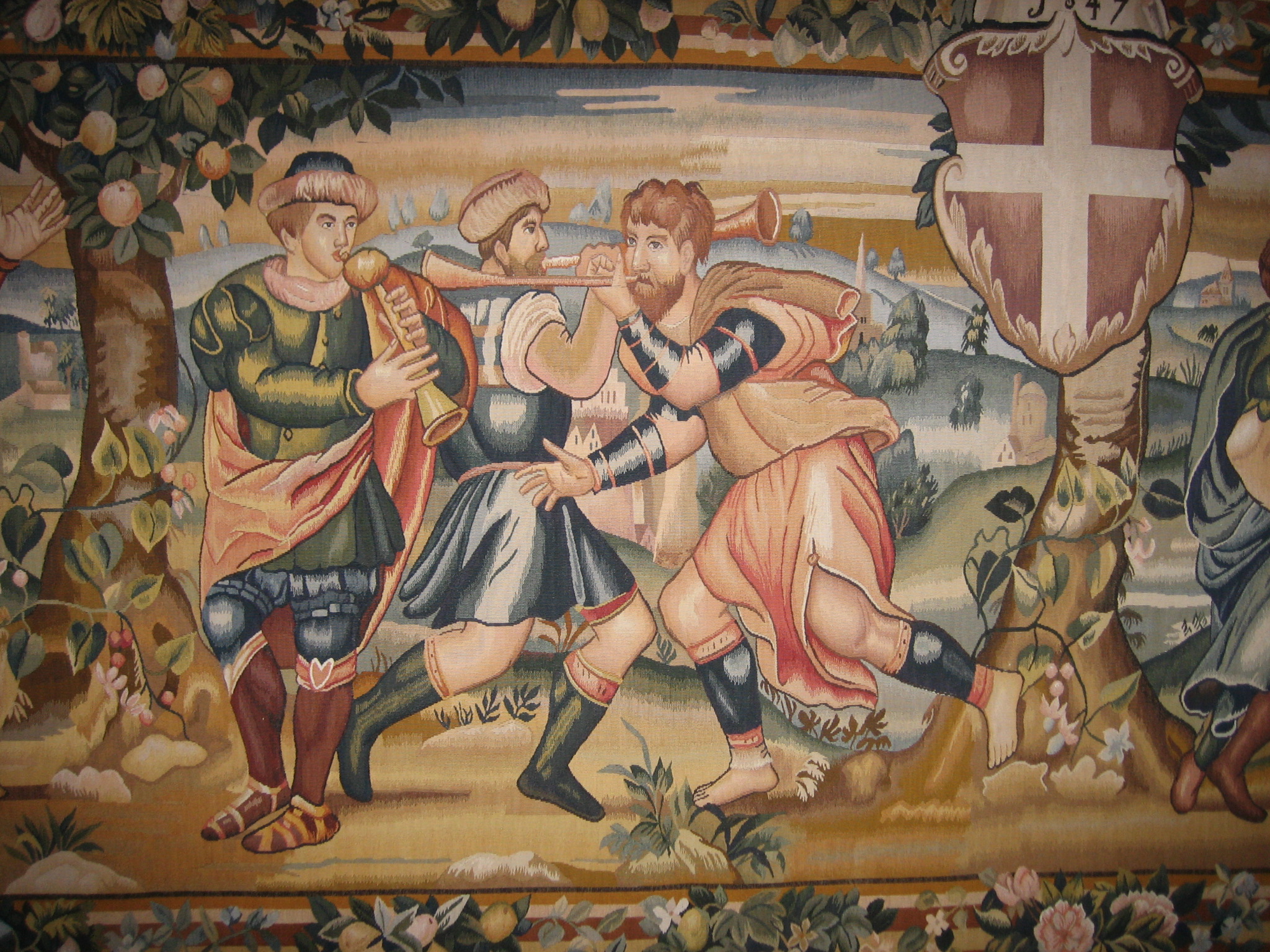
In 1547 the alderman Arent Pakebusch ordered seven tapestries from Enghien in the Spanish Netherlands. The originals, woven with the Tallinn coat of arms and depicting the life of King Solomon, were kept in the Town Hall through almost four centuries of war, occupation, and revolution. They were nearly lost twice. In 1909 a Tallinn city commissioner named Albert Koba proposed selling them to fund a school or hospital; public pressure, including angry articles in the Riga and Saint Petersburg press, killed the plan. During the First World War the tapestries were crated up and sent to Moscow for safekeeping. They could easily have stayed there forever, as did much of the University of Tartu's library, but the Estonian politician Jaan Poska negotiated their return as part of the 1920 Treaty of Tartu that recognized Estonian independence. Today the originals belong to the Tallinn City Museum; the copies hanging in the Town Hall were woven by Hines of Oxford for the building's 600th birthday in 2004.
The Night the Spire Burned
On the evening of 9 March 1944, around 280 Soviet bombers came over Tallinn in two waves. Approximately 8,000 buildings, a third of the city and roughly half its housing, were destroyed by explosive, incendiary, and phosphorus bombs. The first wave started at 7:15 pm and ran until 9:25; the second came at 1 am and continued until half past three. The medieval weighing house on the Town Hall Square was destroyed completely, and the Town Hall spire burst into flames in the first attack, taking Old Thomas with it. In 1952 the burned spire was restored and a new copy of Old Thomas installed. The original 1530 figure now stands in the basement museum, scarred but still recognizably the same little warrior. The 1952 copy was itself replaced in 1996 when Tallinn discovered it had been built badly, water seeping in, the wooden core rotting, the unprotected metal rusting. The 1952 Old Thomas is now displayed at the Tallinn City Museum. The current Old Thomas, gilded on face, sword, and flag, has been on duty since 1996.
What Survives, and Where to Look
The basement holds an armory of medieval firefighting equipment, letters from the 14th to the 16th century to and from the town council, and even revolutionary leaflets from 1905. In 2008 a medieval well was uncovered under the floor. The 1586 alarm clock cast by artillery craftsman Hinrik Hartmann still survives, its rim inscribed in Estonian: Glory to God in the highest. Year 1586 of our Lord. Everyone should keep their own fire and bonfire so as not to cause any harm to the city. The town council met here without interruption from 1248 (when Danish king Erik IV granted Tallinn Lubeck town rights) until 1970. In 2004 the building celebrated its 600th birthday. Together with the rest of Tallinn Old Town, the Town Hall has been a UNESCO World Heritage Site since 1997. Climb the 115 stairs of the tower for a view down on the red roofs and out across the Gulf of Finland, the same view Old Thomas has been keeping watch over for nearly five centuries.
From the Air
Tallinn Town Hall sits at 59.44 N, 24.75 E in the heart of the Old Town, on the southern shore of the Gulf of Finland. The 64-meter tower with its weathervane is visible above the surrounding red roofs. View from 3,000-5,000 feet to take in the medieval Old Town and Toompea hill together. Tallinn Airport (EETN) is 5 km southeast. Best in clear summer weather; winter brings frequent low cloud over the Gulf.