Tallinn
Skype was built behind 14th-century city walls. Wise was too. Tallinn carries an unusual double identity, the kind few European capitals manage: a medieval merchant town preserved almost perfectly, ringed by stone walls and 66 defensive towers when most Hanseatic cities have lost theirs, and at the same time one of the most digitally advanced societies on earth, the place that taught the world how a country can run almost entirely online. The Old Town is UNESCO-listed and so well kept that Hollywood films European medieval scenes here when they cannot afford the real thing. The startup density per capita has consistently topped European tables. The same city does both, and the contrast is the city's most distinctive feature.
Danish Castle, Hanseatic Port
The name probably means Danish-castle, taani-linna in Estonian, after the Danish takeover of 1219. King Valdemar II of Denmark conquered northern Estonia at the Battle of Lyndanisse that year, raising his castle on Toompea hill where a fortified Estonian stronghold had stood since around 1050. The medieval indigenous population of Estonia was one of the last pagan civilizations in Europe to be Christianized, and the conversion was forced at sword-point by the Northern Crusades. For most of the next seven centuries the city was known internationally as Reval, only switching to Tallinn in international use after independence in 1918. The Danish king sold Reval to the Teutonic Order in 1346, by which time it had been a Hanseatic League member for 60 years and was arguably the most significant medieval port in the Gulf of Finland. The strategic position at the crossroads between Western Europe and Novgorod and Muscovy made the city rich. A population of around 8,000 people lived behind walls so well built that the medieval fortifications survive substantially intact today, an outstanding example of German Medieval defensive architecture.
Six Centuries of Foreign Rule
After the Reformation reached Tallinn in 1525, the city converted to Lutheranism. In 1561 it became a dominion of Sweden, then in 1710 fell to Tsarist Russia during the Great Northern War, plague-stricken and exhausted, capitulating along with the rest of Swedish Estonia and Livonia. The Russian Empire kept Tallinn for 208 years, through the abolition of local self-government in 1889 and the industrialization of the 19th century, until 24 February 1918, when the Estonian Declaration of Independence was proclaimed in the city. German occupation followed until November 1918, then 22 years of independence, then in 1940 the first Soviet occupation, in 1941 the Nazi German occupation, and in 1944 the second Soviet occupation. The cycles of conquest left their mark on every neighborhood, every cathedral, every rebuilt block.
The Night of 9 March 1944
Tallinn had endured air raids before, but the Soviet attack of 9 and 10 March 1944 was something else. About 280 Red Army bombers struck in two waves, the first from 7:15 pm to 9:25 pm, the second from 1 am to 3:30 am, dropping incendiary, phosphorus, and explosive bombs across the city. Approximately 8,000 buildings were destroyed, around a third of the capital and roughly half its housing stock. Seven hundred and fifty-seven people were killed, of whom 586 were civilians. Twenty thousand more were left without shelter in the freezing Baltic March. The Town Hall spire burned. The medieval weighing house on the central square was wiped out. That this happened to a city already under Nazi German occupation, bombed by Soviet forces ostensibly fighting the Nazis, captures something of the impossible position Estonia occupied in the war. After the German retreat in September 1944, the Soviets returned and stayed until 20 August 1991.
A Wall, A Spire, A Skyline
Walk the medieval lower town today and you can still trace the old city walls, the round towers like Kiek in de Kok and Fat Margaret marking the corners, the cobbled streets bending around limestone walls. Town Hall Square, the Raekoja plats, is the heart of it, the 14th-century Town Hall on its southern edge, Old Thomas the weathervane atop the spire since 1530. Above all this rises Toompea hill, where the Danish kings built their castle and where today the Estonian parliament meets in the 18th-century Toompea Castle next to the medieval Tall Hermann tower. St. Mary's Cathedral on Toompea is the oldest church on mainland Estonia. The Russian Orthodox Alexander Nevsky Cathedral with its onion domes was built in 1900 as a tsarist statement of Russification, deliberately placed where it could be seen from everywhere in the lower town. The Old Town has been a UNESCO World Heritage Site since 1997.
A Silicon Valley on the Baltic
In its 13 December 2005 edition The New York Times described Estonia as a sort of Silicon Valley on the Baltic Sea, and Tallinn drives that description. Skype was built here. So was Wise (originally TransferWise). The country pioneered e-residency, online voting, and digital signatures. The NATO Cooperative Cyber Defence Centre of Excellence is headquartered in Tallinn, as are eu-LISA, the EU agency for large-scale IT systems, and the IT development arms of multiple multinationals. In 2012 the city had the highest density of startup companies per capita of any European capital. More than half of Estonia's GDP is generated in Tallinn, which holds about a third of the country's 1.4 million people. The 2007 attack of Estonian government and bank websites by Russian hackers became one of the world's first recognized acts of cyber warfare, and the cyber-defense expertise that grew out of that crisis is now headquartered here. The city was European Capital of Culture in 2011 and European Green Capital in 2023.
Cold and Bright
Tallinn sits at 59 degrees north on the southern coast of the Gulf of Finland, with a humid continental climate. February averages around freezing, with mild Baltic winters that occasionally see brief warm spells push temperatures above 5 C. Summers are warm and rainy, daylight stretching past 22:00 in June. The 46-kilometer coast includes three peninsulas, Kopli and Paljassaare and Kakumae, and beaches at Pirita, Stroomi, Kakumae, Harku, and Pikakari. The highest point in the city, in the Hiiu neighborhood of Nomme District, reaches a modest 64 meters above sea level. Toompea hill, despite its prominence, is not connected to the larger limestone cliff that runs through the eastern districts, the cliff that locals call the klint. The Pirita River is the only significant watercourse. Lake Ulemiste, 9.44 square kilometers, supplies the city's drinking water.
From the Air
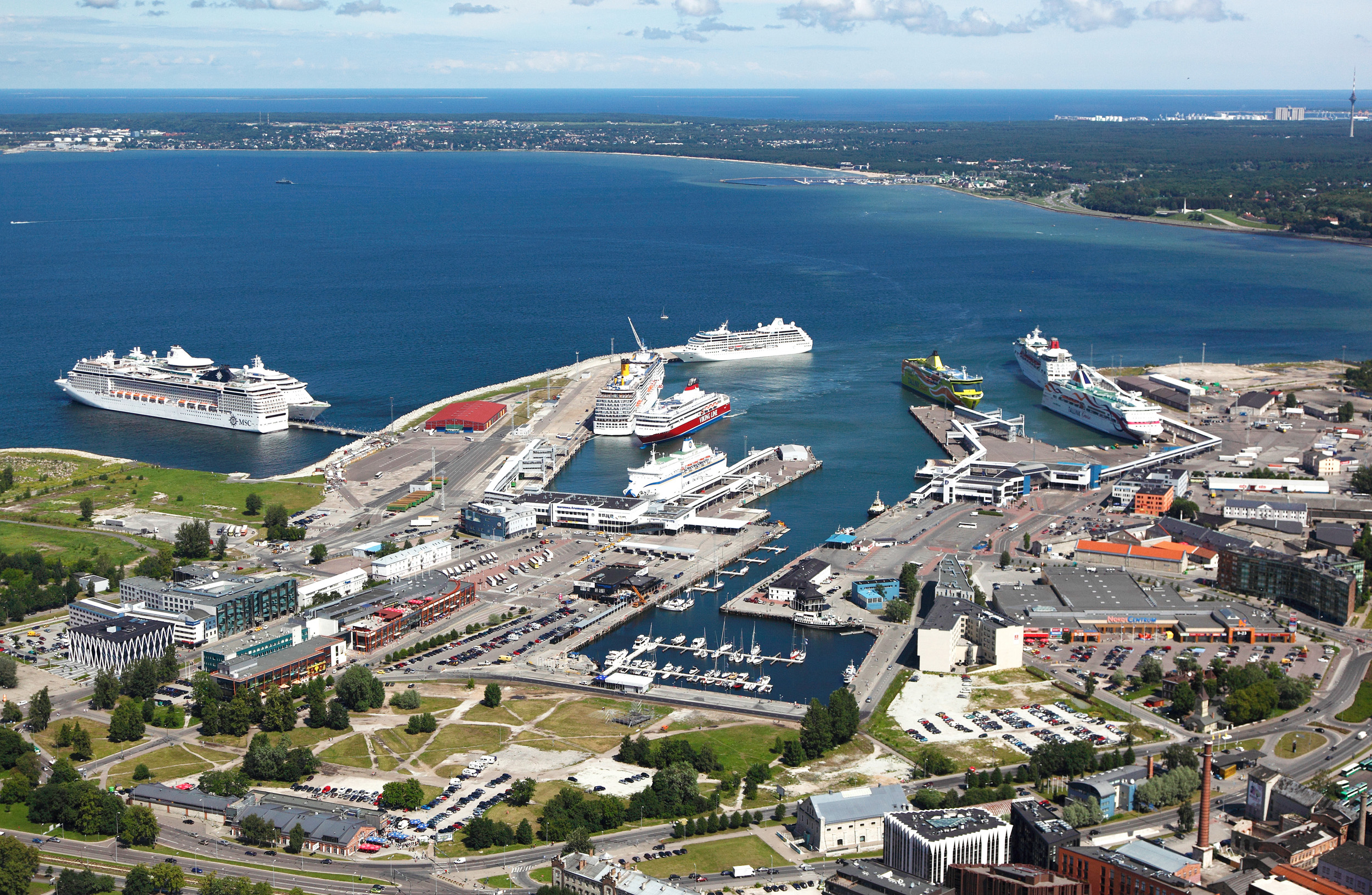
Tallinn lies at 59.44 N, 24.75 E on the southern shore of the Gulf of Finland, 80 km south of Helsinki. View from 5,000-8,000 feet to take in the medieval Old Town, Toompea, the harbor, and the surrounding districts including Pirita and the TV Tower (314 m). Tallinn Airport (EETN) is 5 km southeast of the Old Town. Helsinki Vantaa (EFHK) is 80 km north across the Gulf. Best in clear summer weather; winter brings frequent low cloud and short daylight hours.