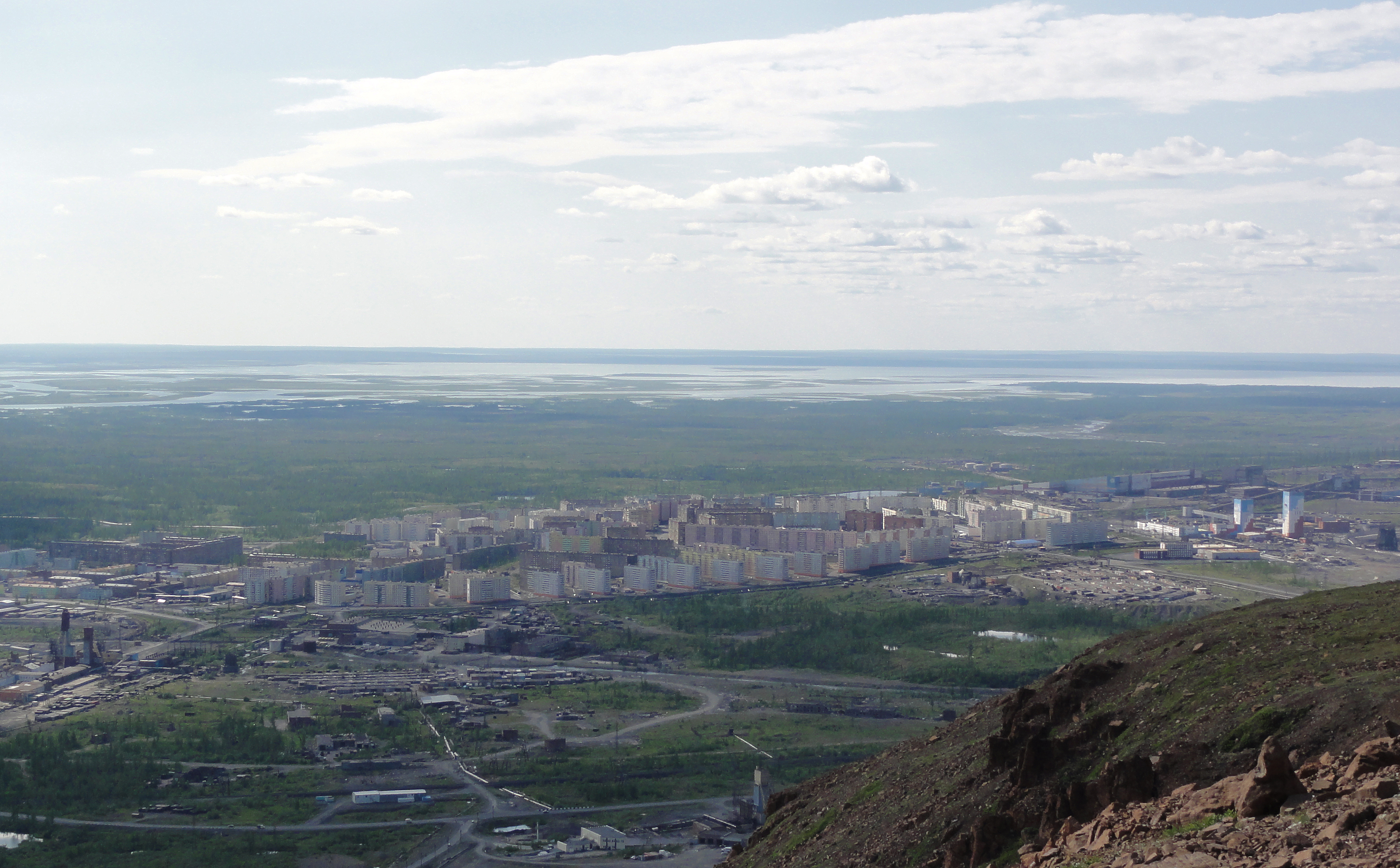
Talnakh
There is a mineral named after this place. Talnakhite, a copper-iron sulfide first identified in the ore bodies beneath this Arctic settlement, carries the name of a town that exists for one reason: the ground beneath it contains some of the largest and highest-grade magmatic sulfide deposits ever found. Talnakh sits 25 kilometers north of Norilsk's center, at the foot of the Putorana Mountains on the Taimyr Peninsula, a district of roughly 48,000 people connected to the larger city by a road that crosses some of the most polluted and desolate terrain in Russia. Before Soviet geologists arrived in the 1950s, this place was tundra. Now it is one of the most productive nickel- and palladium-producing mining districts in the world.
Copper Before History
Long before anyone called this place Talnakh, people were pulling metal from these hills. Archaeological excavations near Lake Pyasino have uncovered evidence of human presence dating to the Bronze Age, including primitive copper-smelting furnaces and balls of native copper. These finds point to a distinct metallurgical tradition, the Pyasina culture, that developed on the Taimyr Peninsula in the late first millennium BCE. Indigenous groups continued extracting native copper from surface deposits and trading it to Russian merchants at the Arctic outpost of Mangazeya during the sixteenth and seventeenth centuries. When Russian explorers like Alexander Middendorff and Khariton Laptev passed through in the seventeenth and eighteenth centuries, they noted the mineral deposits but made no attempt at settlement. The region's isolation and savage climate ensured that serious mining would wait for a regime willing to pay any human cost.
The Discovery That Changed Everything
Between 1919 and 1926, geologist Nikolay Urvantsev confirmed rich polymetallic deposits around Norilsk, but the full scale of the region's wealth remained hidden. In 1935, the Norilsk Mining-Metallurgical Combine was established, its workforce drawn from Norillag, the gulag camp whose prisoners built mines and smelters in conditions that killed thousands. By the late 1950s, prospecting pushed northward from Norilsk, and in 1960, geologists struck the Talnakh ore field. The Oktyabrskoye and Talnakhskoye deposits proved to be extraordinarily rich in nickel, copper, and platinum-group elements. The first major shafts, Mayak and Komsomolsky, were sunk beginning in 1963-1964, staffed partly by Komsomol youth brigades. In March 1971, Talnakh ore reached Norilsk's smelters for the first time, and the settlement's fate was sealed.
Growing Into the Tundra
Talnakh grew with the speed that Soviet central planning could achieve when it chose to. The settlement became an urban district of Norilsk in 1970 and gained city status in 1982. Rows of Khrushchyovka-style concrete apartment blocks appeared along streets named for rivers and explorers, housing the miners and their families. A department store, a sports complex, schools, and a cultural center gave the settlement the infrastructure of a proper Soviet city, even if the view from every window was the same: tundra, smokestacks, and in winter, darkness. In 2005, Talnakh lost its independent city status and was merged into Norilsk as a satellite district. The population has fluctuated with the fortunes of the mining industry, but roughly 48,000 people remain, their lives organized around the shift schedules of the underground mines.
The Cost Beneath the Surface
Decades of mining and smelting have devastated the landscape around Talnakh and Norilsk. Emissions of sulfur dioxide and heavy metals have killed vegetation across vast stretches of tundra and disrupted the herding routes of indigenous reindeer pastoralists. During the 2010s, Nornickel modernized the Talnakh Concentrator, raising its capacity to over 10 million tonnes of ore per year while claiming improvements to environmental controls. The gains were undercut in 2020, when an illegal wastewater discharge from the Talnakh processing plant and a massive diesel spill near Norilsk drew national and international condemnation. The nearby abandoned settlement of Oganer stands as a visible reminder of what happens when extraction moves on: empty buildings slowly returning to the permafrost that supports them.
The Wealth That Remains
Despite the environmental reckoning, Talnakh's ore bodies are far from exhausted. The known mineralized intrusions exceed 1.8 billion tons of resource, and the district continues to produce a significant share of the world's nickel, palladium, and platinum. The Komsomolsky and Mayak shafts still operate, and the concentrator processes ore around the clock. Life in Talnakh follows the rhythms of the mine: shift changes, ore transport, the constant hum of industrial machinery in a landscape where temperatures drop past minus 40 and the polar night swallows weeks at a time. It is a place that exists entirely because of what lies underground, a settlement whose very name has been immortalized in the atomic structure of a mineral, talnakhite, that captures in crystalline form what this corner of the Arctic has always been about.
From the Air
Located at 69.50N, 88.40E, approximately 25 km north of Norilsk's center on the Taimyr Peninsula. Visible from altitude as an urban cluster at the foot of the Putorana Mountains, with mine headframes and industrial facilities prominent. The road connecting Talnakh to Norilsk crosses barren, polluted terrain. Nearest airport is Norilsk Alykel (UOOO), about 50 km to the southwest. No road connections beyond the Norilsk urban area. Severe Arctic weather: polar night from late November to mid-January, temperatures to -50C, frequent blizzards.