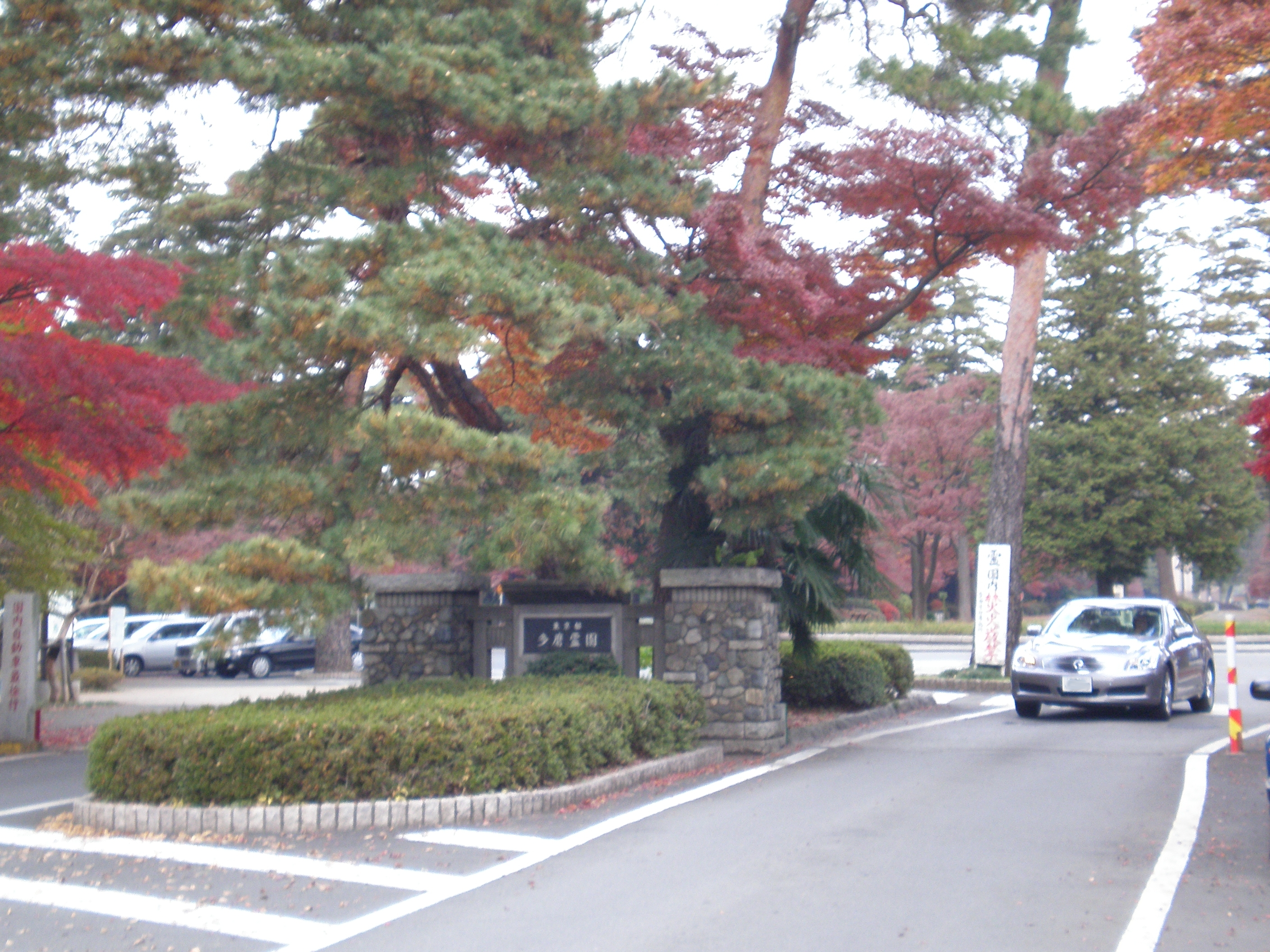
Tama Cemetery: Where Admirals, Spies, and Novelists Share the Silence
During World War II, Kawasaki Ki-61 fighter planes from nearby Chofu Airfield were hidden and repaired among the headstones. Some cemetery buildings still bear the bullet holes from American strafing runs. It is an unlikely detail for a place that began as a park, but Tama Cemetery has always been more than a burial ground. Established in April 1923 in western Tokyo, straddling the cities of Fuchu and Koganei, it is Japan's largest municipal cemetery and one of the biggest green spaces in the Tokyo Metropolis. Under its trees lie some of the most consequential figures in Japanese history -- admirals who planned the Pacific War, writers who shocked a nation, a German spy who chose communism, and the man who built Nissan. The cemetery ran out of new burial plots in 1963. Every grave that opens now is a reburial. The silence here is full.
Built for a City Bursting at the Seams
Around 1900, Tokyo managed death through five public cemeteries -- Aoyama, Yanaka, Zoshigaya, Somei, and Kameido. As the city's population surged in the early twentieth century, those grounds filled. In 1919, city park manager Kiyoshi Inoshita proposed building large park-cemeteries to the north, east, and west of the capital. The western site, in the Tama area, was selected in 1920, chosen partly because multiple rail lines -- the Keio Line, the Seibu Tamagawa Line, the Chuo Main Line, and the old Koshu Kaido road -- already connected it to central Tokyo. Construction began in 1922, and the cemetery opened the following year as Tama Reien. It was redesignated Tama Cemetery in 1935. The planned northern and eastern cemeteries, named Sodaira and Yahashira, were also envisioned but never matched Tama's scale or fame.
A Naval Hero Changes Everything
Tama Cemetery's reputation crystallized in 1934, when Marshal Admiral Togo Heihachiro -- one of Japan's greatest naval heroes and the victor of the Battle of Tsushima in 1905 -- was buried there. Togo's interment drew national attention and transformed Tama from a practical municipal facility into a prestigious final resting place. The military and political elite followed. Today the cemetery holds Prime Ministers Tanaka Giichi, Hayashi Senjuro, Hiranuma Kiichiro, and Okada Keisuke. Marshal Admiral Yamamoto Isoroku, commander-in-chief of the Combined Fleet and architect of the Pearl Harbor attack, rests here. So does General Tomoyuki Yamashita, the 'Tiger of Malaya,' executed for war crimes in 1946. The roster reads like a directory of Imperial Japan's wartime leadership.
The Spy, the Novelist, and the Baseball Pitcher
Not everyone buried at Tama wore a uniform. Richard Sorge, the German-born communist who ran one of the most successful Soviet espionage networks in history from inside Tokyo, was executed in 1944 and eventually buried here. Mishima Yukio, the novelist, poet, playwright, and actor whose ritual suicide by seppuku in 1970 stunned the world, has his grave among these paths. Edogawa Ranpo, the father of Japanese mystery fiction whose pen name was a play on Edgar Allan Poe, is interred at Tama. Yosano Akiko, the pioneering feminist poet, lies here. So does Aikawa Yoshisuke, founder and first president of the Nissan zaibatsu. Nujabes -- the hip-hop producer Jun Seba, beloved worldwide for his atmospheric beats -- was buried at Tama in 2010. The range is staggering: spies beside admirals, poets beside industrialists, voice actors beside prime ministers.
Warplanes in the Graveyard
The wartime chapter adds a surreal layer to Tama's history. As American bombing intensified over the Tokyo region, Kawasaki Ki-61 Hien fighter planes from Chofu Airfield were dispersed into the cemetery for concealment and maintenance. The trees that had been planted to create a park-like atmosphere for mourners now served as camouflage for aircraft. American pilots found the hidden planes anyway, and strafing runs left bullet holes in cemetery structures that remain visible today. After the war, the cemetery returned to its quieter purpose, but the scars stayed. A green lawn section was added in 1962, and in 1993, Mitama Hall, a columbarium for cremated remains, joined the grounds. Every new space at Tama since 1963 has come only through reburial -- the cemetery has been full for over sixty years.
Sixty Years Full and Still Growing
Tama Cemetery today is a different kind of urban green space. It is both memorial ground and public park, a place where families visit ancestral graves and joggers run along the tree-lined paths. Two rail stations bear its name: Tama-reien Station on the Keio Line and Tama Station on the Seibu Tamagawa Line, the latter formerly called Tamabochimae -- 'In front of the Tama Cemetery.' The trees are old and thick now, the paths well worn. Visitors come to pay respects to Yamamoto or Mishima, to photograph Sorge's headstone, or simply to walk through one of the few large green spaces on Tokyo's western edge. It is a place where the full sweep of modern Japanese history lies underfoot -- imperial ambition, wartime sacrifice, literary genius, and the quiet daily work of remembering.
From the Air
Located at 35.68N, 139.51E, straddling Fuchu and Koganei in western Tokyo. From the air, Tama Cemetery appears as a large, distinctive green rectangle amid dense suburban development -- one of the most recognizable open spaces in western Tokyo. Best viewed at 2,000-4,000 feet AGL. Chofu Airport (RJTF) lies approximately 3 nautical miles to the south-southeast. Tokyo Haneda (RJTT) is roughly 15 nautical miles southeast. The Keio Line and Seibu Tamagawa Line rail corridors are visible running nearby.