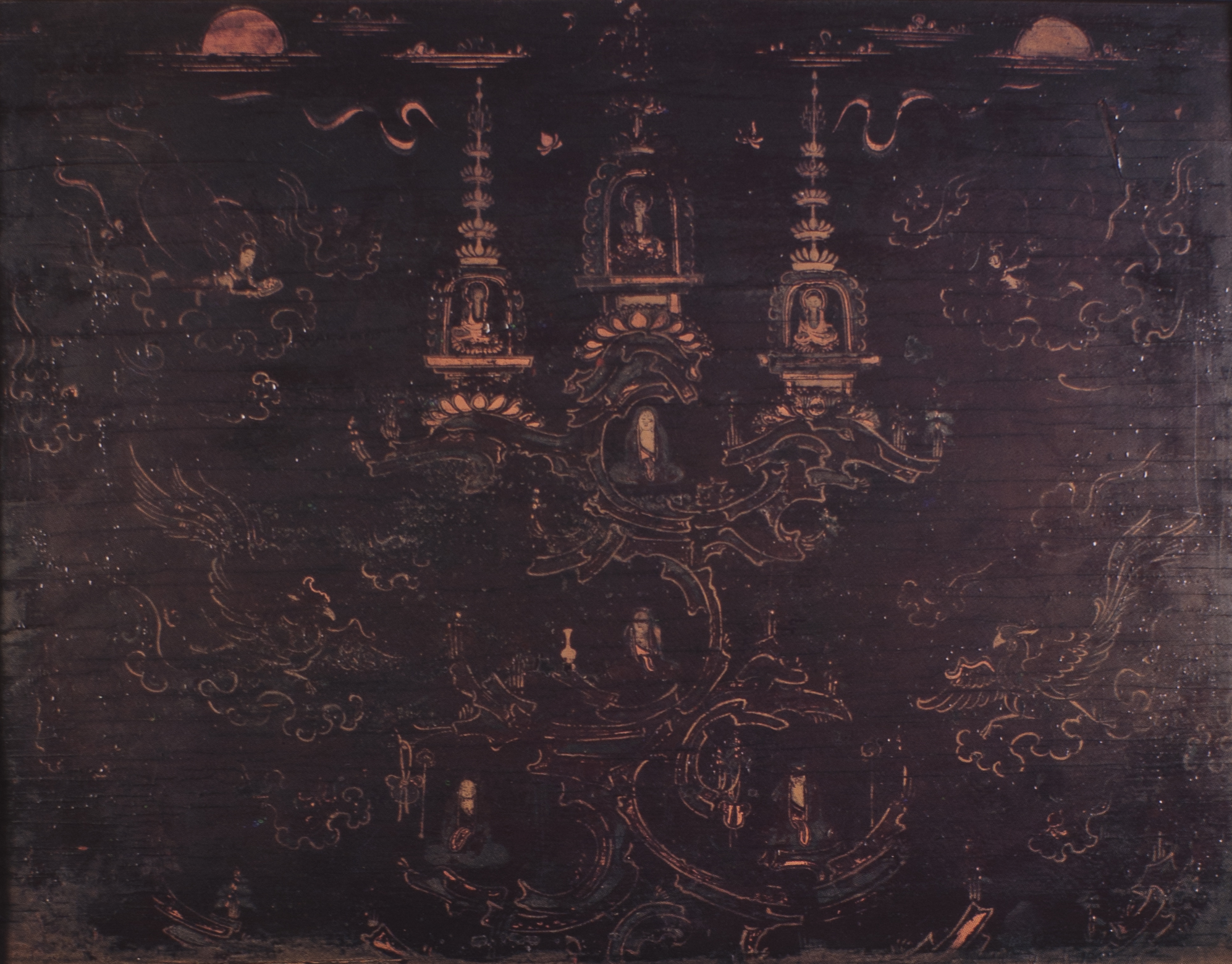
Tamamushi Shrine: Beetle Wings and Buddhist Devotion
Somewhere around the year 650, an artisan pressed thousands of iridescent beetle wings beneath strips of bronze openwork on a miniature shrine no taller than an adult person. The wings came from the tamamushi -- the jewel beetle, Chrysochroa fulgidissima -- and they shimmered green, purple, and gold depending on the angle of light. Nearly fourteen centuries later, those wings have exfoliated away, but the shrine that bears their name still stands inside the Great Treasure Gallery of Horyuji, the oldest wooden temple complex in the world. At just 233 centimeters tall, the Tamamushi Shrine is a small object that carries an enormous weight of history: the earliest surviving example of Japanese lacquer painting, the oldest known depiction of Buddhist narrative art in Japan, and a window into the moment when continental culture and island craftsmanship fused into something entirely new.
A Shrine Fit for an Empress
The Tamamushi Shrine belongs to Horyuji, the temple complex in Nara founded by Prince Shotoku Taishi, the regent and culture hero who championed Buddhism's arrival in Japan. The monk Kenshin, writing in the 1230s, recorded that the shrine originally belonged to Empress Suiko, who died in 628 -- placing its creation in the very first century of Japanese Buddhism. It once sat on the great altar of the kondo, the temple's main worship hall, housing a statue of Kannon and small rows of seated bronze Buddhas. The shrine's structure -- a rectangular dais supporting a plinth topped by a miniature building -- mirrors the architecture of full-scale worship halls of the Asuka period. It is, in essence, a temple inside a temple, built from lacquered Japanese cypress and camphor wood, its roofline curving with the same cloud-shaped brackets found only on the oldest surviving buildings at Horyuji itself.
The Beetle's Shimmer
The tamamushi beetle is native to Japan, a thumb-sized insect whose wing cases refract light into shifting bands of emerald and copper. Artisans layered these wings beneath cut-metal strips across the shrine's surfaces -- a technique called beetlewing decoration that transformed the entire object into a living play of color. Time has stripped nearly all the wings away, but fragments found during conservation confirm what visitors once saw: a shrine that appeared to change color as worshippers moved around it, the metalwork flashing with an unearthly iridescence that must have seemed divine. The color scheme that survives in the painted panels -- red, green, yellow, and white on a black lacquer ground -- suggests a palette that was revolutionary for its era, made possible by the new pigments that arrived in Japan alongside Buddhist teachings.
Stories Painted in Lacquer
The shrine's painted panels are among the oldest pictorial narratives in Japan. On the front doors, two of the Four Guardian Kings stand in armor, clutching slender halberds, their heads ringed with Buddhist haloes. But the most arresting image appears on the left panel of the plinth: the Tiger Jataka, drawn from the Golden Light Sutra. A bodhisattva removes his robes, hangs them on a tree, and casts himself from a cliff to feed a starving tigress and her cubs. The painting depicts this sacrifice in sequential stages -- the figure stripping, falling, and lying among the tigers -- all within a single panel. The style shows influence from Northern Wei China and Sui-dynasty aesthetics, filtered through Korean artistic traditions. These panels represent the meeting point of three civilizations on a surface smaller than a dining table.
Architecture in Miniature
For scholars of Japanese architecture, the Tamamushi Shrine is an irreplaceable record. Its cloud-shaped brackets match those on Horyuji's kondo and pagoda -- buildings that are themselves the oldest wooden structures on Earth. Its shibi roof ornaments, its lipless semicircular tiles, its king-post gable construction all preserve details from an era when almost nothing else survives. The shrine even records architectural features that full-scale buildings have lost: its circular purlins and parallel corner arrangements differ from anything found in later construction. When Shitennoji in Osaka was rebuilt after its destruction in the Pacific War, architects looked to miniature models like this shrine to reconstruct roof styles that had vanished from living buildings. The Tamamushi Shrine is not merely art -- it is a blueprint for understanding how Japan first learned to build.
Surviving the Centuries
The shrine narrowly escaped destruction when the Horyuji kondo caught fire on January 26, 1949 -- a disaster that damaged priceless murals. The shrine had already been removed for the building's restoration, along with other portable treasures. Today it rests in the Great Treasure Gallery, protected by climate-controlled glass, its beetle wings long gone but its painted surfaces still legible after nearly fourteen hundred years. A full reproduction at the Nara National Museum gives visitors a sense of what the original once looked like with its tamamushi decoration intact. The original remains a designated National Treasure of Japan, one of the most important surviving artifacts from the century when Buddhism, continental art, and Japanese craftsmanship first came together on these islands.
From the Air
Located at 34.615°N, 135.735°E within the Horyuji temple complex in Ikaruga, Nara Prefecture. The temple's distinctive pagoda and kondo are visible from low altitude amid flat agricultural land southwest of Nara city. Best viewed from 2,000-3,000 feet AGL. Kansai International Airport (RJBB) lies approximately 30 nautical miles to the southwest, and Osaka Itami Airport (RJOO) is roughly 15 nautical miles to the northwest. The Yamato Plain spreads out below, dotted with ancient temple complexes.