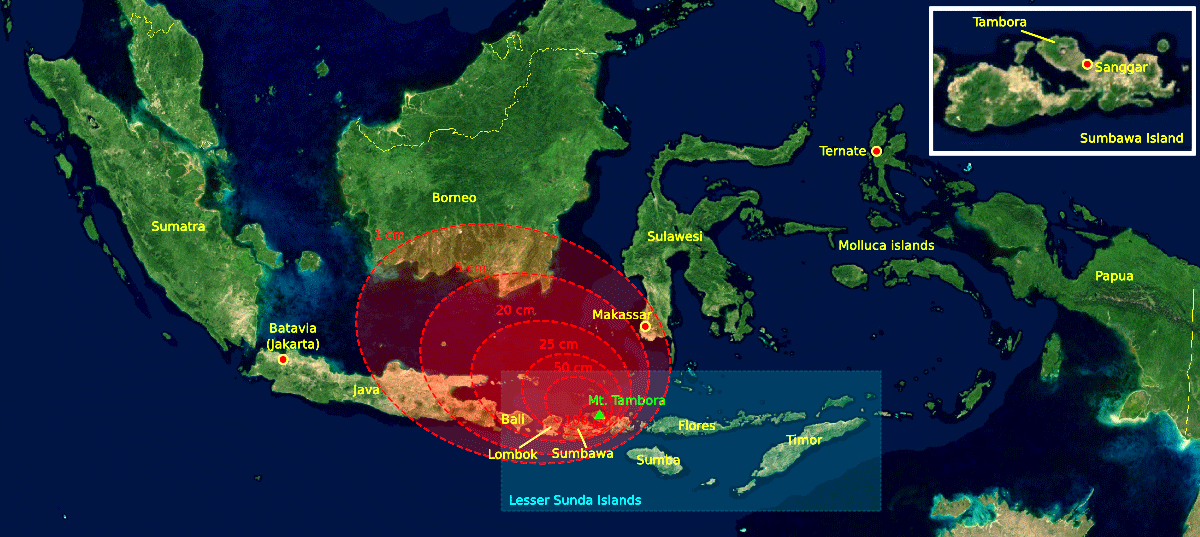
The Pompeii of the East
Nobody remembers what they called themselves. The people of Tambora -- roughly 10,000 of them -- spoke a language that belonged to no known family, traded pottery with Vietnam, and exported honey, horses, and sandalwood across the East Indies. Then, on April 10, 1815, Mount Tambora exploded in the largest volcanic eruption in recorded history. Pyroclastic flows buried their city under meters of superheated ash. The language died. The trade routes vanished. Within a generation, it was as though the kingdom had never existed at all.
A Kingdom in the Crossroads
Sumbawa Island sits in the chain of islands stretching east from Java toward Timor, a position that made it a natural waypoint for maritime trade. The people of Tambora were not poor villagers scraping by on subsistence farming. Bronze bowls, ceramic pots, and glass bottles recovered from the site tell the story of a community embedded in long-distance commerce. Their pottery resembles styles found in Vietnam, suggesting trade connections reaching deep into Indochina. Locally, Sumbawa was known throughout the East Indies for its honey, its horses, its sappan wood -- prized for producing red dye -- and its sandalwood, burned as incense and ground into medicine. Western explorers visited the city shortly before the eruption, one of the last outside contacts with a culture that was about to disappear.
The Last Words
What makes Tambora exceptional among lost civilizations is the completeness of its erasure. The language spoken here was not merely endangered; it was a linguistic isolate, the last survivor of the pre-Austronesian languages that once spread across central Indonesia. When the Austronesian expansion swept through the archipelago thousands of years earlier, most of these older tongues were replaced. Tambora's language held on, an artifact of a deeper past persisting into the modern era. Only a single word list survives, collected before the eruption and published by Stamford Raffles in 1817. Linguists have pored over it for clues: words for sun, moon, and stars share a suffix that hints at cosmic classification; the word for hand connects to Papuan languages spoken on Timor and Alor, hundreds of kilometers to the east. These fragments are all that remain of a way of thinking that once organized an entire society.
Digging Through the Silence
For nearly two centuries, the buried kingdom lay undisturbed beneath the volcanic deposits on Tambora's slopes. In the summer of 2004, volcanologist Haraldur Sigurdsson led a joint team from the University of Rhode Island, the University of North Carolina Wilmington, and the Indonesian Directorate of Volcanology to begin excavations. What they found drew immediate comparisons to Pompeii: homes and inhabitants buried in place, surrounded by the everyday objects of a life interrupted without warning. Bronze artifacts dominated the finds, reinforcing the picture of a prosperous community. The media dubbed it the "Lost Kingdom of Tambora," and Sigurdsson planned to return in 2007 to search for more villages and perhaps a palace. Subsequent expeditions by Indonesia's Bandung Geological Museum in 2006, the National Archaeology Research Institute in 2007, and the Denpasar Archaeology Institute from 2008 to 2011 continued to uncover building remnants, tools, and knives beneath the hardened ash.
The Year Without a Summer
The eruption that buried Tambora's kingdom was no ordinary volcanic event. Mount Tambora ejected an estimated 160 cubic kilometers of material into the atmosphere, lowering global temperatures enough to cause 1816 to be remembered as the "Year Without a Summer." Crops failed across Europe and North America. Frost struck New England in June. Famine spread through parts of Asia. The sulfur dioxide veil turned sunsets vivid red and orange worldwide -- inspiring, some scholars argue, the apocalyptic skies in J.M.W. Turner's paintings. The global catastrophe that followed the eruption is well documented. What happened at the volcano's own doorstep -- the obliteration of a unique culture, its people, its language, its trade networks -- remained invisible until archaeologists began to dig.
What the Ash Preserved
Unlike Pompeii, which became a tourist destination and a household name, Tambora's buried city remains largely unknown outside specialist circles. The excavations have been intermittent, limited by funding and the remoteness of the site on Sumbawa's volcanic slopes. Yet what has been uncovered challenges the assumption that the communities nearest a catastrophe are the least interesting part of the story. Tambora was not a footnote to the eruption. It was a thriving maritime kingdom that spoke the last echo of a language family predating the Austronesian expansion, traded goods across thousands of kilometers of ocean, and vanished so completely that even its name was forgotten. The ash that destroyed the kingdom also preserved it, freezing a moment in 1815 with a fidelity that centuries of weathering would have erased.
From the Air
Located at 8.25°S, 118.00°E on the northern slopes of Mount Tambora, Sumbawa Island, Indonesia. The massive caldera of Tambora -- roughly 6 km in diameter -- is the dominant visual landmark, visible from high altitude as a dark circular depression at the summit. The surrounding landscape shows the volcanic deposits that buried the ancient city. Nearest major airport is Sultan Muhammad Kaharuddin III Airport (WADS) in Sumbawa Besar, approximately 80 nm to the southwest. Bima Airport (WADB) lies roughly 60 nm to the east.