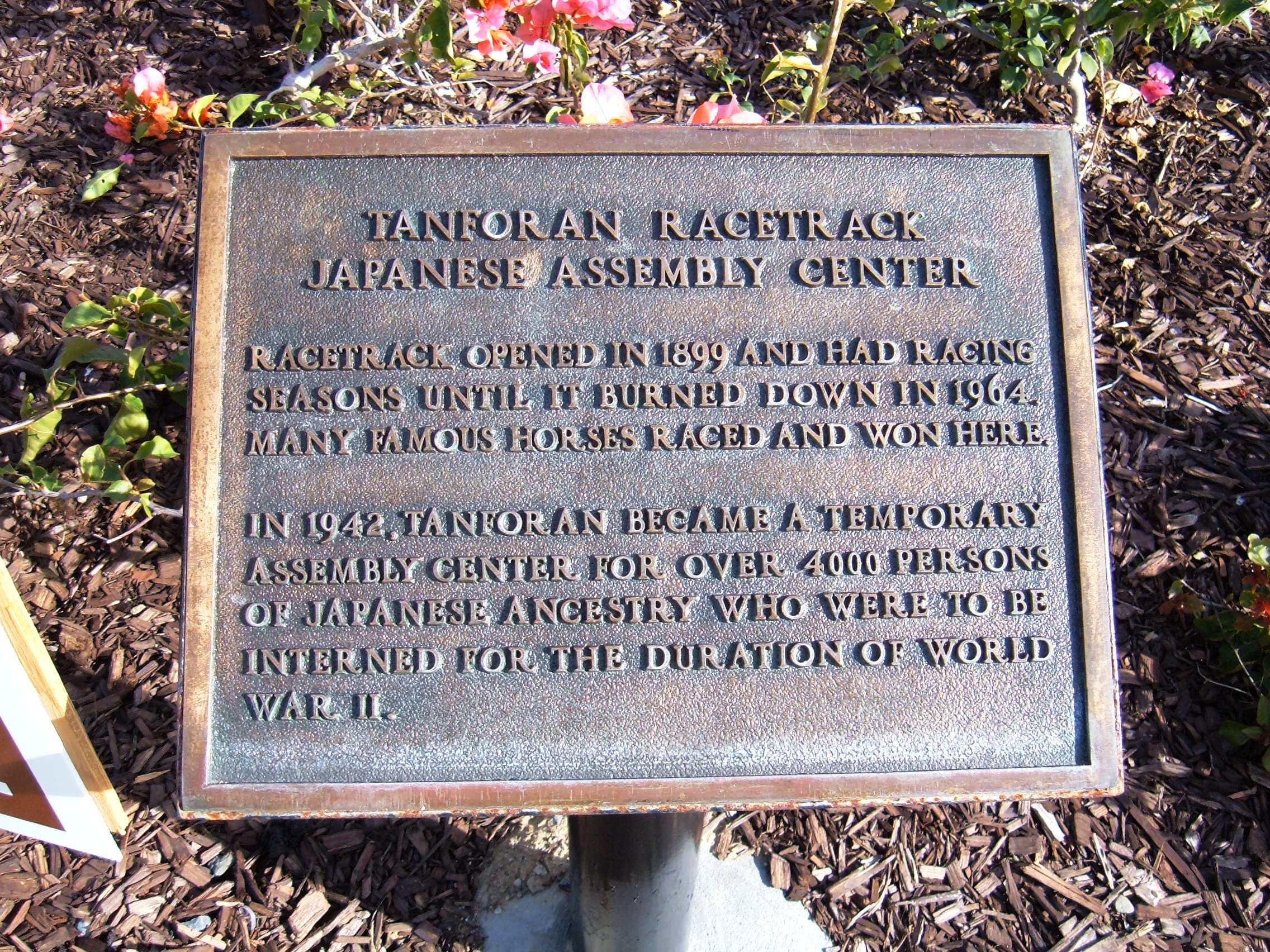
Tanforan Assembly Center
The whitewash did not entirely cover the horse dung on the walls. In late April 1942, families from San Francisco, Alameda, Contra Costa, and San Mateo Counties arrived at the Tanforan Racetrack in San Bruno to find that their new living quarters were converted horse stalls -- hastily cleaned, minimally furnished, and infested with insects. Nearly 8,000 Japanese Americans, the vast majority of them United States citizens born on American soil, were detained here under Executive Order 9066. They were given identification tags to keep families together, the same technique used for livestock. The population of San Bruno in 1940 was 6,519. The internment camp held more people than the town.
Into the Stalls
The Wartime Civil Control Administration acquired Tanforan Racetrack on April 4, 1942, as a temporary assembly center while permanent relocation camps were built further inland. Plans called for up to 10,000 detainees. Because infield barracks were still under construction when the first families arrived, hundreds were housed in the horse stalls that lined the track. The whitewashed surfaces trapped insects and traces of dung. Living space was measured in feet: couples received one allotment, families of eight were crammed into quarters barely larger. Among the approximately 1,600 children detained here, elementary school students turned in writing assignments using terms like "treacherous Japs" -- a hyper-patriotism learned from comic books. One administrative officer, after three months, admitted he understood the detainees less than the day he arrived.
Art, Books, and Endurance
Despite the indignity of their circumstances, detainees at Tanforan built a community. UC Berkeley professor Chiura Obata established an art school that operated twelve hours a day and enrolled 636 students, from elementary school children to adults. His fellow artists George and Hisako Hibi documented the camp in paintings and drawings. Librarian Kyoko Hoshiga, a Mills College graduate, started the camp library with 50 donated books and grew the collection to 4,000 volumes. Taro Katayama edited the camp newspaper, the Totalizer. Three troops of Boy Scouts were organized. The post office, initially a pick-up-only operation, added home delivery on May 4 and within two weeks was handling 6,000 pieces of mail per day. During the six months of detention, there were 64 births and 22 deaths. Three sisters, all doctors, were split across three different camps: Tanforan, Manzanar, and Poston.
The Trains to Topaz
Starting on September 9, 1942, detainees began transferring to the Topaz War Relocation Center in the Utah desert. The first group of 214 departed that day; groups of approximately 500 followed daily until September 22, by which point roughly 4,400 had been moved. The remaining detainees were relocated beginning September 26, again in daily trains of 500. The last train left Tanforan on October 13, carrying 308 detainees. The site was turned over to the Army a few weeks later. For those who endured the transfer, Tanforan had been the first stop in a longer journey of displacement. Topaz, at 4,600 feet in the desert, would prove even harsher -- dust storms, bitter cold, and the realization that temporary detention had become indefinite incarceration.
Shopping Mall, Memorial, Memory
After the war, the site returned to its former use as a racetrack from 1947 to 1963. Then it became a shopping mall -- The Shops at Tanforan -- which operated until 2022. A memorial plaque was installed, later joined by a memorial garden in 2007. In 2016, the Tanforan Assembly Center Memorial became a permanent installation at the adjacent San Bruno BART station, with photographs of detainees displayed on the concourse level. The memorial plaza, dedicated on August 27, 2022, includes a bronze statue by Sandra J. Shaw depicting two Mochida sisters from Hayward, inspired by Dorothea Lange's photograph of the family waiting to board the bus. The children in Lange's photograph wear identification tags. The memorial includes a reconstructed horse stall. This is what it means to remember: not just the facts of what happened, but the physical dimensions of the space in which people endured it.
From the Air
The Tanforan site is at 37.64N, -122.42W in San Bruno, just west of US-101 and adjacent to the San Bruno BART station. The former racetrack footprint is now occupied by commercial development, but the memorial plaza is visible near the BART station entrance. San Francisco International Airport (KSFO) is just 3nm to the southeast. The flat terrain of the former track is evident in the site's layout.