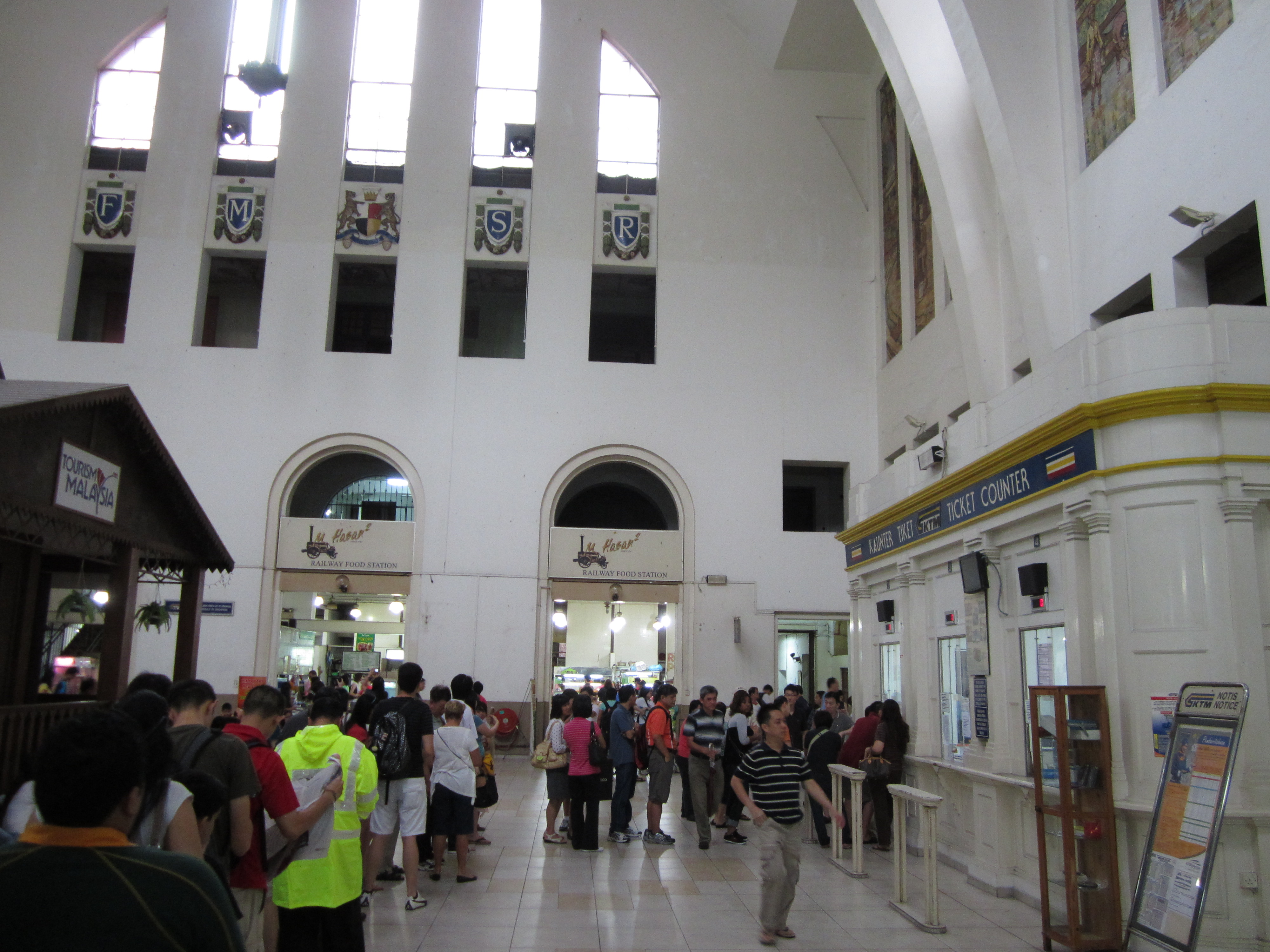
Tanjong Pagar Railway Station
On the last day of June 2011, the Sultan of Johor climbed into the cab of a locomotive at Tanjong Pagar railway station and drove the final train north. Sultan Ibrahim Ismail had trained with KTM specifically for this moment, two drivers flanking him for safety as the engine pulled away from a building his grandfather had helped bring into existence. In 1923, Sultan Ismail had opened the causeway linking Singapore to the Malay peninsula. Eighty-eight years later, his grandson closed the chapter that the causeway began. The Art Deco station at 30 Keppel Road, with its marble reliefs and barrel-vaulted hall, fell silent for the first time since 1932.
Wharves, Rails, and Rubber
The story of Tanjong Pagar begins at the waterfront. In 1859, Captain William Cloughton built the area's first dry dock, and by 1864 the Tanjong Pagar Dock Company was constructing wharves to serve the growing shipping trade. The harbor area became known as New Harbour before being renamed Keppel Harbour in 1900. The demand for rail connections to move tin and rubber from the Malay interior to Singapore's port drove construction of the Singapore-Kranji Railway, completed in 1903. Between 1906 and 1907, the line extended south to Tanjong Pagar and the wharves themselves -- though it was eventually disused after residents complained about the noise. The station that stands today was completed and officially opened on May 2, 1932, by Governor Sir Cecil Clementi. Its architects gave Singapore an arrival point worthy of the colony's ambitions: four white marble reliefs on the exterior depicting Agriculture, Industry, Commerce, and Transport, carved by a sculptor from Florence.
Art Deco at the End of the Line
Step inside the main hall and the station's grandeur becomes unmistakable. A barrel-vaulted ceiling arches overhead. Wall panels depict the economic activities that defined colonial Malaya -- rice planting, rubber tapping, shipping, bullock cart transport, copra growing, tin mining -- rendered in locally manufactured tiles that used rubber in their composition to dampen sound. The two long platforms stretched far enough to accommodate the longest mail trains, sheltered beneath umbrella-shaped reinforced concrete roofs. Upstairs, a 34-room hotel once rivaled Raffles in its reputation. Dennis Lim, whose father ran the hotel for over 60 years beginning in 1932, remembered massive rooms with high ceilings and waiters dressed in white with silver buttons. Dignitaries and Malaysian royalty frequented the upper floors during the hotel's peak. But by the 1970s, roof leaks and plumbing failures -- the result of neglected maintenance by the Malayan Railway authorities -- had eroded both the building and its clientele.
Sovereignty on the Platform
When Singapore separated from Malaysia in 1965, the railway land beneath and around the station remained under Malaysian ownership -- a strip of foreign sovereignty running through the heart of an independent nation. For decades, the arrangement created one of the world's most peculiar immigration rituals. Malaysian officers operated inside Singapore at Tanjong Pagar, stamping passports for a border crossing that technically happened 30 kilometers to the north. In 1990, the two governments signed the Points of Agreement: Malaysia would relocate the station, freeing the land for joint development split 60-40 in Malaysia's favor. But the agreement unraveled over interpretation. Singapore said it took immediate effect; Malaysia insisted it would activate only when Malaysia chose to move. The impasse dragged through the 1990s and 2000s, producing immigration procedures so convoluted that a Singaporean woman was jailed in 2007 for not having the right stamps in her passport.
The Canteen, the Bookshop, and the Last Nasi Biryani
The station's soul lived in its margins. Habib Railway Book Store and Money Changer occupied the main hall from 1936, where Mohd Seeni worked before taking ownership in 1958 -- the longest-serving member of the station's daily life. In the canteen, established in 1984 by the Hasan brothers, Mohammed Ali Latif built a nasi biryani business from scratch, growing from 20 servings a day to 300. On the station's final day of operations, his food sold out in two hours. More than 700 customers came to eat one last plate and say goodbye. These were the textures of a place that functioned not merely as transit infrastructure but as a community -- a crossroads where the bureaucratic absurdity of disputed sovereignty coexisted with the smell of spiced rice and the rustle of paperback novels.
A Monument in Waiting
The station was gazetted as a national monument on April 9, 2011, barely three months before its closure. In 2015, the Urban Redevelopment Authority proposed transforming it into a multi-functional community space anchoring one end of the Rail Corridor, a linear park stretching from Kranji to Tanjong Pagar that would be nearly ten times longer than New York's High Line. The winning design includes a public park called Station Green and an integrated entrance to the future Cantonment MRT station. The redevelopment will unfold over 20 years. For now, the Art Deco shell sits quietly at 30 Keppel Road, its marble allegories of Commerce and Transport watching over a building that no longer serves either purpose -- but that contains, in its walls and platforms and empty hotel rooms, the compressed history of two nations learning to be neighbors.
From the Air
Tanjong Pagar railway station is located at approximately 1.273N, 103.838E in Singapore's Tanjong Pagar district, near the waterfront south of the central business district. The Art Deco building is visible from lower altitudes along the southern Singapore coastline. Nearest major airport is Singapore Changi Airport (WSSS), 17 km east. Seletar Airport (WSSL) lies 13 km north. The Johor-Singapore Causeway, integral to the station's history, is visible to the north connecting Singapore to Johor Bahru.