Tanna Tunnel
Sixty-seven workers died building a hole through a volcano. The Tanna Tunnel, bored through the Hakone mountains between Atami and Numazu, was supposed to be a straightforward piece of railway engineering when construction began in 1918. Instead, it became a 16-year ordeal of collapses, earthquakes, scalding hot spring water, and unstable rock that nearly defeated Japan's best engineers. When the tunnel finally opened on December 1, 1934, it eliminated a tortuous mountain detour on the Tokaido Main Line and helped stitch together the rail corridor between Tokyo and Osaka. Nearly a century later, trains still rumble through it every day, most passengers unaware that the darkness around them was carved at an extraordinary human cost.
The Gotemba Bottleneck
When Japan's railway planners first routed the Tokaido Main Line connecting Tokyo with Osaka, the Hakone mountains presented an impassable wall. The only option was a long detour north to Gotemba, looping around the volcanic range before descending south to Numazu. This route, now known as the Gotemba Line, followed the same path that the Tomei Expressway still traces today. But what worked for a young railway system quickly became a bottleneck as Japan industrialized. The Gotemba loop added distance and travel time to the country's most important rail artery, the trunk line linking the capital to the commercial centers of Nagoya, Kyoto, and Osaka. A direct tunnel through the mountains would eliminate the detour entirely, shaving critical hours from the journey.
Into the Mountain
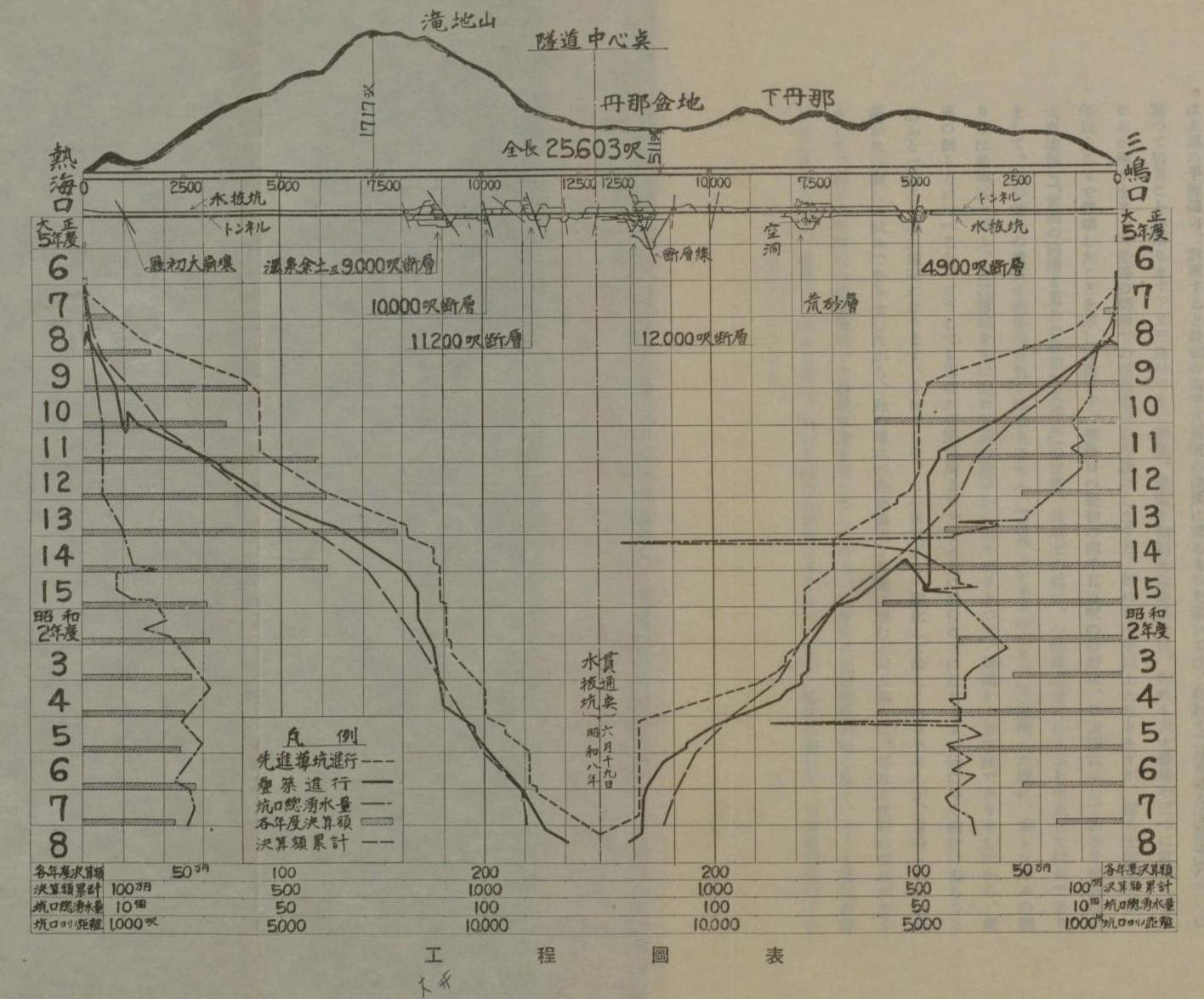
In 1918, the Japanese Railroad Ministry contracted the Kajima Corporation to punch 7,804 meters through the Hakone range. The project was promoted as a public works initiative to boost Japan's economy during the post-World War I recession. No one anticipated what the mountain had in store. The Hakone range is an active volcanic zone, riddled with geological faults and prone to earthquakes. Workers encountered soft, unstable rock formations, massive water seepage, and vents of scalding hot spring water that turned the tunnel into a sweltering, dangerous gauntlet. On April 1, 1920, disaster struck from the Atami side: a massive section of the tunnel collapsed, trapping 42 workers underground. Rescue crews dug frantically for a week, pulling 17 survivors from the rubble. Twenty-five men were not so fortunate.
The Earth Fights Back
The 1920 collapse was only the beginning. In 1923, the Great Kanto Earthquake, one of the most devastating seismic events in Japanese history, damaged the tunnel workings. Remarkably, no workers died in the quake itself, but the setback pushed the timeline further into the future. Then, on February 26, 1930, another earthquake triggered a second major collapse, killing five more workers. By the time construction ended, 67 men had lost their lives building the tunnel. The project had taken far longer and cost far more than anyone had projected, a testament to the raw power of the volcanic geology that the engineers had underestimated. The harrowing story of the construction became the subject of a stage play by Hideji Hojo in 1942, cementing the Tanna Tunnel's place in the national consciousness as a monument to both engineering ambition and human sacrifice.
Breakthrough and Legacy
The two ends of the tunnel met on June 19, 1933, after 15 years of labor. The Tanna Tunnel opened to rail traffic on December 1, 1934, and at the time of its completion it was Japan's second-longest tunnel, surpassed only by the Shimizu Tunnel. The Gotemba detour was finally bypassed, and the Tokaido Main Line gained the direct route its planners had always envisioned. But the story did not end there. When Japan built the Tokaido Shinkansen, the world's first high-speed rail line, a parallel bore was required. The Shin-Tanna Tunnel, completed in 1963, runs alongside its older sibling at 7,950 meters. Today, both tunnels remain in active service: the original carries conventional Tokaido Main Line trains, while the Shin-Tanna carries bullet trains at speeds that would have been unimaginable to the workers who clawed through volcanic rock with the tools of 1918.
From the Air
Located at 35.104N, 139.017E, the tunnel passes beneath the Hakone mountains between Atami and Numazu in Shizuoka Prefecture. The tunnel itself is invisible from the air, but the route can be traced by the railway line disappearing into the mountainside on both the Atami (east) and Numazu (west) portals. Look for the coastal resort town of Atami on Sagami Bay and follow the rail corridor inland. The parallel Shin-Tanna Tunnel for the Shinkansen runs nearby. Best viewed at 3,000-5,000 feet AGL to appreciate the mountain terrain the tunnel bypasses. Nearest airport: Mt. Fuji Shizuoka Airport (RJNS), approximately 55 km west. Tokyo's Haneda Airport (RJTT) lies about 85 km northeast.