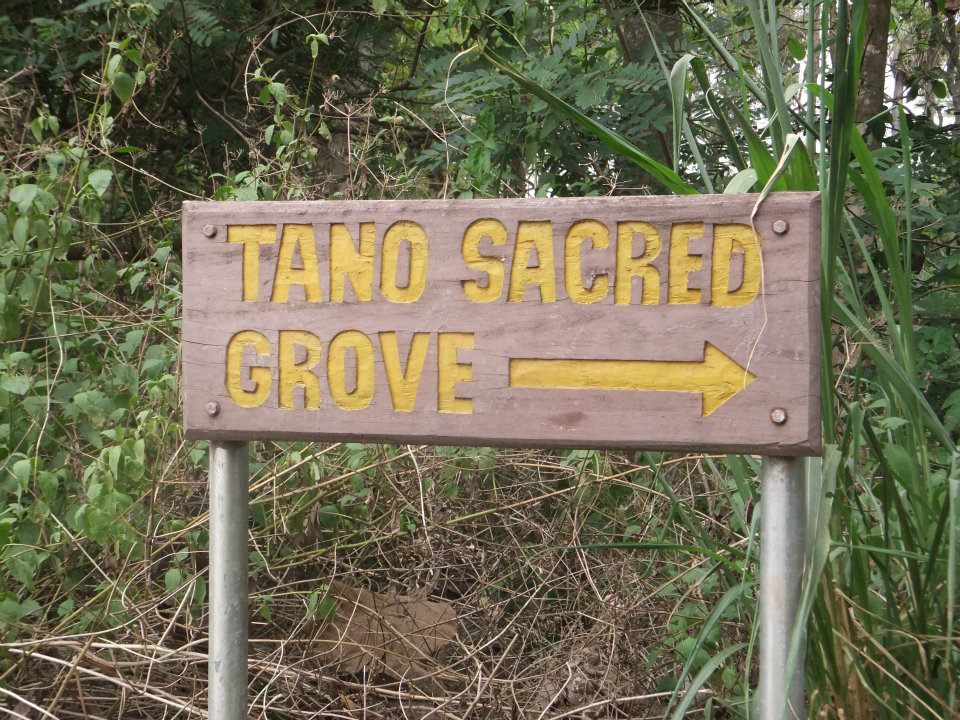
Tanoboase Sacred Grove and Shrine
The rules are old and absolute: do not hunt here, do not farm here. The deity Taakora gave these instructions to Afya Ankomah in an age that only oral tradition remembers, and the Bono people of central Ghana have obeyed ever since. Near the town of Tanoboase in Ghana's Bono East Region, a dense grove of ancient trees surrounds a formation of rock caves and shrines that the Bono consider their origin place -- the cradle from which their people emerged into the world. The forest has survived because the rules have survived. Where everything else in the landscape has been cleared, burned, or farmed, this grove remains.
The God at the River's Source
The word Tano refers to several deities in Akan spiritual tradition, and it shares its name with the Tano River, one of the major waterways of southern Ghana. Taakora, regarded as the highest of the Akan gods on earth, is believed to dwell at the river's source within the grove. This connection between deity, water, and forest is not metaphorical to the Bono -- it is geographic fact woven into spiritual practice. The Tano River rises near this grove, and the forest's root systems feed the springs that feed the river. By prohibiting farming and hunting in the grove, the Bono effectively created a watershed protection system centuries before that term existed. The sacred and the practical were never separate here. Protecting the gods' home meant protecting the water supply.
Shelter in Stone
Inside the grove, a rock formation rises from the forest floor, and within it lies the shrine. The rock contains five distinct compartments: a main entrance, a durbar ground where gatherings are held, a hideout, a watchtower, and a stairway carved or worn into the stone. Inside the shrine rests the original brass pan, a sacred object central to Bono ceremonial life. These caves were not merely spiritual spaces. During the slave trade and inter-tribal wars that convulsed West Africa, the rock formation served as a physical refuge -- a hideout where kings and their people could shelter from enemies who might burn a village but could not easily penetrate a stone labyrinth inside a forbidden forest. The sacred grove's spiritual prohibition against entry became a military advantage: attackers who feared the gods would not pursue their quarry into Taakora's domain.
Conservation by Belief
What Western science calls biodiversity conservation, the Bono have practiced through religious observance for centuries. The grove is an oasis of intact forest in a region where agriculture has transformed most of the landscape. Different species of trees thrive here alongside animals and fish -- particularly catfish in the streams connected to the Tano River -- that have vanished from surrounding areas. Mike Anane, a Ghanaian environmental writer, has noted that scholars and NGOs are increasingly recognizing how traditional religious beliefs serve as effective knowledge systems for addressing environmental challenges. The old top-down models of development, he argues, cannot work alone in the face of ecological crisis. At Tanoboase, the evidence is visible: a patch of ancient forest persists not because a government decree protects it, but because people believe a god lives there and have believed it long enough for the forest to outlast everything around it.
From Shrine to Eco-Tourism Site
In 1996, the grove became a Community Based Ecotourism Project, an attempt to channel the site's cultural significance into economic benefit for the surrounding village. Five years later, in 2001, the Ghana Association for the Conservation of Nature selected Tanoboase as an eco-tourism destination. Visitors can now enter the grove with local guides, climb through the rock shrine's compartments, and hear the oral traditions that have governed this place for generations. The site is recognized as part of Ghana's material cultural heritage. But the transition from sacred space to tourist attraction carries its own tensions. The grove's survival depended on prohibition -- on the belief that this forest was too sacred to touch. Opening it to outsiders, even respectfully, tests whether a place can remain holy when it is also a destination. So far, the Tanoboase people have managed the balance, welcoming visitors while maintaining the rules that kept the grove alive.
From the Air
Located at 7.75N, 1.05W, near Techiman in Ghana's Brong Ahafo (now Bono East) Region. The sacred grove appears as a dense patch of dark-green forest surrounded by lighter agricultural land, making it visible as a distinct ecological island from lower altitudes. The nearby town of Tanoboase and the larger market city of Techiman provide orientation. Nearest airport is Sunyani (DGLE), approximately 70 km to the southwest. The Tano River originates near this area and flows south through the region.