Tanzan Shrine: Where a Ball Game Changed Japan
The meeting that changed the course of Japanese history began with a kicked ball. Sometime around 644, during a game of kemari at the foot of these mountains, a young prince named Naka no Oe lost his shoe. The man who picked it up was Fujiwara no Kamatari, a courtier who would become his closest political ally. Together, they plotted the Taika Reform that overthrew the powerful Soga clan and centralized imperial power. When Kamatari died in 669, his eldest son carried his father's remains to a peak called Tonomine on the southern side of Mount Goharetsu and built a thirteen-story pagoda over the grave. That pagoda still rises through the maple canopy of Tanzan Shrine -- the only thirteen-story wooden pagoda in the world -- a monument to an alliance sealed over a game of kickball in ancient Nara.
A Grave Atop the Mountain
The shrine traces its origin to the Asuka period, when Kamatari's eldest son, the monk Jo'e, established a Tendai temple called Tonomine-ji on the mountaintop. Jo'e moved his father's remains here and erected the original thirteen-story pagoda as a funerary monument. The location was deliberate: Tonomine sits on the southern side of Mount Goharetsu in what is now Sakurai, Nara Prefecture, just five kilometers from the Ishibutai Kofun, the massive stone burial chamber of the Soga clan that Kamatari had helped overthrow. The grave of the man who destroyed the Soga looks down from above on the grave of the family he defeated. During the Heian period, as the Fujiwara clan rose to become the most powerful family in Japan, the temple prospered alongside them. Emperors Daigo and Go-Hanazono bestowed the site with special honorifics, and the Tokugawa bakufu provided significant financial support during the Edo period.
The Only Pagoda of Its Kind
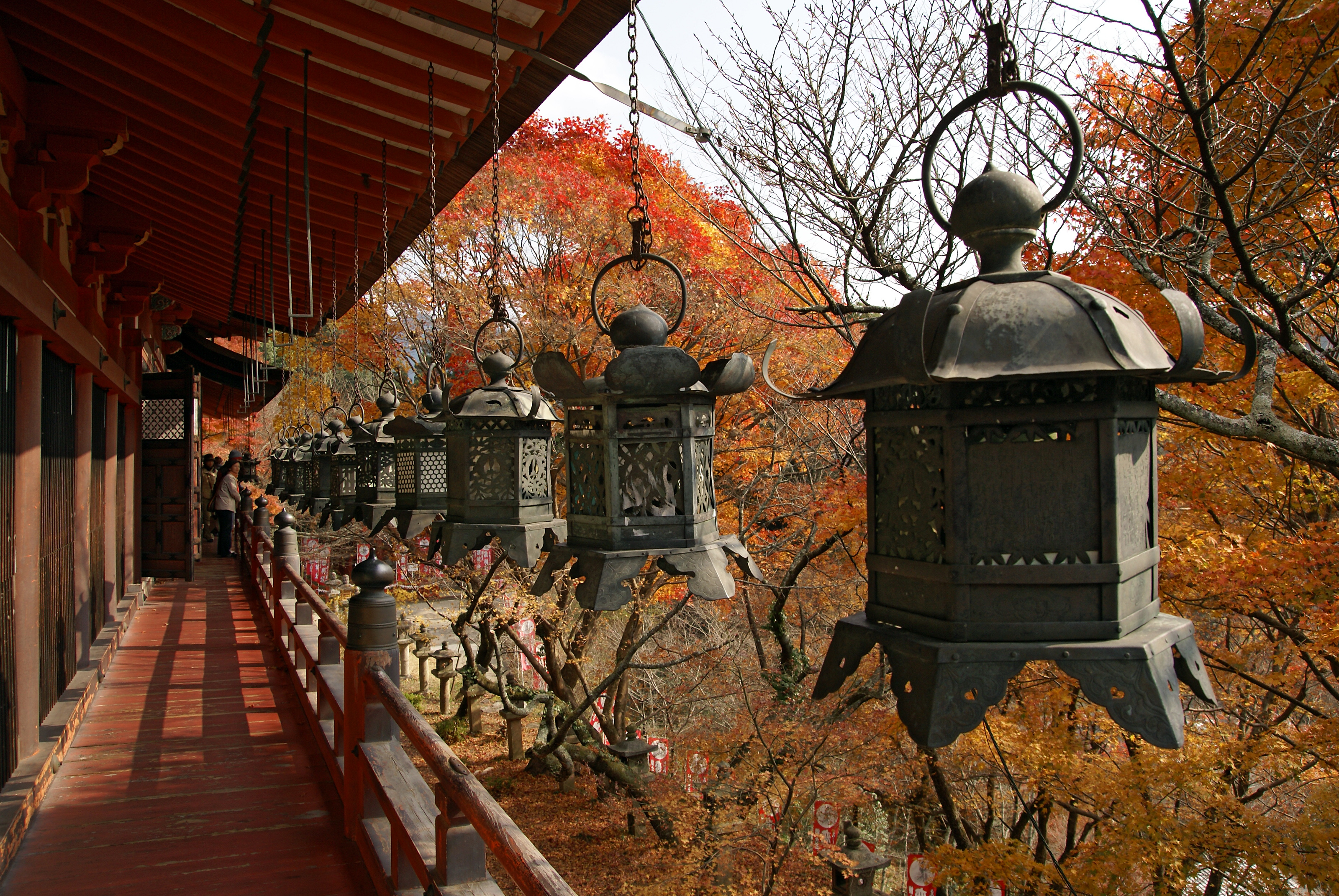
The present thirteen-story wooden pagoda was built in 1532, a reconstruction of Jo'e's original Asuka-period structure. It is designated an Important Cultural Property of Japan, and it stands alone in the world -- no other thirteen-story wooden pagoda exists anywhere. The pagoda rises through layers of curving eaves, each tier slightly smaller than the one below, creating the cascading silhouette that defines Japanese pagoda architecture. The main hall, or honden, is built in the Kasuga-zukuri style and dedicated to the spirit of Fujiwara no Kamatari. Together, these structures sit among dense groves of maple trees that transform the mountain into a sea of crimson and gold each autumn, making Tanzan Shrine one of the most celebrated autumn foliage destinations in all of Nara Prefecture.
Two Faiths, One Ground
For centuries, Tanzan Shrine embodied shinbutsu-shugo, the Japanese system of religious syncretism that blended Buddhism and Shinto worship on the same ground. The Tanzan Shrine and its parent temple, Tonomine-ji, coexisted on the site, with two subtemples -- Myoraku-ji and another -- operating within the precincts. Buddhism provided the theology; Shinto provided the connection to the land and its spirits. This arrangement persisted until the Meiji Restoration of 1868, when the new government launched the shinbutsu bunri movement to separate Buddhism from Shinto. Tanzan Shrine was designated solely as a Shinto shrine, its Buddhist structures rededicated for Shinto worship. In 1874, it received the status of bekkaku kanpeisha, an Imperial shrine of special distinction. That status was abolished after World War II, but the shrine retains its Shinto identity, dedicated to the kami of Fujiwara no Kamatari.
Kicking the Deerskin Ball
Every year on April 29 and the second Sunday in November, Tanzan Shrine hosts the Kemari Matsuri -- a kickball festival that reenacts the ancient game that brought Kamatari and Prince Naka no Oe together. Participants dress in the flowing robes and tall hats of the Asuka-period court, arrange themselves in a circle on the shrine grounds, and kick a ball made of deerskin back and forth without letting it touch the ground. Kemari is not competitive; the goal is elegance and cooperation, keeping the ball aloft through collective grace. The festival draws visitors from across Japan who come to watch this living echo of a thirteen-hundred-year-old ball game -- a game whose most consequential match ended not with a score, but with a political revolution that shaped the nation.
From the Air
Located at 34.466°N, 135.862°E on a forested mountainside in Sakurai, Nara Prefecture. The shrine sits on Tonomine peak on the southern side of Mount Goharetsu, surrounded by dense forest. The pagoda may be visible through canopy gaps from low altitude. Best viewed from 2,000-3,000 feet AGL. Kansai International Airport (RJBB) lies approximately 35 nautical miles to the southwest, and Osaka Itami Airport (RJOO) is roughly 20 nautical miles to the northwest. The Ishibutai Kofun, a large stone burial mound, sits about 5 km to the southwest.