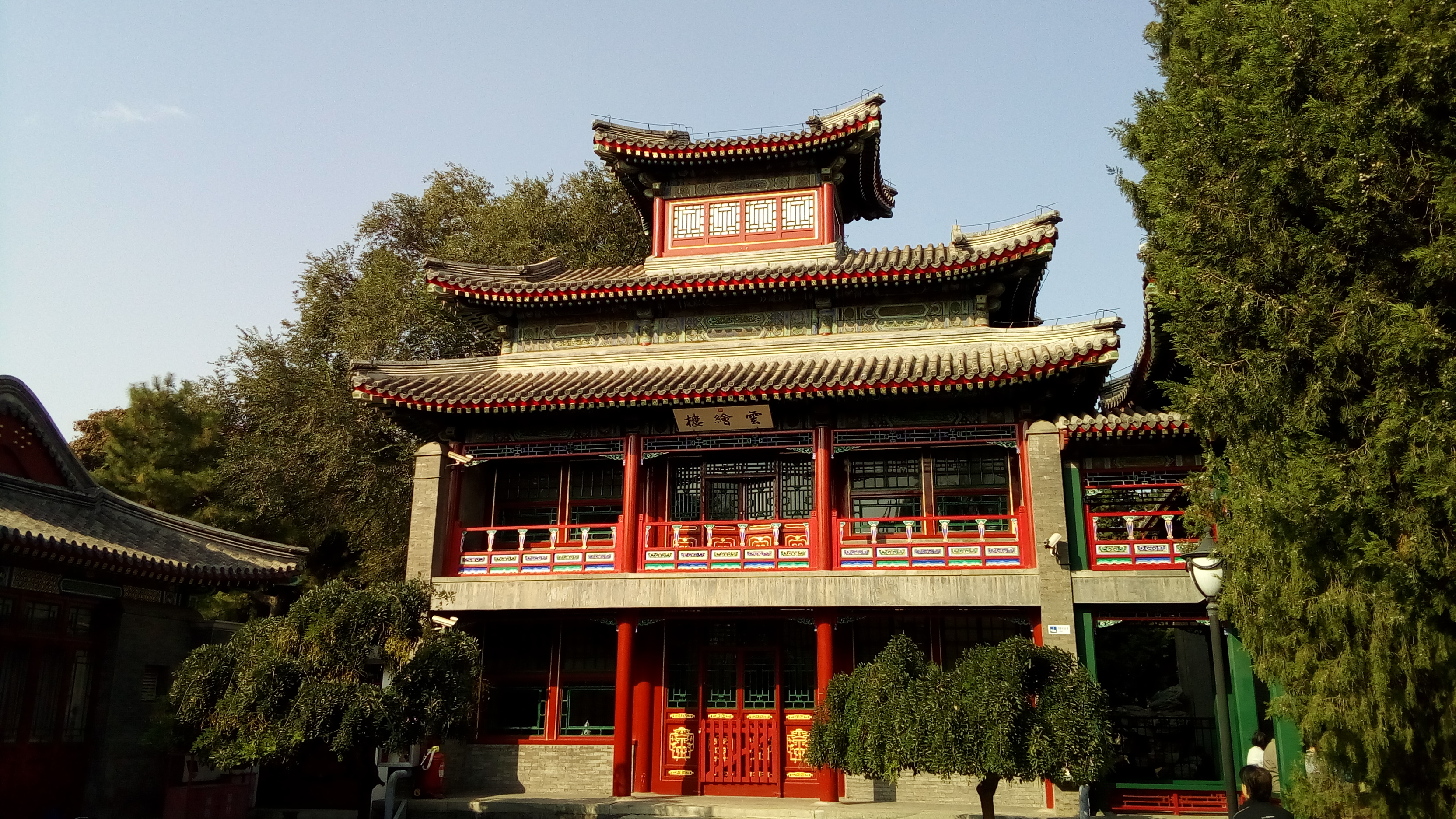
Taoranting Park
'Wait till the chrysanthemums are yellow and home-made wine is ripe -- I'll drink with you and be carefree.' The Tang dynasty poet Bai Juyi wrote those lines over a thousand years ago, and they gave this park its name. Taoranting -- the Pavilion of Carefree Delight -- sits in southern Beijing's Xicheng District, a 59-acre refuge that has drawn scholars, lovers, and ordinary citizens since the Qing dynasty, when most of the city's gardens were reserved exclusively for the imperial family.
A Pavilion Built for the Common Scholar
The Taoran Pavilion was built in 1695, during the 34th year of the Kangxi Emperor's reign. Its chief engineer, Jiang Zao, supervised the construction while also overseeing the nearby kiln workshop. In an era when Beijing's finest green spaces were locked behind palace walls, this park became one of the few places where literati -- the scholar-bureaucrats who formed China's intellectual class -- could gather, drink, and compose poetry without imperial invitation. The pavilion's name deliberately evokes Bai Juyi's vision of egalitarian pleasure: wine shared between friends, chrysanthemums blooming, the burdens of court life left at the gate.
Love, Revolution, and Pilgrimage
Within the park lies the tomb of Gao Junyu and Shi Pingmei, a couple whose love story has taken on the weight of legend. Gao, a revolutionary and early Communist Party member, and Shi, one of China's pioneering female writers, met in the 1920s. After Gao's death in 1925, Shi was consumed by grief and died just three years later at the age of 26. Their story was retold in a book and later a film, transforming their graves into a pilgrimage site for young couples who leave flowers and notes. Nearby rests the tomb of Sai Jinhua, a courtesan and political figure whose own extraordinary life spanned the fall of the Qing dynasty.
Layers Beneath the Lake
The park's 17 acres of water are dotted with pavilions that line the banks, their reflections fracturing on the lake's surface when boats pass. But the grounds hold deeper history than the 1952 date of the park's modern construction might suggest. An old temple built during the Yuan dynasty (1276-1368) stands within the park boundaries, predating the Taoran Pavilion by more than three centuries. Walking from the Yuan-era temple to the Qing pavilion to the Communist-era tombs, a visitor crosses seven hundred years of Chinese history in the space of a morning stroll.
Everyday Poetry
Today, Taoranting Park is popular with residents and visitors for walking and boating. Located just north of Beijing South railway station, it serves as a green buffer between the city's transit infrastructure and its older residential neighborhoods. Elderly couples practice tai chi near the water. Kite-flyers claim the open lawns. The literary associations remain: the park's name is still a quiet declaration that pleasure and contemplation are not the exclusive province of emperors. Bai Juyi's invitation -- to drink, to be carefree, to wait for the chrysanthemums -- is still open to anyone who walks through the gate.
From the Air
Located at 39.87N, 116.38E in Xicheng District, southern Beijing, just north of Beijing South railway station. Nearest major airports are Beijing Daxing International (ZBAD) and Beijing Capital International (ZBAA). The park's lake is visible from moderate altitude as a green break in the dense urban grid south of the city center.