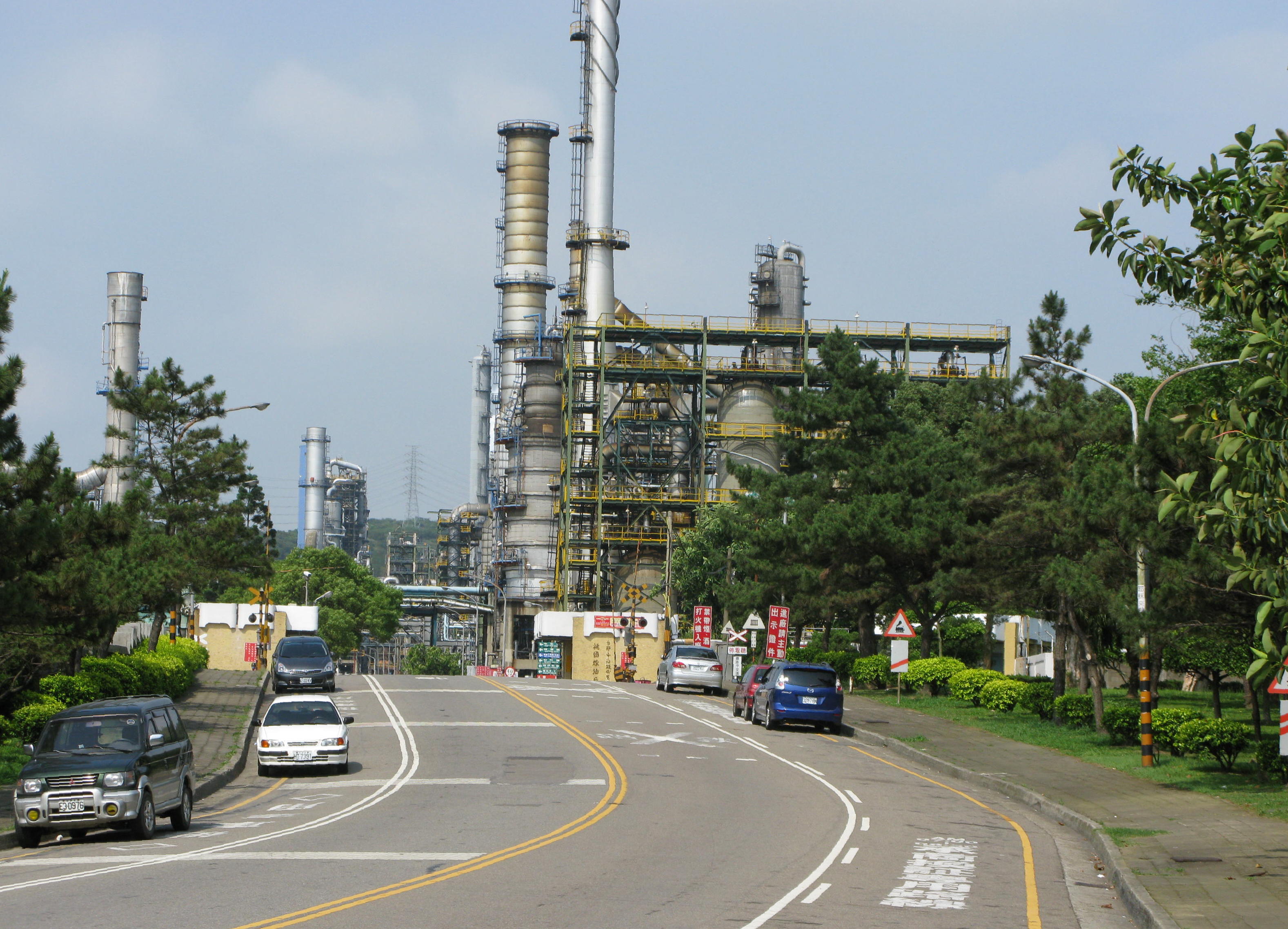
Taoyuan Refinery
Every liter of gasoline pumped north of Taichung traces its origin to a 480-hectare industrial complex in Guishan District, where the Taoyuan Refinery has been converting crude oil into fuel since April 1977. Operated by CPC Corporation's Refining Business Division, the facility processes 200,000 barrels of crude per day and supplies petroleum products to roughly half of Taiwan's population. It is not a place that invites tourism or architectural admiration, but it is one of the most consequential pieces of infrastructure on the island.
Built for a Tiger Economy
Planning for the refinery began in 1970, when Taiwan's economy was accelerating at a pace that demanded new energy infrastructure. The government selected a site in Nanshang Village, Guishan District, in March 1972, and five years of civil engineering, infrastructure construction, and equipment installation followed. The refinery commenced operations in April 1977, joining Taiwan's network of state-run petroleum facilities at a moment when the island's industrial output was expanding faster than its energy supply could keep pace. The timing was no accident. Taiwan was in the midst of its transformation from an agricultural economy into one of the Four Asian Tigers, and the factories driving that transformation needed fuel.
Five Decades of Expansion
The refinery's development timeline reads like a condensed history of Taiwan's environmental and industrial evolution. A gasoline desulfurization unit arrived in 1984. The first heavy oil desulfurization unit followed in 1987, producing low-sulfur fuel oil at a time when acid rain and urban smog were forcing governments across Asia to tighten emissions standards. A second heavy oil unit came online in 1990. By 2001, planners were already looking ahead to low-benzene, low-aromatic gasoline formulations designed to improve air quality further. Between 2008 and 2009, a cracked gasoline hydrodesulfurization unit and debottlenecked diesel capacity brought the facility to its current output level. Each upgrade reflected a shifting balance between the demand for more fuel and the growing insistence that producing it should not poison the air.
Catching What Burns
The most significant recent addition to the refinery is invisible to anyone driving past: the Flare Gas Recovery System, completed in 2018. Before its installation, waste gases from crude oil distillation, catalytic cracking, storage tank breathing, and loading operations were routed to flare stacks and burned. The FGRS intercepts those gases before they reach the flame. Pipelines carry them to a system that uses liquid jet ejector technology to pressurize the mixture, then separates it into water, gas, and oil phases. The gas passes through an amine absorption tower to strip out hydrogen sulfide, and if it meets quality standards -- 80 parts per million of hydrogen sulfide or less -- it enters the fuel gas system for reuse. The Taoyuan Refinery was the first facility in Taiwan to achieve full recovery of its waste gases.
The Invisible Lifeline
The refinery also maintains the Wugu and Shalun oil depots, which together form the distribution backbone for northern Taiwan's petroleum supply. These are not facilities that appear on tourist maps or feature in travel guides. They are the kind of infrastructure that people notice only when it fails, and the Taoyuan Refinery has not failed in nearly five decades of continuous operation. From the highways of Taipei to the fishing boats of Keelung, from the factories of Hsinchu to the buses of Taoyuan, the fuel originates here: a sprawl of distillation columns, storage tanks, and pipeline networks that converts crude oil arriving by sea into the energy that keeps northern Taiwan moving.
From the Air
Located at 25.0334°N, 121.308°E in Guishan District, Taoyuan City. The 480-hectare facility is clearly visible from altitude as a large industrial complex with storage tanks, distillation columns, and flare stacks. It sits approximately 10 km south of Taoyuan International Airport (RCTP). From 3,000-5,000 feet, the tank farm and pipeline corridors are the most distinctive visual features. Taipei Songshan Airport (RCSS) is approximately 25 km east.