Taq-e Bostan
Sacred springs still feed a reflecting pool at the base of the cliff. Above the water, arched alcoves open into the rock face, and inside them Sasanian kings stand frozen in stone, receiving crowns from gods. Taq-e Bostan sits five kilometers from the center of Kermanshah in western Iran, where the Zagros Mountains form a natural corridor between Mesopotamia and the Iranian Plateau. For nearly 1,700 years, wind and rain have scoured these carvings, yet the figures remain sharp enough to read the inscriptions, identify the crowns, and count the arrows in a royal quiver. Sassanid kings chose this spot deliberately. The springs were sacred, the setting was beautiful, and the location straddled a Silk Road caravan route, guaranteeing that every traveler heading east or west would see their faces carved into the mountain.
Crowns Bestowed by Gods
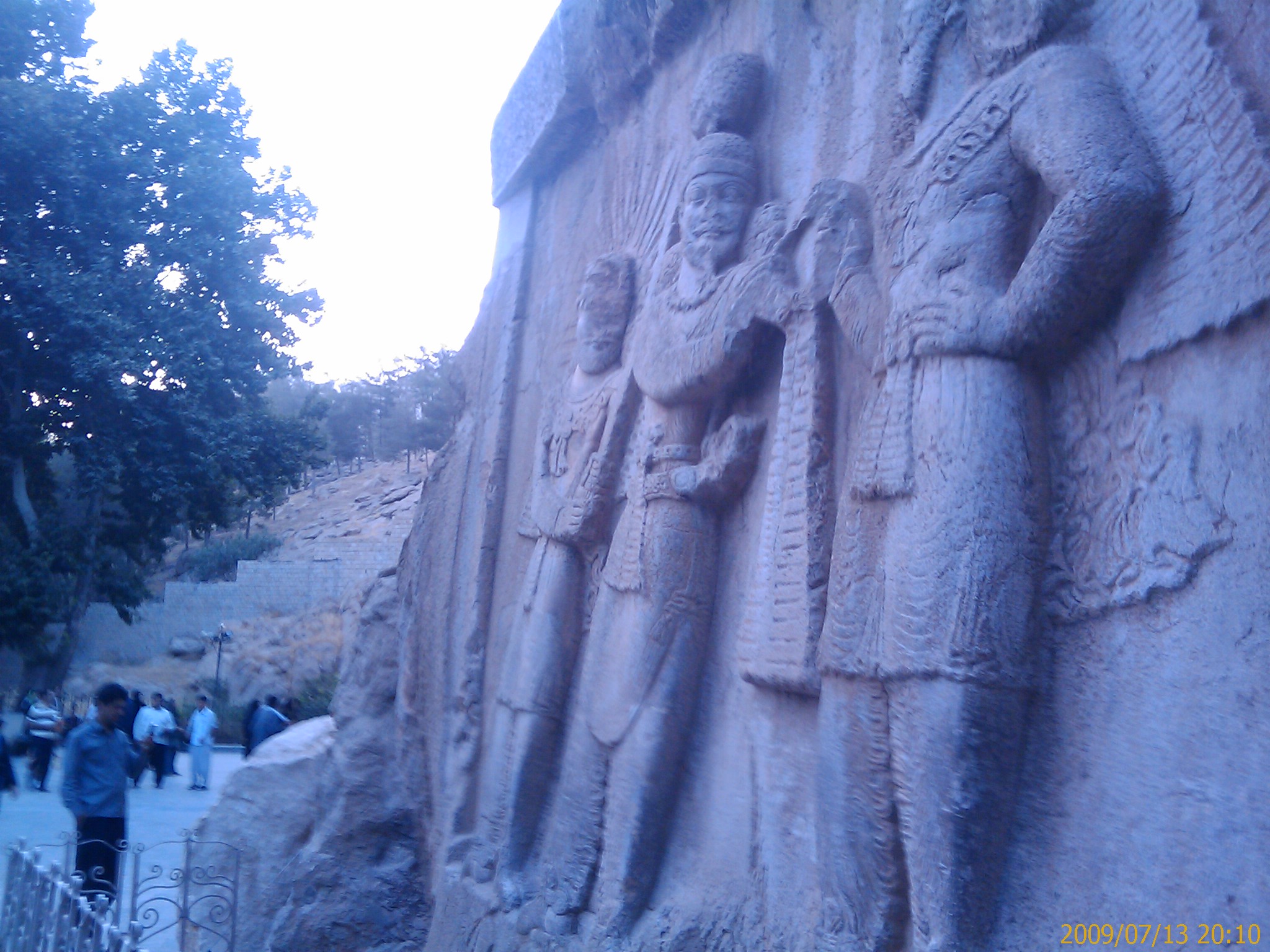
The most dramatic relief at Taq-e Bostan depicts the investiture of Ardashir II, who reigned from 379 to 383 CE. The panel, roughly four meters wide and nearly four meters high, shows the king in the center receiving a royal diadem from Shapur II on his right, while the god Mithra stands to his left. Beneath Ardashir's feet lies a fallen figure, most likely the Roman emperor Julian, who died fighting the Sasanians in 363 CE. The composition makes the political theology explicit: kingship comes from the gods, and Rome lies defeated. Investiture scenes were a hallmark of Sasanian art, repeated across thirty surviving rock reliefs in the Zagros Mountains. But Taq-e Bostan's version, with its fallen Roman and divine witnesses, is among the most complete and best preserved.
Father and Son in the Smaller Arch
The smaller of the two rock-cut arches, sometimes called Taq-e Bustan II, holds a different kind of monument. Two royal figures face each other on the back wall, identified by Pahlavi inscriptions as Shapur II, known as Shapur the Great, and his son Shapur III. The vestibule measures six by five by 3.6 meters. Scholars date its completion to around 385 CE, during Shapur III's reign, though the question of who commissioned it is more complicated than it appears. The crown depicted on Shapur III does not match those on his coins. Instead, it more closely resembles the crown of his predecessor Ardashir II. Some scholars have argued that Shapur III usurped a relief originally belonging to Ardashir, inserting his own inscriptions over or beside the earlier work. Both inscriptions declare the kings to be "Mazda-worshipping," their race "from the Gods," rulers of "Iran and Aniran" -- the Sasanian formula for claiming dominion over the entire known world.
The Great Iwan of Khosrow II
The larger arch shelters the most elaborate carvings at Taq-e Bostan. Three figures dominate the back wall: Khosrow II, the last great Sasanian king, flanked by the supreme god Ahura Mazda and the goddess Anahita. Below and around them, the walls come alive with hunting scenes. On one side, the king hunts boar from a boat while elephants drive the animals toward him. On the other, he pursues deer on horseback. The recurve bow he uses has been identified as Hunnish in design, a reminder that the Sasanian Empire absorbed influences from the steppe peoples on its northern frontier. Female musicians play changs, Persian harps, accompanying the hunt with music. A fully armored cataphract, horse and rider encased in scale and mail, stands in relief nearby, representing the heavy cavalry that made Sasanian armies the dominant military force between Rome and China for four centuries.
Centuries Added to the Cliff
The carvings did not end with the Sasanians. In the nineteenth century, the Qajar-era governor of Kermanshah, Mohammad-Ali Mirza Dowlatshah, added his own relief to the complex, depicting himself before Fath-Ali Shah Qajar. It is a striking act of continuity: twelve hundred years after Sasanian kings carved their divine investitures into this cliff, a Qajar governor placed himself in the same tradition, on the same rock. The site has since been transformed into an archaeological park. Column capitals from the late Sasanian and early Islamic periods have been gathered here from Taq-e Bostan itself, from nearby Mount Behistun, and from Kermanshah. Springs still flow beside the reliefs, feeding the basin that has reflected these carved kings since the fourth century. Arthur Pope, founder of the Iranian Art and Archaeology Institute, saw in sites like this the essence of Iranian civilization. Art, he believed, "was characteristic of the Iranian people and the gift which they endowed the world with."
From the Air
Located at 34.39N, 47.13E on the outskirts of Kermanshah, western Iran. The rock-cut arches are visible at the base of a cliff on the eastern edge of the city. Best viewed from 2,000-4,000 feet AGL approaching from the west across the Kermanshah valley. Nearest airport is Kermanshah (OICC/KSH), just a few kilometers away. The reflecting pool at the base of the cliff can serve as a visual landmark. The Zagros Mountains rise sharply around the site; expect terrain-induced turbulence in afternoon conditions.