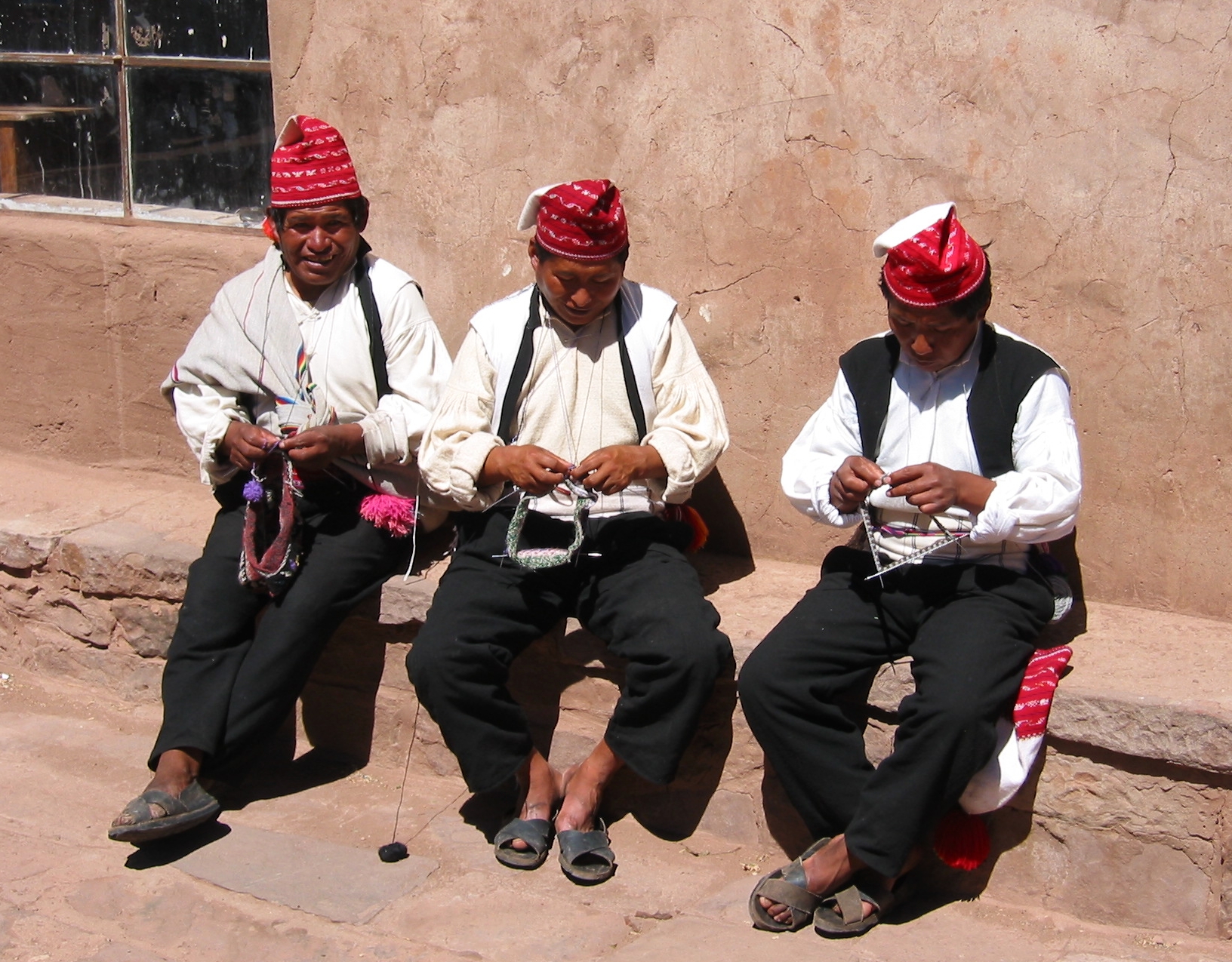
Taquile Island
On Taquile Island, you can tell whether a man is married or single by the color of his hat. The men of this small island in Lake Titicaca -- 5.5 kilometers long, rising to 4,050 meters above sea level -- are the community's knitters, learning the craft in early boyhood and producing textiles so fine that UNESCO proclaimed "Taquile and Its Textile Art" a Masterpiece of the Oral and Intangible Heritage of Humanity in 2005. About 2,200 people live here, 45 kilometers offshore from Puno, speaking Puno Quechua and governing themselves by a moral code inherited from the Inca: ama sua, ama llulla, ama qhilla -- do not steal, do not lie, do not be lazy.
Thread and Identity
Textile production on Taquile is not a cottage industry or a tourist performance. It is the organizing principle of social life. Men knit the chullo caps whose colors and patterns communicate marital status, community role, and personal skill. Women spin wool and dye it using vegetables and minerals gathered from the island, then weave the chumpis -- wide belts with intricate geometric designs -- worn by everyone in the community. The division is strict and deeply traditional: men do not weave, women do not knit. Together, they produce textiles regarded as among the highest-quality handicrafts in Peru, with techniques and patterns passed between generations as carefully as the Quechua language itself. The resulting garments are not decorative. They are worn daily, read like a social register, and carry the accumulated knowledge of centuries.
The Island's Own Rules
Taquile runs on collectivism. The island is divided into six sectors, called suyus, which rotate crops to maintain soil fertility on the steep terraced hillsides where potatoes are the primary staple. Families own rams, sheep, cows, chickens, and sometimes guinea pigs. Fishing supplements the diet, along with simple meals that reflect the island's isolation: pancakes with sugar for breakfast, vegetable soup and fresh lake fish for lunch, more soup and bread for dinner. There is no grand cuisine here, but there is consistency and self-sufficiency. The island generates its own electricity through solar panels chosen by community vote. A small radio station connects residents across the steep terrain. Catholic faith coexists with Andean tradition -- the community maintains two Catholic churches alongside deep reverence for Pachamama, the earth mother, and four mountaintop apu deities to whom offerings of coca leaves are made before every significant activity or journey.
Forty Thousand Visitors a Year
Tourism arrived on Taquile in the 1970s, and approximately 40,000 visitors now come each year. The Taquileans responded by building one of the most studied community-controlled tourism models in South America, offering homestays, local guides, cultural activities, and communal restaurants. But the relationship has not been entirely on their terms. As mass day-tourism grew, outside operators from Puno increasingly captured the transportation and booking revenue, leaving the islanders with a shrinking share of the income generated by their own culture. The community established its own travel agency, Munay Taquile, to reclaim control over who comes, how they arrive, and where the money goes. It is an ongoing negotiation between a community that measures wealth in handwoven cloth and an industry that measures it in throughput.
Cantuta and Coca Leaves
The landscape of Taquile is austere and windswept, but not barren. Kolle trees provide firewood and roofing material. The cantuta flower, Peru's national flower, grows on the hillsides. Chukjo plants serve as natural detergent, and muna is brewed into medicinal tea. Coca leaves, essential to Andean spiritual practice, are not cultivated on the island -- they must be brought in from the mainland, which gives each leaf a weight of intention. Three are offered before any activity or trip, a small ritual that connects daily life to something older than the Catholic churches on the hilltop. The stone arch leading to the main square frames a view of Lake Titicaca that stretches to the Bolivian shore, a reminder that this island, for all its self-contained order, exists within the largest high-altitude lake in the world.
From the Air
Located at 15.78S, 69.68W in Lake Titicaca, approximately 45 km east of Puno, Peru. Taquile is a distinct island landmass visible as an elongated shape roughly 5.5 km long, rising to 4,050 meters above sea level. The terraced hillsides and clustered village at 3,950 meters are visible at lower altitudes. Nearest airport is Inca Manco Capac International Airport (SPJL) in Juliaca, approximately 75 km to the northwest. The island sits in deep blue lake water, easily distinguished from the surrounding open water of Titicaca.