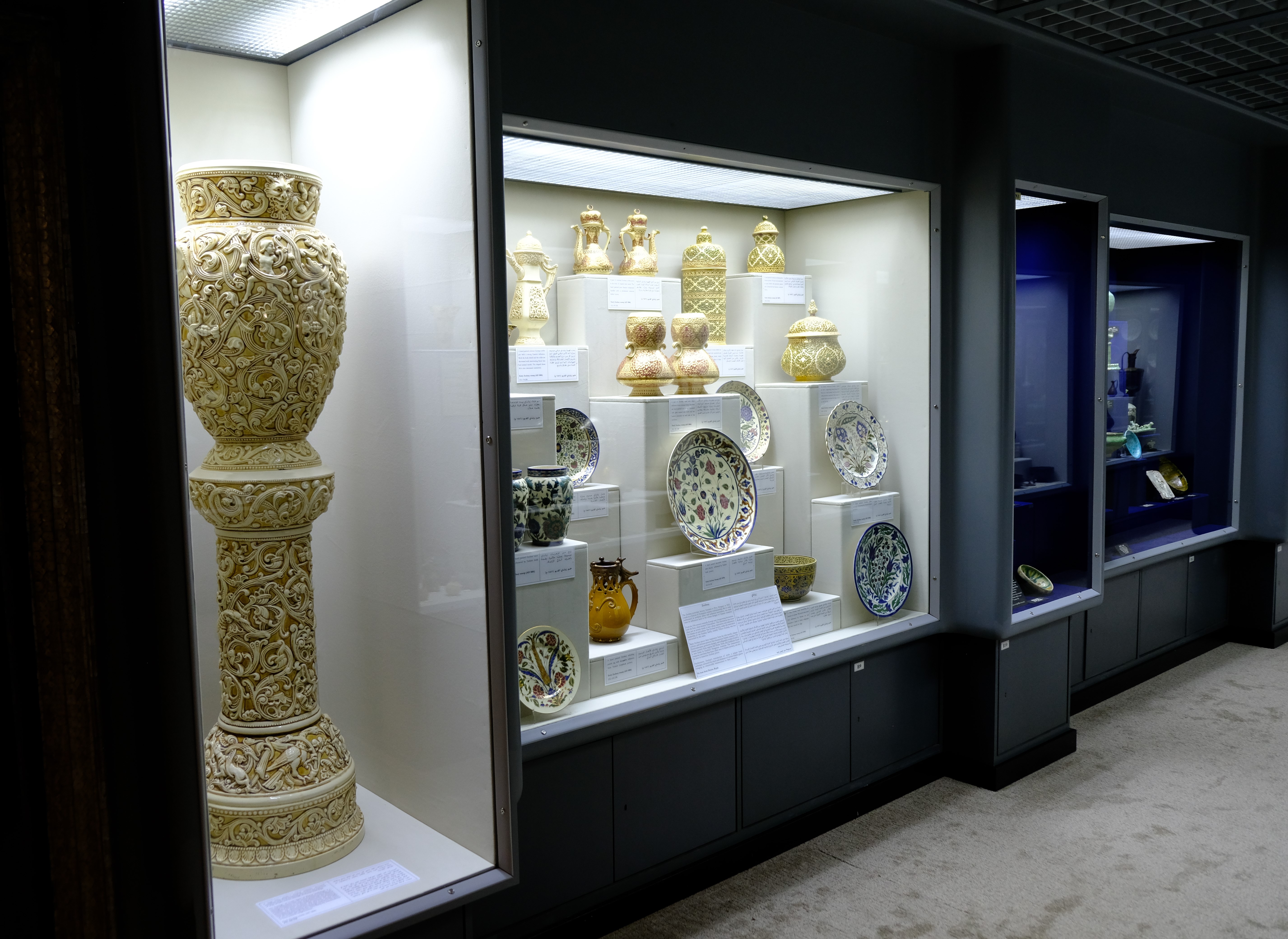
Tareq Rajab Museum
It started with a boy spending his school allowance on books. In the 1940s, a fourteen-year-old Tareq Al-Sayid Rajab traveled to Baghdad and came home with something more valuable than souvenirs: a collector's eye. When Kuwait's Educational Office in London later gave the young student a weekly stipend, he spent most of it not on meals or entertainment but on manuscripts and rare volumes. The office reimbursed him without complaint, classifying every purchase as educational. They were not wrong. Those early acquisitions laid the foundation for what would become the first Islamic art museum in Kuwait and the entire Gulf region, formally inaugurated in 1980 in the residential neighborhood of Jabriya.
Rough Roads to Remote Villages
Tareq Rajab did not build his collection from auction catalogs alone. Alongside his wife Jehan, a specialist in Islamic costume and jewelry drawn to the cultures vanishing under rapid modernization, he drove across unpaved roads through mountain passes and camped beside villages and tribal settlements in Syria, Palestine, and Iran. In an era before modern highways connected these regions, the couple bargained with dealers in Damascus and Istanbul, then pushed into the countryside to find what the dealers never saw. Jehan's keen interest in material culture and living traditions gave these trips a second purpose: they were not just acquiring objects but documenting ways of life that modernity was erasing. When Tareq became Kuwait's Director of Museums and Antiquities in the 1960s, the idea for a dedicated museum of Islamic art began to crystallize. He supplemented the overland finds with acquisitions from Sotheby's, Christie's, and Bonhams in London.
Thirty Thousand Objects Under One Roof
The collection grew to over thirty thousand items, of which approximately ten thousand are on permanent display across two locations. The original museum, opened in 1980, houses manuscripts, ceramics, metalwork, glass, arms and armor, textiles, costumes, and jewelry. A 7th-century Ma'il script folio from the Hijaz ranks among the earliest Quranic manuscripts in existence. A rare Al-Kindi treatise on optics sits near a folio from the Shahnameh of Shah Tahmasp, one of the most celebrated illustrated manuscripts in Persian art. The jewelry collection alone numbers in the thousands of individual pieces, including a Fatimid gold bracelet, a head ornament once owned by the Mughal Emperor Humayun, and a necklace belonging to Princess Salme of Zanzibar and Oman. The firearms collection, 200 guns from the 17th to the 19th century, is considered one of the most important assemblages of Islamic firearms in the world.
Invasion and Survival
On August 2, 1990, Iraqi forces invaded Kuwait. Tareq Rajab was in Jordan. His two eldest children were traveling abroad. Jehan and their youngest son, Nader, remained in Kuwait through the entire occupation. Iraqi troops looted the family's New English School and destroyed their collection of Iraqi carpets. Yet the museum itself survived. After liberation, the Rajab family re-equipped and reopened the school. They also continued expanding the museum's holdings. Geza Fehervari, a professor of Islamic Art and Archaeology at the University of London's School of Oriental and African Studies, had developed a close relationship with Tareq and became the museum's first curator. His scholarly involvement helped elevate the collection's international reputation. The museum emerged from the occupation not diminished but more determined, a quiet act of cultural resistance against destruction.
The Calligraphy Wing
In 2007, the Rajab family opened a second location: the Tareq Rajab Museum of Islamic Calligraphy, dedicated to the art of Arabic script in its many forms. The British Ambassador to Kuwait, Stuart Laing, presided over its public opening. Inside, visitors encounter Holy Coverings from Mecca, a large number of Hilya descriptions of the Prophet Muhammad, and manuscripts spanning centuries of calligraphic tradition. The museum also displays the three classical instruments of Arabic music: the oud, the qanun, and the ney. A North Indian ivory sarinda dating to approximately 1800 stands out among the musical instruments. The Fatimid bronze lion incense burner from the 11th or 12th century serves as the museum's mascot, an eleven-hundred-year-old animal presiding over a collection that spans continents and millennia.
A Family Legacy in Three Generations
Tareq Rajab died in 2016, but the museum remains entirely family-funded and family-operated. The third generation of Rajabs is now actively involved in its management. In a region where state-funded mega-museums have become architectural landmarks, the Tareq Rajab Museum stands apart as something more personal: a private obsession made public. The collection was never assembled by committee or curated by algorithm. It reflects the specific tastes and stubborn curiosity of a man who started buying books with his school lunch money and never stopped. The residential setting in Jabriya reinforces this intimacy. There are no grand atriums or soaring galleries. Instead, visitors move through rooms scaled to a home, where ceramics from the Parthian period share space with Mughal glassware and Ottoman textiles, each object carrying the fingerprints of the journeys that brought it here.
From the Air
The Tareq Rajab Museum is located in Jabriya, a residential district in Kuwait's Hawalli Governorate, at 29.317N, 48.047E. The museum occupies a private residence and is not easily distinguished from the air. Kuwait International Airport (OKKK) lies approximately 10 km to the southwest. The museum sits within Kuwait City's suburban sprawl between the coast and the desert interior. Approach from the east over the Persian Gulf for orientation, using Kuwait Towers and the coastal highway as reference points.