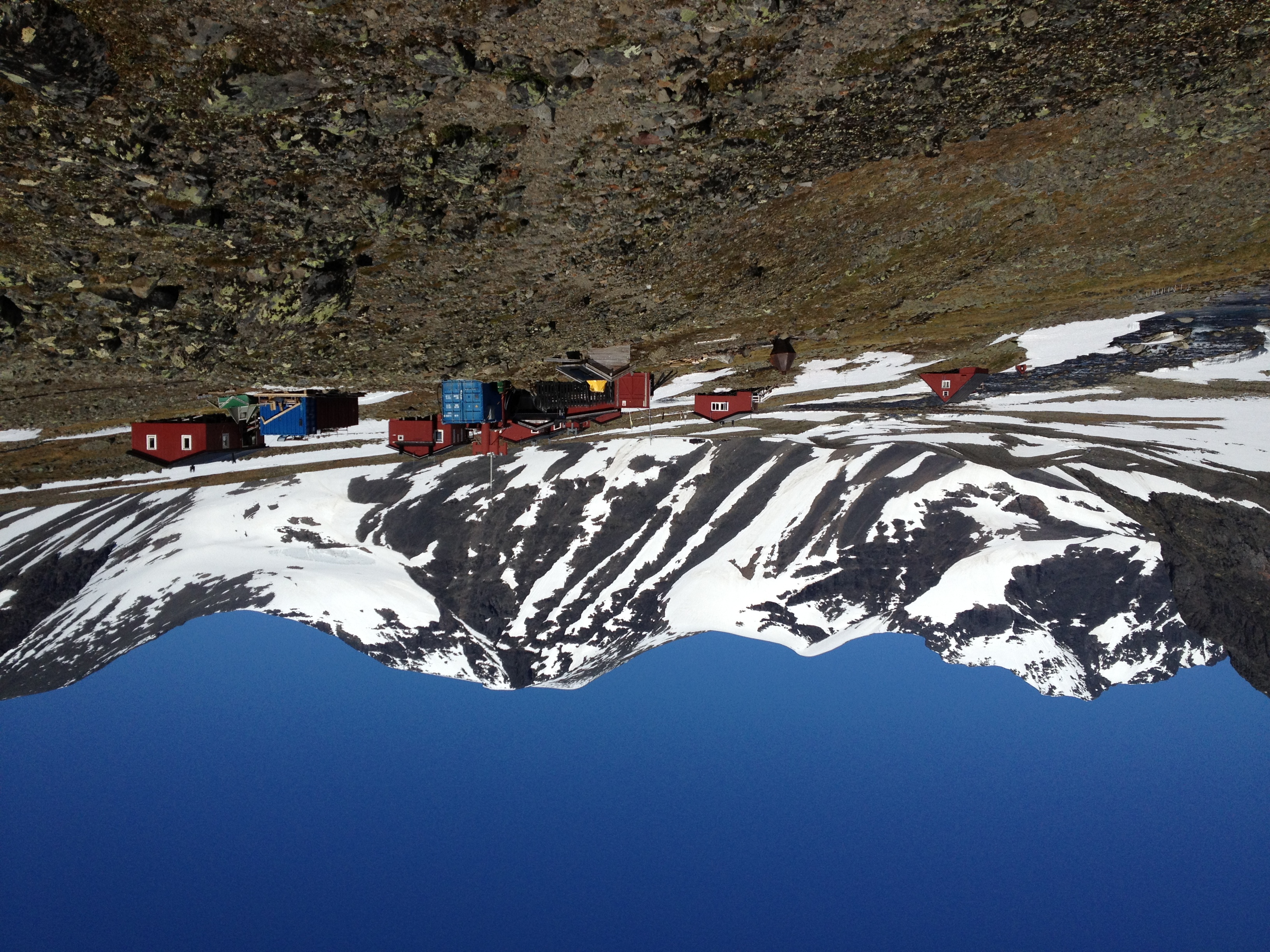
Tarfala Research Station
On 20 December 1992, a katabatic wind screamed down the Tarfala Valley and hit 81 meters per second -- 290 kilometers per hour -- setting a record that still stands as the highest wind speed ever measured in Sweden. The instruments that captured it belong to Tarfala Research Station, a cluster of buildings at 1,135 meters elevation in the shadow of Kebnekaise, Sweden's highest mountain. Run by Stockholm University since 1961, the station exists for one primary purpose: to watch glaciers die, grow, and tell their stories about a changing climate. It has been doing so longer than any other research station on Earth.
Eighty Years of Watching Ice
Regular glaciological measurements at Storglaciaren began in 1946, just after the end of World War II, making it the longest continuous glacier mass balance study in the world. The work is painstaking and physical: each winter, researchers dig snow pits in the accumulation zone, measuring snowpack depth and density to determine how much the glacier gained. In summer, they read stakes driven vertically into the ice the previous autumn, measuring how much has melted away. Most stakes must be replaced every year. The difference between winter gain and summer loss -- the mass balance -- reveals whether a glacier is healthy, retreating, or advancing. Decade after decade, these numbers have built a dataset that climate scientists worldwide rely on as a baseline for understanding glacial change.
Frozen Ground Beneath
Until the late 1970s, scientists doubted that mountain permafrost existed in the Scandinavian mountains at all. Tarfala changed that. In 1976, refraction seismic soundings proved conclusively that the valley sits within a zone of widespread discontinuous permafrost, with frozen ground beginning just two meters below the surface on wind-exposed ridges. Four years of systematic research followed, using seismic, geoelectric, and borehole temperature methods to map the frozen underground. In March 2000, the EU-sponsored PACE project drilled two boreholes into bedrock above the station -- one reaching 100 meters deep, fitted with 30 thermistors. At that depth, the rock holds a steady minus 2.75 degrees Celsius. Extrapolating from the geothermal gradient, researchers estimate the permafrost extends 330 meters down. That frozen column is now warming, its upper layers registering temperature increases that mirror the warming air above.
A Station Built and Rebuilt
Tarfala's history is one of stubborn persistence against the elements. Annual university courses began in 1959, and the station was officially inaugurated in 1961, expanded with four buildings funded by the Wallenberg Foundation. Over the following decades, a sauna, laboratory, lecture hall, and living quarters were added. But the Arctic fought back. Winter storms destroyed buildings in 1975, 1985, and 1993. Spring slush avalanches damaged the laboratory hut in 1982 and again in 1991. Each time, the damaged structures were repaired or rebuilt during the brief summer months. The station's long-term director, Valter Schytt, welcomed scientists and students from across Sweden and abroad, building Tarfala's international reputation. In 1985, Schytt died during a winter visit to the valley he had dedicated his career to studying -- a loss the research community marked by dedicating the subsequent permafrost studies to his memory.
Continental Climate, Maritime Neighbor
The Tarfala Valley occupies a peculiar climatic position. Though only a mountain ridge separates it from Norway's western coast, the valley's climate is surprisingly continental -- drier, with sharper temperature swings than the maritime conditions just to the west. Annual precipitation at the station averages about 1,000 millimeters, less than half what falls in the Norwegian mountains on the other side of Kebnekaise. This steep climatic gradient directly affects the glaciers: those on the Norwegian side receive far more snow, while Tarfala's glaciers survive on thinner rations. The mean annual air temperature at the glacial equilibrium line, roughly 1,500 meters above sea level, sits at about minus 6 degrees Celsius. It is this combination of continental aridity and Arctic cold that has made Tarfala such a valuable natural laboratory -- the glaciers here respond sensitively to even small shifts in temperature and precipitation, amplifying signals that would be harder to detect elsewhere.
From the Air
Tarfala Research Station is located at 67.91°N, 18.61°E at 1,135 m elevation in the Tarfala Valley, at the eastern foot of Kebnekaise in Swedish Lapland. The station is not visible from standard cruising altitude but the valley and surrounding glaciers (Storglaciaren, Isfallsglaciaren, Kebnepakteglaciaren) are identifiable landmarks. Nearest major airport is Kiruna (ESNQ), approximately 70 km east. The station is surrounded by mountainous terrain reaching above 2,000 m; maintain safe altitude. No airstrip at the station -- access is by foot only (19 km hike from Nikkaluokta trailhead).