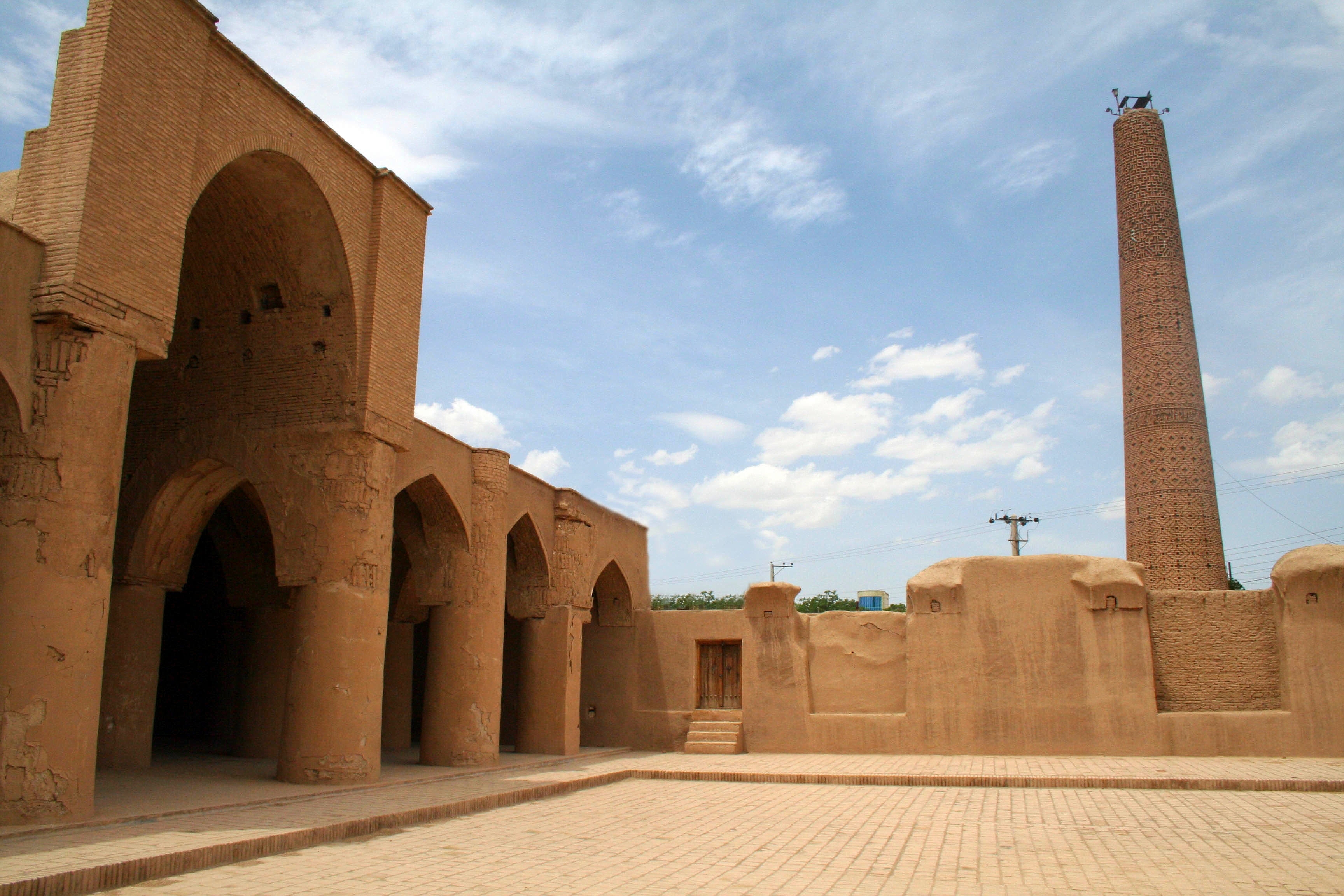
Tarikhaneh Mosque
The pillars give it away. They are massive -- 3.5 meters tall, nearly 2 meters in diameter -- built from radial brickwork in a technique perfected not by Islamic architects but by Sasanian palace builders centuries earlier. These columns, almost identical in construction to those supporting the great arch at Ctesiphon, hold up the prayer hall of the Tarikhaneh Mosque in Damghan, one of the oldest Islamic structures in Iran. The mosque was built on the foundations of a Zoroastrian fire temple, using pre-Islamic engineering to serve a new faith. Three civilizations -- Zoroastrian, Sasanian, and Islamic -- converge in a single building that has stood since roughly the eighth century CE.
God's Home
The name itself bridges eras. In Turkic, 'tari' (also spelled tanri or tengri) means god or sky -- the same root as the Turko-Mongol sky deity Tengri -- and 'khaneh' is the Persian word for home: 'God's Home.' The mosque is also known as the Mosque of 100 Gates, echoing the Greek name Hecatompylos given to the nearby ancient city of Qumis. The building was added to the Iran National Heritage List on January 6, 1932, making it among the earliest structures to receive formal heritage protection in the country. Scholars debate its exact construction date. Historian Mohammad Karim Pirnia dated the original building to the late seventh or early eighth century CE, based on architectural analysis. Others have argued for a ninth-century date based on stylistic features. No definitive inscriptions exist to settle the question, but the consensus places it among the very earliest mosques built in Iran after the Arab conquest.
Sasanian Engineering, Islamic Purpose
The architecture tells a story of cultural adaptation. The courtyard follows an essentially Arabian plan: a square open space surrounded by arcades of barrel vaults supported by slightly pointed fired-brick arches set on the thick circular pillars. But the construction technique is pure Sasanian. The massive circular pillars repeat the radial brickwork used in the imperial palaces of the Sasanian dynasty, which ruled Iran before the Arab conquest. The hypostyle prayer hall consists of several naves divided by arcades and covered by vaults, with the central nave wider than the others. This was standard mosque architecture, but executed in a building language that predated Islam in Iran by centuries. The result is a structure that looks simultaneously familiar and foreign -- a mosque that feels like a palace, a prayer hall held up by the engineering of fire-worshippers.
The Minaret That Lost Its Top
Standing at a distance from the main mosque are two structures: the remains of a square column of uncertain date, possibly part of the original construction, and a cylindrical minaret. The minaret is 4.2 meters in diameter at its base, and its style resembles later Seljuk-era minarets, suggesting it was added centuries after the mosque was first built. Its top has fallen, but based on its proportions it originally stood more than 30 meters high, with a gallery supported on muqarnas corbels -- the honeycomb-like decorative brackets that became a hallmark of Islamic architecture. The minaret dates to the Ziyarid dynasty, specifically the period between 1026 and 1032 CE. Together, the mosque and its minaret span at least three centuries of continuous Islamic use, layered atop the Zoroastrian and Sasanian foundations beneath.
Where Fire Became Prayer
The fire temple that preceded the mosque is documented but not visible. Zoroastrian fire temples were sacred spaces where a perpetual flame was maintained as a symbol of truth and righteousness. When the Arab conquest brought Islam to the Iranian plateau in the seventh century, many fire temples were converted to mosques. Tarikhaneh represents one of the most architecturally significant of these conversions, because the builders did not demolish the existing structure but adapted it. They kept the Sasanian columns. They kept the building techniques. They reoriented the space toward Mecca and added the architectural elements required for Islamic worship. The result, standing in Damghan's dusty landscape after more than twelve centuries, is a monument to the pragmatism of conquerors and the durability of good engineering.
From the Air
Located at 36.16N, 54.35E in the city of Damghan, Semnan province, northeastern Iran. The mosque complex with its distinctive cylindrical minaret may be visible from low altitude. Damghan is a small city on the Tehran-Mashhad highway corridor. The nearest airports include Semnan Airport (OIIS) to the west and Shahroud Airport (OINJ) to the east. The ancient ruins of Qumis (Hecatompylos) lie approximately 30 km to the southwest.