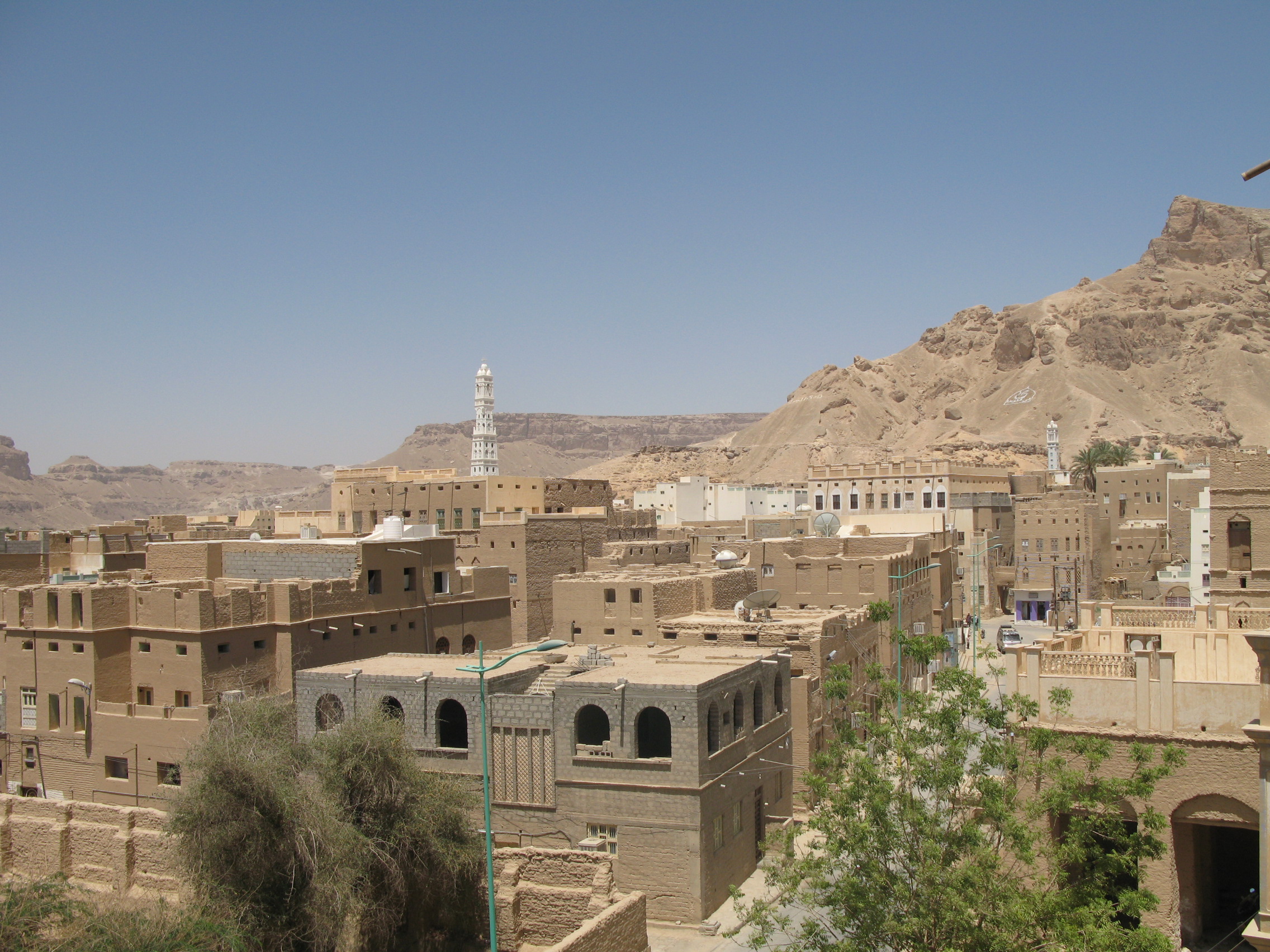
Tarim, Yemen
Somewhere in the Hadhramaut, 180 kilometers inland from the Arabian Sea, a mud-brick minaret rises 53 meters into the desert air. The Al-Muhdhar Mosque's tower is one of the tallest earth structures on the planet, and it belongs not to a capital city or a famous metropolis but to Tarim -- a town most atlases barely register. Yet for centuries, this settlement in Yemen's deepest wadi has punched so far above its weight in Islamic scholarship, architecture, and global diaspora that it earned the title "City of Scholars." It is estimated to contain the highest concentration of Sayyids -- descendants of the Prophet Muhammad -- anywhere in the world. The scholars who trained here carried their learning to Southeast Asia, East Africa, and the Indian subcontinent, weaving a network of influence that long predated the modern idea of globalization.
Faith at the Edge of Empire
Tarim's Islamic identity reaches back to the earliest days of the faith. In the tenth year of Hijra -- 631 CE -- a delegation from Hadhramaut traveled to Medina to meet the Prophet Muhammad himself. The city converted early and stood with Abu Bakr, the first Sunni caliph, during the Ridda wars that followed the Prophet's death in 632. Abu Bakr is said to have prayed for Tarim's scholars and water to increase, a blessing the city claims was answered many times over. Companions of the Prophet were brought to Tarim for treatment after a battle at Al-Nujir Fortress, and some were buried in the cemetery of Zambal. These connections seeded a scholarly tradition that grew for centuries, producing figures like Imam al-Haddad and generations of religious teachers whose influence extended far beyond the valley walls. Today, Dar al-Mustafa continues that tradition as a well-known institution for the study of traditional Islamic sciences.
Fortunes Made in Singapore, Spent in the Desert
Tarim's story took a sharp turn in 1809 when a Wahhabi invasion tore through Hadhramaut. Invaders destroyed valuable books and manuscripts from the Robat at Tarim, burning some and dumping others into wells. The economy collapsed, and Hadhramis began leaving in waves -- for Hyderabad, where the Nizam's army offered employment, and for the trading ports of Southeast Asia. One soldier, Umar bin Awadh al Qu'aiti, rose to the rank of Jemadar in Hyderabad and used his wealth to found the Qu'aiti dynasty back home. Meanwhile, the Al-Kaf family built their fortune in Singapore. When they returned, they wanted to modernize Tarim. Sayyid Abu Bakr al-Kaf financed a motor road from Tarim to the coast at Shihr, but camel-owning tribes -- who held a transport monopoly between the coast and the interior -- blocked its use. Undeterred, Abu Bakr al-Kaf poured his personal wealth into brokering a peace between the rival Qu'aiti and Kathiri sultanates in February 1937. Working alongside Harold Ingrams, Britain's first political officer in Hadhramaut, he achieved what became known as "Ingrams' Peace" -- an agreement totally unprecedented in the region's history.
From Sultanates to Socialism
Tarim remained a pocket of Kathiri territory surrounded by Qu'aiti lands, a geographic oddity that reflected the valley's tangled politics. That complexity ended abruptly in November 1967 when Britain withdrew from South Yemen. The Marxist National Liberation Front seized power, and Tarim -- the city of scholars and mosques -- found itself inside a communist state, the People's Democratic Republic of Yemen. Despite the ideological whiplash, Hadhramaut continued to survive in large part on remittances sent home by its global diaspora. When North and South Yemen unified in 1990, Tarim entered yet another political chapter, but its identity as a center of learning and faith proved more durable than any government.
Mud-Brick Manhattan
Saudi Aramco World once called the Hadhramaut's tall mud-brick towers "Manhattan in the Hadramaut," and Tarim is the style's spiritual home. Foreign architectural influences filtered in through the diaspora -- returnees from Java, India, and East Africa brought ornamental features and hybrid designs that make Tarim's skyline a visual record of cultural exchange. The Al-Muhdhar Mosque's minaret, completed in 1914 and designed by local poets Abu Bakr bin Shihab and Alawi Al-Mash-hur, is the tallest in South Arabia and among the tallest earthen structures anywhere. It honors Omar Al-Muhdar, a Muslim leader from the 15th century. Nearby, the Al-Kaf Library -- attached to Al-Jame'a Mosque -- houses more than 5,000 manuscripts covering religion, Islamic law, Sufism, medicine, astronomy, agriculture, mathematics, philosophy, and the eight volumes of al-Hamdani's Al-Iklil. Between 300 and 400 of these manuscripts are believed to be unique in the Islamic world. Most were written by Yemeni authors from Wadi Hadhramaut, though some traveled from as far as Morocco and Khurasan.
Life in the Valley
The Hadhramaut Valley spans roughly 90,000 square kilometers of southern Yemen -- a narrow, arid coastal plain giving way to a broad plateau averaging 1,400 meters, cut by deeply sunk wadis that carry water only seasonally. Tarim sits 35 kilometers northeast of Seiyun, the nearest city with an airport. Hadhramis farm wheat and millet, tend date palm and coconut groves, and grow some coffee in the valley floor, while Bedouins graze sheep and goats on the plateau above. The Sayyid aristocracy remains highly respected in both religious and secular affairs. Most of the population follows the Shafi'i school of Sunni jurisprudence, and the practical differences with Yemen's Zaydi Shias are small enough that worshippers freely pray in each other's mosques. Tarim's climate is hot desert -- almost no rain, except for the occasional torrential downpour that sends floodwater surging through the wadi. It is a place shaped by scarcity, where scholarship and faith became the exports that mattered most.
From the Air
Tarim sits at 16.05N, 49.00E in the Hadhramaut Valley of southeastern Yemen. The nearest airport is Seiyun (OYSY), approximately 30 km to the southwest. From cruising altitude, look for the distinctive narrow wadi cutting through the broad desert plateau. The mud-brick towers and the tall Al-Muhdhar minaret are visible on approach. The surrounding plateau reaches elevations around 900 m, with the valley floor considerably lower. Hot desert climate with generally excellent visibility, though occasional heavy rains can cause flash flooding in the wadi.