Tarko-Sale
A monument to geologists stands in Tarko-Sale, erected in 2000 to honor the men and women who came to this stretch of the Pyakupur River and found what lay beneath it. The gesture captures the town's identity precisely: Tarko-Sale exists because of what was discovered underground, and the discovery reshaped not just this remote corner of the Arctic but the entire energy calculus of Russia. Founded in 1932 as a small settlement in Purovsky District of Yamalo-Nenets Autonomous Okrug, the town spent decades in obscurity before the oil and gas boom of the 1970s turned it into something far more consequential than its modest population would suggest.
From Settlement to Gas Capital
Tarko-Sale's trajectory mirrors the arc of Western Siberia's energy story. Established in 1932, it lingered as a minor settlement for decades, receiving urban-type status only in 1976 as the surrounding gas fields began producing. Full town status came even later, on March 23, 2004. But by then, the town had already become the headquarters of Novatek, Russia's largest independent gas producer. The surrounding Yamalo-Nenets Autonomous Okrug holds an estimated 80 percent of Russia's natural gas reserves and roughly 15 percent of the world's supply, making the region beneath Tarko-Sale one of the most energy-dense territories on Earth. The nearby Kharampur, Khancheyskoye, and Urengoy gas fields ring the town with industrial infrastructure, while Novy Urengoy, the nearest city, anchors the broader gas extraction network.
Where Two Rivers Meet
Tarko-Sale sits on the Pyakupur River near its confluence with the Ayvasedapur, 560 kilometers southeast of Salekhard, the regional capital. The location places it just south of the Arctic Circle, in a landscape shaped by the proximity of the Yamal and Gyda peninsulas to the north and the Kara Sea beyond them. Winters are long and brutal, summers brief and surprisingly warm -- the subarctic climate delivers both extremes with equal conviction. The town's name comes from the Nenets language, and the region remains home to indigenous Nenets communities whose reindeer herding and fishing traditions predate the gas industry by centuries. The Purovsky District Museum of History and Local Lore, with over 26,990 items in its collection, documents both the indigenous heritage and the more recent transformation wrought by energy extraction.
The Airport That Gas Built
Tarko-Sale Airport was founded in 1962, a modest facility serving a modest settlement. Then the gas arrived. The discovery of oil and natural gas deposits in the 1970s transformed the airport from a backwater airstrip into a critical logistics hub, expanding to handle the equipment, personnel, and supplies that the extraction industry demanded. Its IATA code is TQL, and flights connect the town to Tyumen and other Western Siberian cities. Beyond the airport, the town also hosts a wood processing plant operated by Yamal LPK, which produces glued laminated timber and MHM panels -- a reminder that not everything in Tarko-Sale revolves around hydrocarbons, even if most of it does.
Memorials on the Tundra
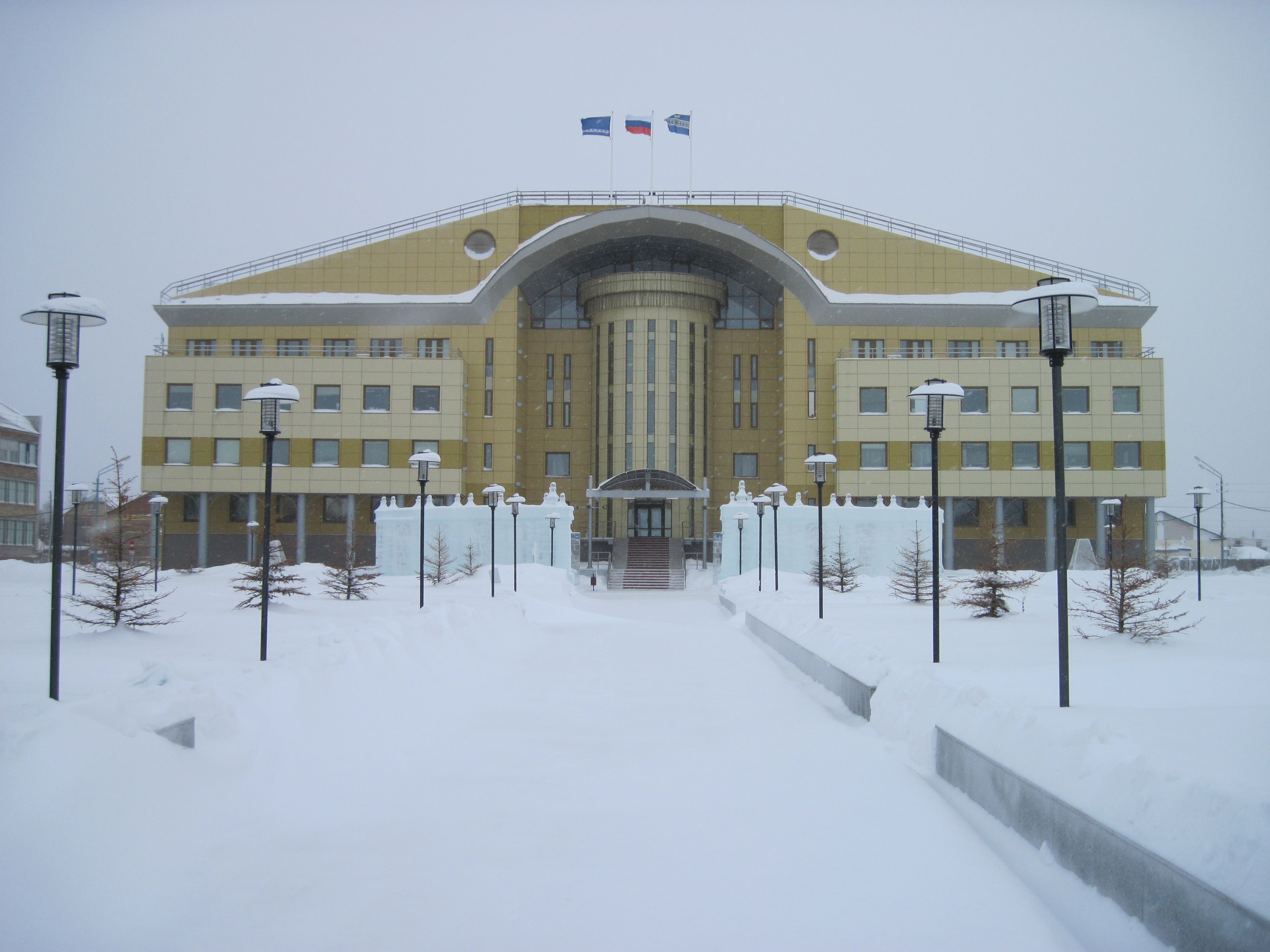
Tarko-Sale's public spaces tell the story of a place caught between eras. The monument to geologists, erected in 2000, celebrates the explorers who opened the region to development. A war memorial honors those who fought in the Second World War, connecting this Arctic settlement to a conflict fought thousands of kilometers to the west. Between these markers, the town itself is a study in Soviet-era planning adapted to extreme conditions -- compact apartment blocks, utilitarian infrastructure, streets designed more for function than beauty. From the air, Tarko-Sale appears as a small cluster of buildings beside the winding Pyakupur, dwarfed by the immensity of the surrounding taiga and tundra, a human foothold in a landscape that remains overwhelmingly wild.
From the Air
Tarko-Sale is located at approximately 64.91N, 77.77E, just south of the Arctic Circle. Tarko-Sale Airport (TQL) serves the town. The settlement is identifiable from altitude by its position at the confluence of the Pyakupur and Ayvasedapur rivers. Novy Urengoy Airport (USMU) is the nearest major airfield. The surrounding landscape is flat taiga and tundra with numerous rivers and gas field infrastructure visible from altitude.