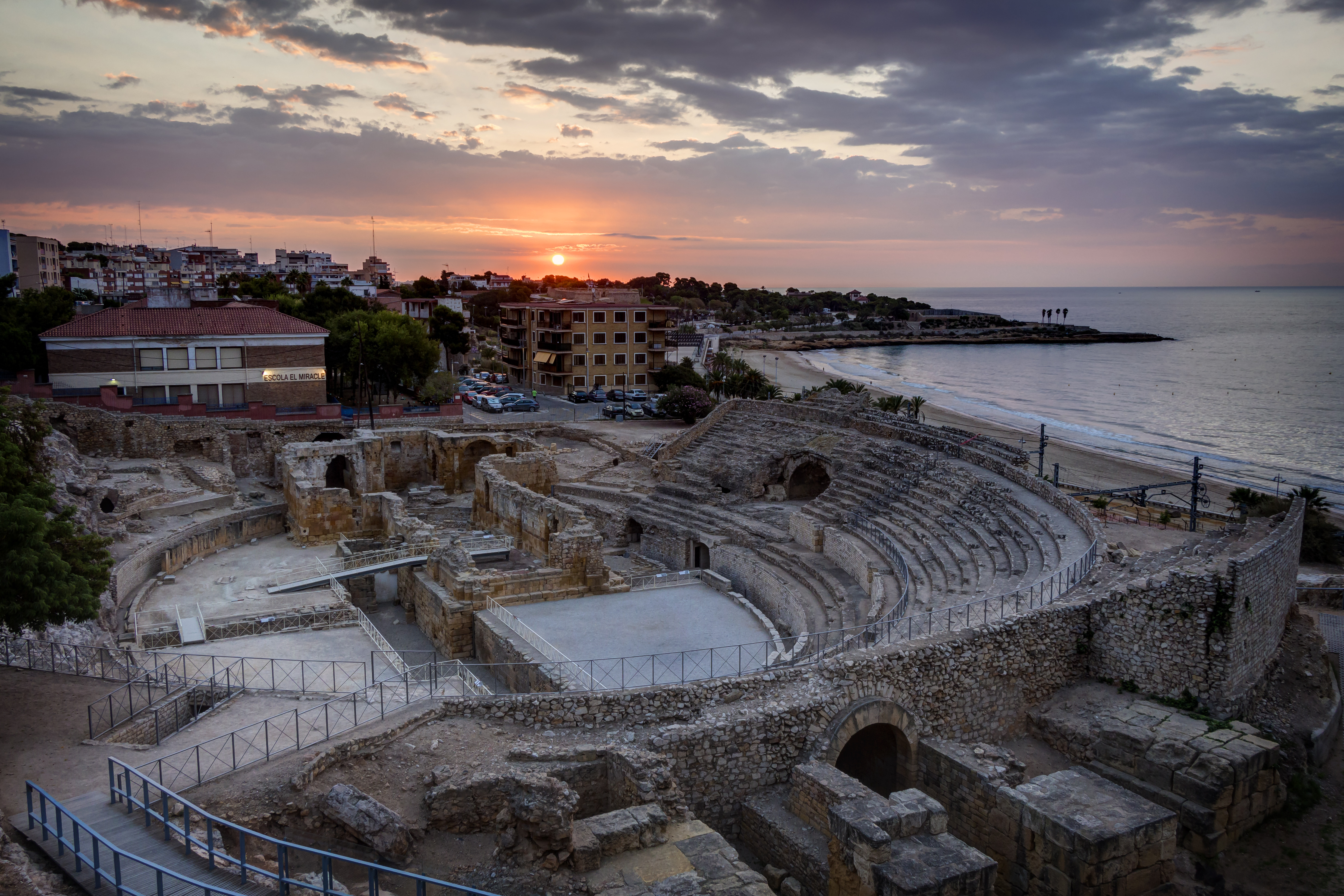
Tarragona Amphitheatre
Three men burned alive here in 259 AD, and the place has never quite let go of that fact. The Roman Amphitheatre of Tarraco sits at the edge of the Mediterranean, its stone tiers carved into a slope that drops toward the sea. Built at the turn of the 2nd century AD to seat 15,000 spectators for gladiatorial combat and beast hunts, it served the capital of Hispania Tarraconensis - one of Rome's most important provincial seats on the Iberian Peninsula. But it is the amphitheatre's afterlife, not its original purpose, that makes it remarkable. On this same sand where gladiators bled, Bishop Fructuosus and his deacons Augurius and Eulogius were executed during Emperor Valerian's persecution of Christians, transforming a place of entertainment into a site of martyrdom.
Blood and Sand by the Sea
Tarraco was Rome's gateway to Iberia. As the capital of Hispania Tarraconensis, it hosted emperors, administered provinces, and demanded the full apparatus of Roman civic life - including spectacles. The amphitheatre was built at the end of the 1st century and into the 2nd century AD, positioned below the city walls with the Mediterranean at its back. The elliptical arena measured approximately 130 meters along its long axis, large enough for elaborate staged hunts and multi-combatant gladiatorial contests. An inscription dating to the reign of Elagabalus in the 3rd century survives on the podium, hinting at renovations or imperial patronage during that flamboyant emperor's brief rule. For the 15,000 spectators packed into its tiers, the amphitheatre offered something no enclosed arena could: the sound of waves mixing with the roar of the crowd.
From Martyrdom to Sanctuary
The execution of Fructuosus and his deacons in 259 AD changed the amphitheatre's meaning permanently. Once Christianity became the empire's official religion in the late 4th century, the arena where blood sport had drawn cheering thousands became consecrated ground. A basilica rose over the sand where the three martyrs had burned, its stones cannibalized from the very structure that had witnessed their deaths. Tombs were cut into the arena floor. Funerary mausoleums attached themselves to the church walls like barnacles on a ship's hull. The amphitheatre had not been demolished - it had been repurposed, its identity overwritten by the faith it once tried to destroy.
A Building That Refused to Die
After the Islamic conquest of Iberia, the site fell into centuries of abandonment. When builders returned in the 12th century, they erected a Romanesque church directly over the ruins of the Visigothic basilica, layering yet another era onto the palimpsest. That church stood until 1915, when it was demolished - an act of archaeological clearance that revealed the strata beneath. But between those two churches, the amphitheatre had also served as a Trinitarian convent beginning in 1576 and later, from 1780, as a prison where convicts labored to build Tarragona's port. Each reuse left its mark: religious carvings atop Roman masonry, iron fixtures drilled into ancient stone, convent walls threading through gladiatorial corridors.
Ruins Open to the Sky
Recovery began in the mid-20th century, funded in part by the Bryant Foundation, and the amphitheatre was gradually excavated and stabilized. In 2000, UNESCO designated it part of the Archaeological Ensemble of Tarraco, recognizing the entire complex of Roman ruins in Tarragona as a World Heritage Site. Today the amphitheatre sits open to the Mediterranean air, its elliptical outline clearly readable even where the upper tiers have crumbled away. The foundations of the Visigothic basilica and the Romanesque church remain visible within the arena, ghostly outlines on the sand where gladiators once circled each other. Visitors stand where 15,000 Romans sat and look out at the same sea - unchanged while everything around it has been built, burned, consecrated, abandoned, imprisoned, and finally understood.
From the Air
Located at 41.11N, 1.26E on the Tarragona waterfront along the Mediterranean coast of Catalonia, Spain. The amphitheatre's elliptical outline is clearly visible from moderate altitude, sitting between the coastal road and the sea, just below the old city walls. Nearest airports: Reus Airport (LERS) approximately 8 km west, Barcelona-El Prat (LEBL) 90 km northeast. The Roman ruins contrast sharply with the modern city grid surrounding them. Best viewed on approach from the sea.