Tartu Art Museum
The building leans. You notice it from the street: the corner of the Tartu Art Museum visibly tilts to one side, the windows on the upper floors looking subtly off-true even after Polish restorers braced everything in place. The locals call it the Leaning House (Kreenima Maja in Estonian). It was built in 1793 on swampy ground beside the Town Hall Square, and the soft soil beneath the heavy stone foundation has been pulling it sideways ever since. The noble family that owned it carries one of the more famous names in Russian military history: Barclay de Tolly, the Russian commander whose strategic retreat in 1812 saved the Russian army to fight Napoleon another day.
Pallas and a Founding
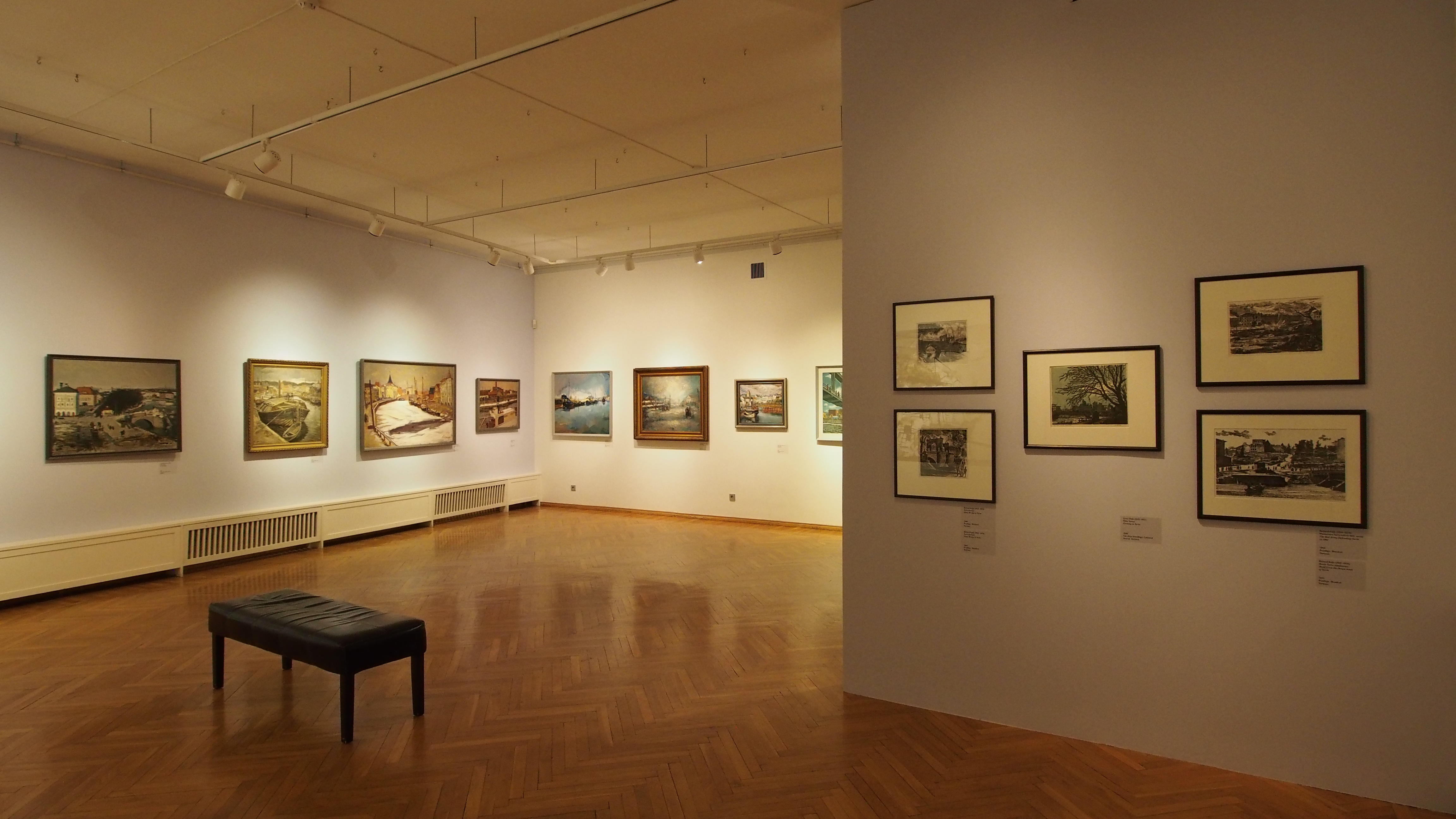
The Tartu Art Museum has its roots in the artistic association Pallas, which in 1918 founded the Higher Art School Pallas, the institution that did more than any other to shape modern Estonian visual art in the interwar republic. Twenty years after the association's founding, its members decided their school deserved a proper museum. On 17 November 1940, in the brief and bitter window between the first Soviet occupation and the Nazi invasion, the Tartu Municipality signed the founding decree. The museum opened at Suurturg 3, today Raekoja Square 3, on the western side of the Town Hall Square. The collection began with 133 works donated by Pallas artists; the first catalogue entry was a painting titled Interior by Ida Anton-Agu. In summer 1941 the State Ethnographic Museum (now the Estonian National Museum) handed over its 20th-century art holdings, doubling the collection in a single transfer.
Bombed, Moved, Rebuilt
The Second World War nearly destroyed the new museum. In 1943, during a bombing raid, the brick building at Lai 17, where the collection was then housed, collapsed. Most of the works were saved. The museum was relocated several more times in the war's chaos, finally settling in 1946 on two floors of a building at Vallikraavi 14. It moved again in 1988 to its current home, the Leaning House on Town Hall Square. Built in 1793 for the Barclay de Tolly family, the house had been built partly on solid ground and partly on swampy fill, and the differential settlement pulled the structure visibly sideways over the next two centuries. Polish restoration experts stabilized the building when the museum took it over, and it stopped falling, but the lean remains, and it remains the museum's signature.
An Estonian Canon
The collection now numbers around 23,000 works and is the largest art museum in Southern Estonia. Its core is the Pallas school: Konrad Magi, who turned the Estonian landscape into something molten and Fauvist, his Landscape of Vilsandi from 1913 hangs in the collection; Nikolai Triik, whose Winter in Tartu with Emajogi captures the river under ice; Karin Luts and her dreamy Composition. Island of Happiness from 1927; Ado Vabbe and Aleksander Vardi. Beside them sit the older masters, Johann Koehler from the 19th-century National Awakening period and Julie Wilhelmine Hagen-Schwartz, who broke out of Baltic German painting conventions to become one of the first professional female artists in the Russian Empire. The Russian school is represented by Ivan Aivazovsky's seascape Aiju-Dag, plus works by Ivan Shishkin, Maximilian Voloshin, Konstantin Somov, and the avant-garde duo Mikhail Larionov and Natalia Goncharova.
Provocation and Public Quarrels
Under the directorship of Rael Artel, who took over in 2013 after years of independent curating that included guest work at the Kumu Art Museum in Tallinn and the Art Museum in Lodz, the Tartu Art Museum has not shied away from controversy. The 2012 exhibition MOH? FUI! OAK! OSSA! VAU! gathered the most scandalous Estonian art since the 1990s and started a public debate about the borders of art that ran in newspapers for weeks. The 2015 show My Poland. On Recalling and Forgetting, an exhibition of contemporary Polish art about the Holocaust, did the same. These are uncommon arguments to host in a small Estonian museum, but they fit the city. Tartu is the university town, the more bookish and intellectual sister to Tallinn's commerce and government, and provoking debate is part of how it sees itself.
Town Hall Square from Above
Tartu's Town Hall Square sits in a curve of the Emajogi River, the river that drains the great lake Vortsjarv into Lake Peipus on the Russian border. The square is a fan of pastel facades sloping gently toward the river, the pink-and-white town hall at the head, the Art Museum at the lower left corner with its visible lean. From the air you can see the Stone Bridge that no longer exists (it was destroyed in 1941 by retreating Soviet forces), the modern road bridges that replaced it, the wooded mound of Toomemagi behind the square crowned with the ruins of Tartu Cathedral. The whole town fits inside a few square kilometers; the university campus, the Old Town, and the riverfront, all within easy walking distance of the Leaning House.
From the Air
The Tartu Art Museum sits on Town Hall Square at 58.38 N, 26.72 E, in the curve of the Emajogi River in southern Estonia. View from 3,000-4,000 feet to see the Town Hall Square, the Toomemagi park, and the cathedral ruins together. Tartu Airport (EETU) is 8 km south. Tallinn (EETN) is 187 km northwest. Best visibility in clear summer weather.