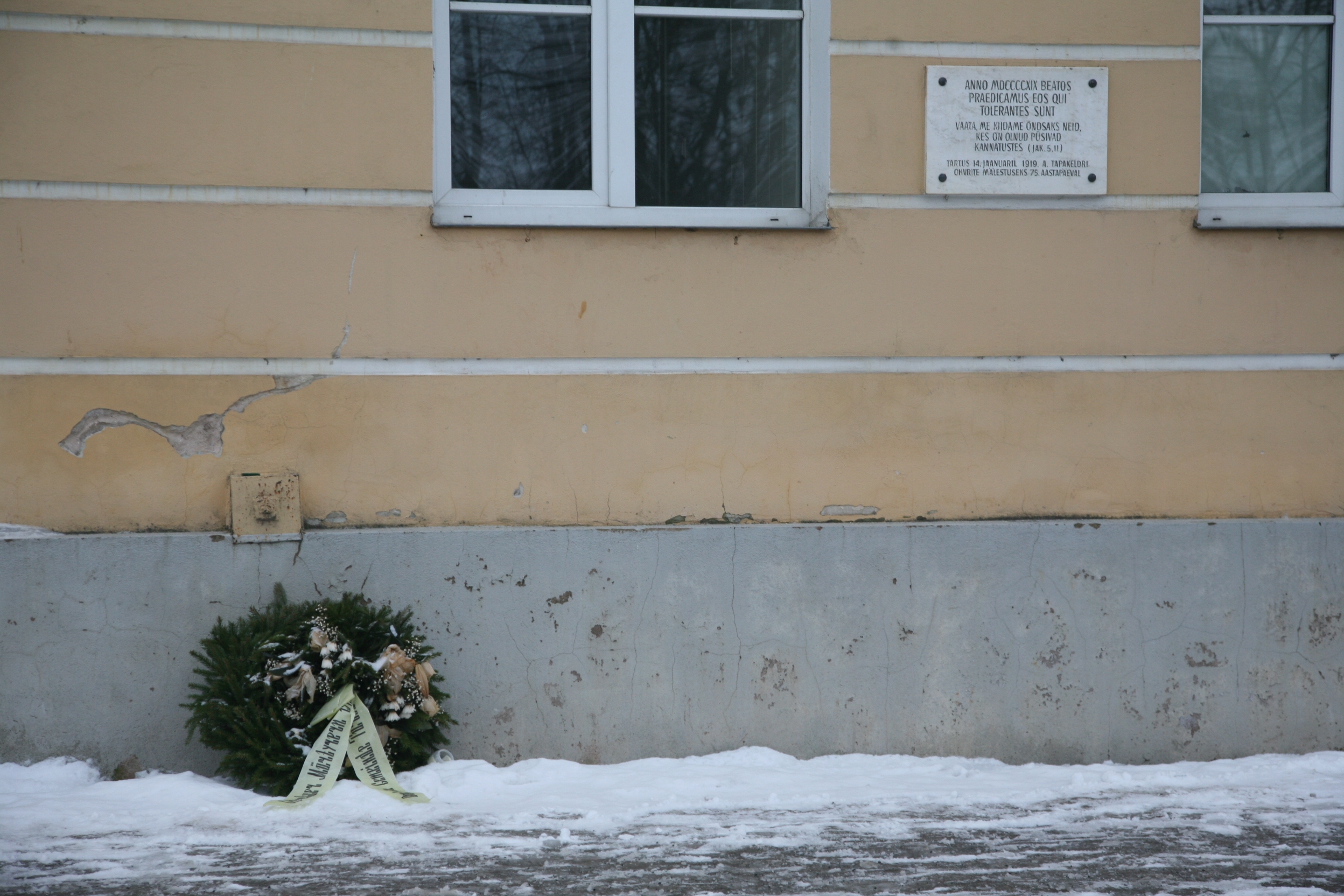
Tartu Credit Center massacre
Tuesday, 14 January 1919, began like any other day in the basement at 5 Kompani Street in Tartu, where the Bolshevik occupation authorities had been holding nineteen prisoners for the previous eleven days. Then word came through the windows: the White Guards were almost in the city, the Reds were leaving. Within minutes the cell doors were locked. A short man in a black fur cap entered with two armed companions and a list. He called out the name of Bishop Platon Kulbusch first. The bishop was led down to the basement. A muffled detonation came back up through the floor. The man returned and called another name. The pattern repeated itself for the next half hour, the survivors counting the gunshots, understanding what was happening below them. Nineteen people died that morning before the Estonian forces took the city.
Red Terror as Policy
The killings were part of a deliberate Soviet program. The Decree On the Red Terror, issued by the new Soviet government on 5 September 1918, formally authorized the execution of so-called enemies of the people or their internment in concentration camps. The Cheka, the Bolshevik secret police, had already begun mass executions before the decree was issued; the document gave the practice legal cover. Not all Bolshevik leaders approved. Nikolai Bukharin, Lev Kamenev, Mikhail Olminsky, and Grigory Petrovsky each criticized the powers granted to the Cheka. None of them stopped what was happening in places like Tartu. By January 1919 the Bolshevik occupation of Estonia was collapsing under the Estonian War of Independence, and the retreating Red forces took out their political enemies in detention before they fled. Two days before Tartu, the same penal squad had carried out executions in nearby Elistvere Parish.
The Nineteen
The dead were not anonymous. They included Platon Kulbusch, the Estonian Orthodox Bishop of Tallinn, who had returned from refuge to share his people's fate. Two Orthodox high priests died with him, Nikolai Bezhanitsky and Mikhail Bleive, both later canonized as hieromartyrs of the Eastern Orthodox Church. Two Lutheran pastors. Two professors of theology from the University of Tartu, Gotthilft Traugott Hahn and Moritz Wilhelm Paul Schwartz, who had spent their careers teaching scripture and now died for being teachers. Three estate owners. One estate manager. One restaurant owner. Two city councilors. A lawyer. A potter. A student. The head of the Baltic German community in Tartu, Arnold Johann Heinrich von Tideboehl. And, in a detail that suggests the killings were as much about settling local scores as about ideology, even one Red Army soldier with a Russian surname. The list reads like a cross-section of Tartu's professional and intellectual life, the people the new revolutionary order considered most dangerous to its own survival.
An Eyewitness Account
One survivor, Arved von Vegesack, published his account later in 1919 in a small booklet titled Dorpat, Compagnie-Strasse 5 vom 3. bis 14. Januar 1919. He described how the doors closed, how the policeman entered with his list, how Bishop Platon was the first taken. "A few minutes pass," Vegesack wrote, "and then we hear a muffled detonation below us, the meaning of which we cannot yet fathom." The pattern repeated itself, and gradually the prisoners understood. "It's in the basement below us," someone whispered. Then nothing more was said. "What we experience in our hearts during the following half hour cannot be expressed in words," Vegesack wrote. He watched the elderly priest Bezhanitsky, whom the prisoners called the patriarch, set out calmly and composedly on his last journey. He saw Professor Hahn rise from his seat, wrap his cloak around himself, and leave the room with long slow strides without looking back. He felt Herr von Krause's last warm handshake. "Always new victims! The minutes feel like eternities. The line of unfortunates never seems to end. Each of us expects to be next and for many of us it will be the case."
The Squad
The executions were carried out by the 2nd Viljandi Penal Squad, formed from the Estonian Red Riflemen Regiment, 117 men in total under Commissar Aleksander Jea. The use of Estonian-speaking Red troops to kill Estonian civilians was a particular cruelty of the early Soviet years, when the regime preferred to mask its violence as local against local. Within hours of the killings the Estonian forces took Tartu and the Bolshevik occupation collapsed. The bodies were found in the basement. Photographs were taken. The Estonian writer Eduard Vilde, then heading the Estonian News Bureau in Copenhagen, made sure the world heard about the massacres in Tartu and Rakvere; his account, with photographs, ran in the major French illustrated magazine L'Illustration under the title Lescrime du bolchevisme en Esthonie, the crime of Bolshevism in Estonia.
Memory and Memorial
Within weeks of the massacre, Jaan Poska, head of the Estonian delegation to the Paris Peace Conference, ordered a prayer service for the souls of Bishop Platon and the other victims at the Russian Orthodox Cathedral in Paris. The entire Estonian delegation attended. Through the half-century of Soviet occupation that followed Estonia's loss of independence in 1940, the killings could not be openly commemorated, but they were not forgotten. After the restoration of Estonian independence in 1991 the memory was officially honored again. In January 2009, ninety years after the killings, formal commemoration was held in Tartu as part of the city's annual remembrance of its 1919 liberation from the Bolsheviks. A memorial plaque marks the wall of the building at 3 Kompani Street where the basement still exists. In 2003 a bronze bas-relief of Bishop Platon was installed on the same wall. Bishops Platon and the priests Bezhanitsky and Bleive are venerated as hieromartyrs, killed for the faith, in the Eastern Orthodox calendar. The story of what happened in that basement is taught in Estonian schools as part of the founding history of the Republic, an early warning of what the next century would bring.
From the Air
The site of the Tartu Credit Center massacre is at 3 Kompani Street in central Tartu, at 58.38 N, 26.72 E, near the Emajogi River and the Town Hall Square. The building still stands; the cellar is intact. View from 3,000-4,000 feet to take in central Tartu, the river, and Toomemagi hill together. Tartu Airport (EETU) is 8 km south. Tallinn (EETN) is 187 km northwest.