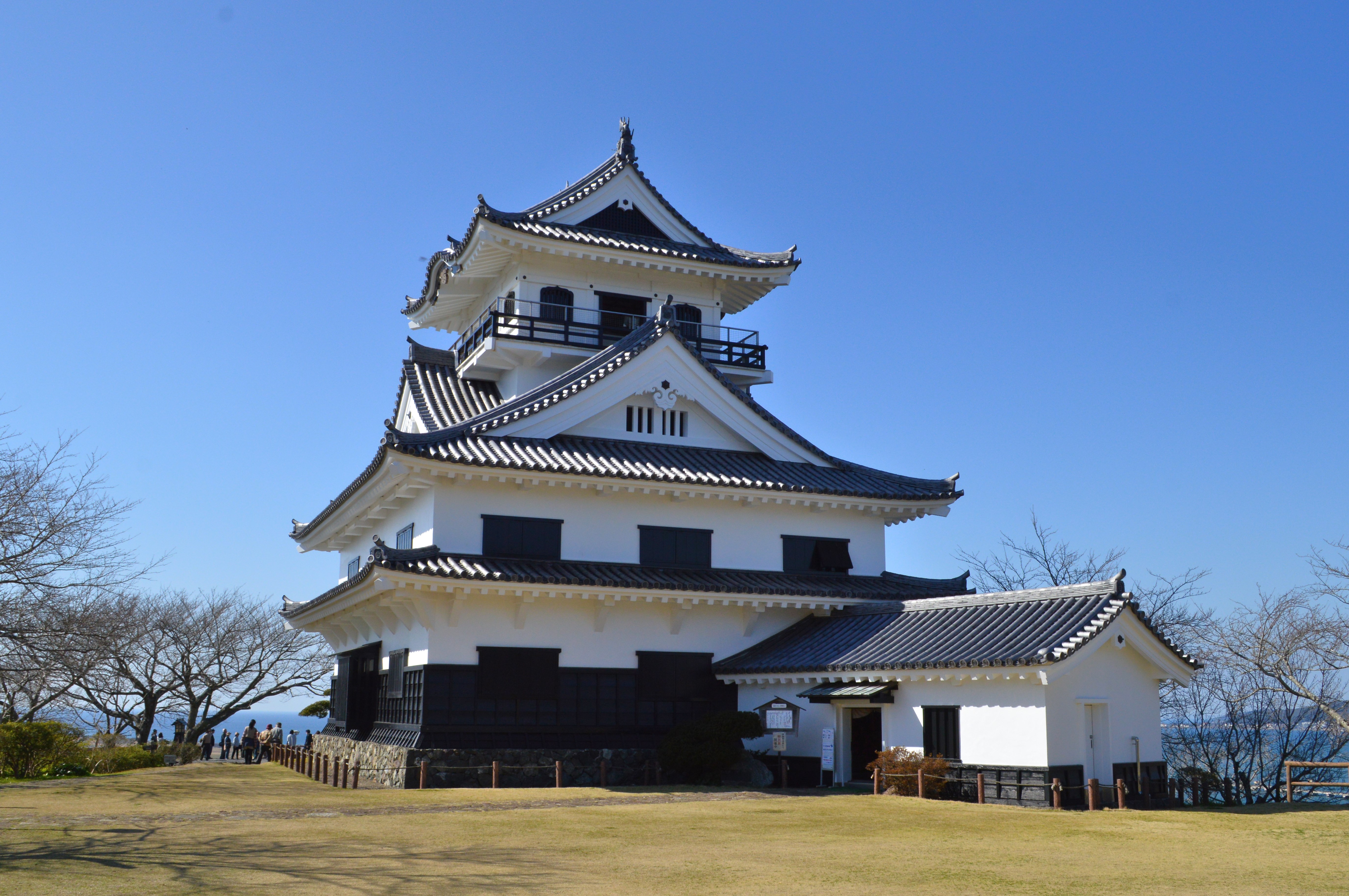
Tateyama Castle
The castle on the hilltop at the southern tip of the Boso Peninsula is not the one Satomi Yoshiyori built. That fortress -- raised in 1580 to command the mouth of Edo Bay and protect the domains of a lord who answered to no one -- was dismantled by the Tokugawa Shogunate after it crushed the Satomi clan in 1614. What stands there now is a 1982 reconstruction modeled after Inuyama Castle, because no records survive to show what the original looked like. Yet this replacement tells a story as rich as anything the original walls contained: a tale of rival clans, strategic geography, literary imagination, and a nineteenth-century novel so beloved that an entire castle was rebuilt in its honor.
The Warlord's Gatehouse
Satomi Yoshiyori was, for a time, the most powerful man on the Boso Peninsula. During the Sengoku period -- Japan's century of civil war -- he controlled virtually all of Awa Province and much of the surrounding territory. In 1580, he chose the hilltop overlooking the harbor at Tateyama to build his castle, a position that gave him commanding views across the entrance to Edo Bay. Any fleet approaching the future capital of the Tokugawa would have to pass under his guns. It was a statement of independence as much as strategy. The Satomi clan had ruled Awa for generations, and Yoshiyori intended to keep it that way. But the consolidation of power under the Tokugawa Shogunate left no room for independent lords. In 1614, the Shogunate destroyed the Satomi clan, suppressed Tateyama Domain, and let the castle crumble. For nearly 170 years, the hilltop stood empty.
A Second Life Under New Masters
In 1781, the Tokugawa government reversed course and reinstated Tateyama Domain under new management. Inaba Masaaki became the first daimyo of the revived domain, heading a branch of the Inaba clan. He rebuilt the castle's fortifications, strengthening walls and earthworks on the old hilltop site. But rebuilding did not mean restoration to former glory. Masaaki's successor, Inaba Masatake, was permitted only a jinya -- a modest fortified residence rather than a proper castle with a donjon tower. Under the rigid hierarchy of the Tokugawa system, the scale of your castle declared your rank, and the Inaba were not granted the status the Satomi had once seized by force. The Inaba clan held Tateyama quietly through the remaining decades of the Edo period, residing in their understated compound until the Meiji Restoration of 1868 swept away the feudal system entirely.
The Novel That Built a Castle
The Tateyama Castle that visitors see today owes its existence less to military history than to literature. In 1982, the city of Tateyama reconstructed a castle tower on the old hilltop site, primarily as an annex to the Tateyama City Museum. Since no images or plans of the original Satomi-era donjon survived, the architects modeled the new structure after Inuyama Castle in Aichi Prefecture, one of Japan's oldest surviving original castle towers. The result is handsome but historically approximate -- a generic symbol of feudal authority rather than a faithful reproduction. Inside, the exhibits focus not on the castle itself but on the epic novel Nanso Satomi Hakkenden, written by Edo-period author Takizawa Bakin over nearly three decades in the early nineteenth century. Bakin's sprawling tale of eight samurai brothers, bound together by magical beads representing Confucian virtues, is set in this very region among the Satomi clan. The novel became one of the most popular works of Japanese fiction, and Tateyama Castle serves as its shrine.
Cherry Blossoms and Kestrels
The castle grounds occupy a hillside park that draws visitors for reasons having nothing to do with feudal warfare or epic literature. In spring, the slopes erupt with sakura blossoms, and the hilltop becomes one of the most popular hanami spots in southern Chiba Prefecture. Birdwatchers come year-round, drawn by the park's position on the southern tip of the Boso Peninsula, where migrating raptors and seabirds pass through in significant numbers. From the reconstructed tower's upper floors, the view stretches across Tateyama's harbor to the blue expanse of Tokyo Bay, with the Miura Peninsula and the coast of Kanagawa visible on clear days. The same strategic geography that made this hilltop valuable to Satomi Yoshiyori in the sixteenth century makes it a spectacular viewpoint today. The difference is that the ships passing below are fishing boats and ferries, not warships, and the only battles being waged are between photographers jostling for the best angle on the cherry trees.
From the Air
Located at 34.981N, 139.856E on a hilltop in the city of Tateyama at the southern tip of the Boso Peninsula, Chiba Prefecture. The reconstructed castle tower is visible on the forested hill above Tateyama harbor. Approach from the south or west over Tokyo Bay for the best perspective, with the castle silhouetted against the town below. Recommended viewing altitude: 2,000-4,000 feet. The Boso Peninsula narrows dramatically here, with the Pacific to the east and Tokyo Bay to the west. Nearby airports: Tokyo Haneda (RJTT) approximately 50nm north-northwest, Tokyo Narita (RJAA) approximately 65nm north-northeast, Tateyama Air Base (RJTE) immediately adjacent to the town. The harbor and beach areas below the castle provide additional visual reference points.