Tatoi Palace
Forty-two square kilometres of Mediterranean pine forest run up the southeast slope of Mount Parnitha 27 kilometres north of central Athens, and at the heart of them stands a yellow stuccoed villa with green shutters, in some places lovingly restored, in some places still showing the burns of the 2021 wildfires. This is Tatoi, the summer palace of the former Greek royal family. The Athenians of antiquity called the area Dekeleia and built a fort here in the Peloponnesian War. The Athenians of the late twentieth century, mostly, did their best to forget about it. Twenty-three members of the House of Glucksburg lie in the small cemetery at the south end, ending with King Constantine II, who was buried here in January 2023.
A Danish Prince in Greek Pinewoods
George I was born Wilhelm of Schleswig-Holstein-Sonderburg-Glucksburg in Copenhagen in 1845, and arrived in Athens at age seventeen as the chosen replacement for the unpopular King Otto. He bought the Tatoi estate in 1872 with private funds he had carried from Denmark, partly because he wanted somewhere to retreat from the heat and politics of Athens, and partly because he understood that a king without his own land was not entirely a king. He laid out a model farm. He planted vineyards. He brought in Danish dairy cattle and built railway sidings to ship Tatoi wine to Athens. The villa itself was a comfortable Italianate house, more country squire than imperial palace. Successive generations of the family added stables, a Russian-style chapel, a power station, a telegraph office, and a network of estate roads. They lived there in summer, and many of them chose to be buried there.
Fires, Wars, and Confiscations
Tatoi has burned more than once. In July 1916 an arsonist set the palace alight; the royal family escaped, but sixteen palace personnel and firefighters died in the blaze. The estate was confiscated during the Second Hellenic Republic in the 1920s, returned to King George II in 1936, and then suffered the long indignity of the Second World War. While the king was in exile in Cairo and Greece groaned under German occupation, the woods at Tatoi were chopped down for fuel and corpses were buried in shallow graves on the estate. George II returned in 1946, the family returned, and Tatoi resumed its slow patrician rhythm until 1967, when the colonels' coup forced the young King Constantine II into exile in December of that year. He never lived at Tatoi again. The estate was abandoned in 1973, the cattle and horses left in the stables to starve, vandalism and looting picking the buildings clean.
The Slow Argument
In 1994 the socialist government of Andreas Papandreou formally confiscated the royal estates. What followed was almost three decades of legal argument, political indifference, and gentle decay. With government permission, the exiled Constantine removed nine cargo crates of personal items in 1993; some of them surfaced at a Christie's auction in 2007. Seventeen thousand objects remained in storage at the Ministry of Culture, including antiquities, old masters, and a life-size portrait of Queen Anne-Marie. A 2007 announcement to turn the palace into a museum was followed by a 2012 announcement to sell it instead. The Friends of Tatoi Association, founded in 2012, has lobbied steadily for restoration. Ten royal cars were declared cultural monuments in 2015; they sat in the ruined garage with the roof falling on them until 2020, when they were finally moved and restored.
The 2021 Fires and What Came After
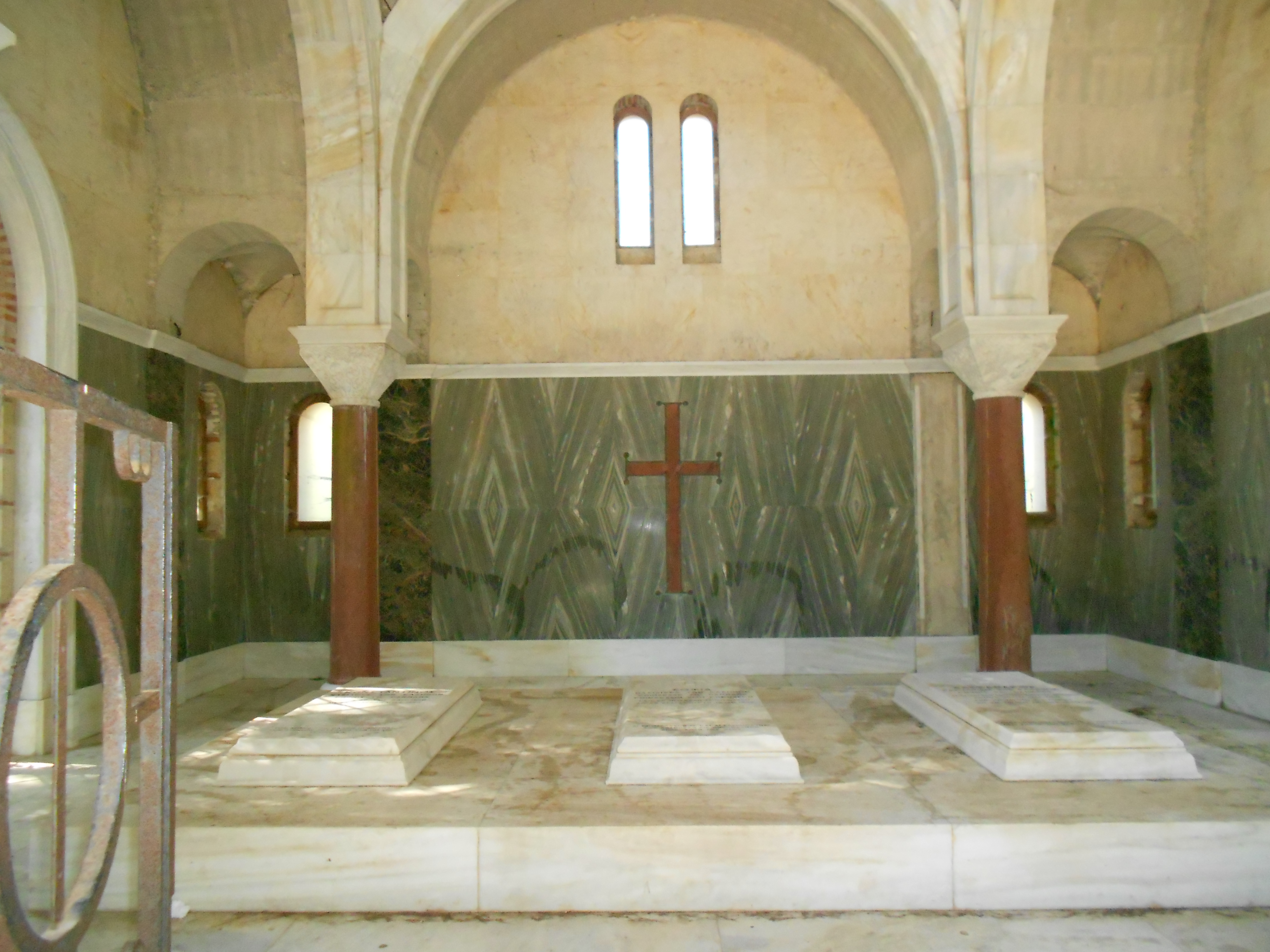
On the second day of August 2021, Greece burned. The fire that swept Mount Parnitha consumed 42,000 acres of the Tatoi estate and broke into the palace itself. The main villa was saved by firefighters; two adjoining storage containers full of objects were lost. The royal cemetery burned, but the mausoleum housing Constantine I, Sophia of Prussia, and Alexander, and the small Church of the Resurrection nearby, both survived. Several outbuildings did not: the Directorate building, full of furniture, the caretaker's house, the Telegraph Office, and Sturm House. The fires forced the question of Tatoi's future to a head. After Constantine II died in January 2023 and was buried with quiet ceremony beside his ancestors, the Greek Minister of Culture, Lina Mendoni, announced that the palace would become a museum by late 2025. Restoration is now under way.
What's Buried at Tatoi
The royal cemetery sits in a clearing among burnt and recovering pines. George I lies there, assassinated in Thessaloniki in 1913. Alexander, who died at twenty-seven in 1920 from blood poisoning after his pet monkey bit him, lies near him. Constantine I, twice deposed, twice exiled, dead in Sicily in 1923, was brought home and buried here. So was Paul, his son, who reigned through the civil war years, and Frederica, his queen, whose conservative politics divided post-war Greece. Constantine II, the last king, exiled at twenty-seven, died in Athens at eighty-two and was buried here on 16 January 2023. The list goes on through twenty-three names, the family that ruled Greece from 1863 to 1974 and then continued to bury its dead in the soil it no longer owned. The forest started recovering in 2024. By the time the museum opens, the pines around the graves should be green again.
From the Air
Tatoi Palace lies at 38.16 degrees north, 23.79 degrees east, on the southeast slope of Mount Parnitha 27 km north of central Athens. The disused Tatoi airfield (LGTT, formerly Hellenic Air Force Academy) lies on the estate itself; Athens International (LGAV) is 35 km southeast. From cruising altitude the dark forested wedge of Parnitha is unmistakable just north of the urban sprawl. The palace itself is a small cluster of pale buildings near the southern edge of the woods. Summer haze and the lingering smoke of fire seasons can reduce visibility; winter and spring offer the clearest views.