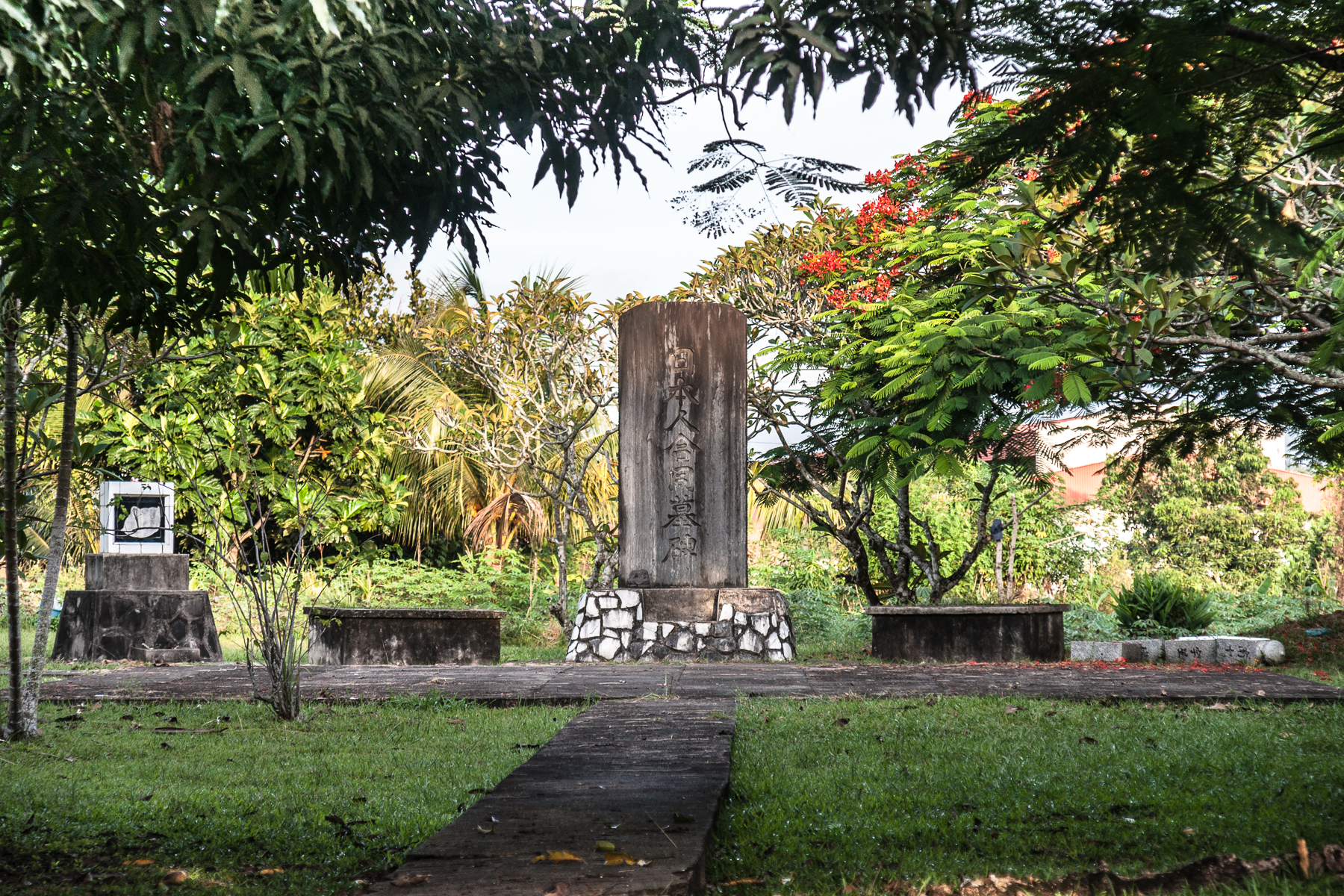
Tawau Japanese War Memorial
Five names are carved into one of the gravestones: Sadatoshi Ohta, Ryoichi Muromoto, Isao Ohtomo, Koji Matsuo, Takeshi Kusumoto. They did not die in combat. The vast majority of the people buried in Tawau's Japanese cemetery died before World War II, during a period when Japanese settlers came to North Borneo not as soldiers but as farmers, planting rubber and coconut under the tropical sun. The cemetery on Tanjung Batu Street is now a war memorial, but its stones tell an older story - one of commerce, immigration, and the tangled alliances that drew Japan to the far edge of Borneo.
Planters Before Soldiers
The Anglo-Japanese Alliance of 1902 opened doors across the British Empire for Japanese enterprise. In Tawau, on the southeast coast of what was then British North Borneo, Japanese businessmen saw opportunity in the fertile land. On 19 January 1916, the Nippon Industrial Company purchased 240 acres for rubber cultivation and another 607 hectares of adjacent land. The resulting estate, known as the Kuhara Estate, produced rubber and Manila hemp under the ownership of Fusanosuke Kuhara, a Japanese industrialist who would later become a prominent political figure in Japan. A second plantation, the Kubota Estate, specialized in coconut and began operations the same year under Kubota Umeme. The growing Japanese community needed a burial ground, and so the cemetery was established - a practical necessity for a settler population that intended to stay.
Between Two Wars
Most of the graves predate 1941. The people buried here were planters, laborers, and their families - the ordinary dead of a community far from home. They died of tropical diseases, accidents, old age, the unremarkable causes that don't make history books. The cemetery served a community that lived under British administration, traded in the colonial economy, and maintained its cultural practices on foreign soil. Japanese characters on the headstones marked the names and dates of lives lived in the equatorial heat of Borneo. When the war came in December 1941, the relationship between the Japanese community in Tawau and the British administration was shattered. Japanese forces occupied North Borneo, transforming the settlement from a colonial outpost into a military position.
From Cemetery to Memorial
After the war, the cemetery's function changed. The Japanese community that had sustained it was largely gone - some repatriated, others displaced by the upheaval of occupation and liberation. Monuments were added after the war, including one dated 25 May 1988 bearing rows of Japanese characters. The site was fenced on three sides. Over the decades, only a few relics recalled its original purpose as a burial ground. The transition from active cemetery to memorial reflected Tawau's own transformation: a town that had been razed by Allied bombing in 1944, rebuilt in the postwar years, and gradually absorbed its complicated history into a Malaysian identity that acknowledged the Japanese presence without celebrating it.
The Road to Tanjung Batu
Today the memorial sits on Tanjung Batu Street, west of the Tawau Golf Course. It is not a major tourist attraction. There are no crowds, no guided tours, no gift shops. The fencing and the few remaining gravestones occupy a quiet plot in a town that has grown up around them. Kuhara Road, one of Tawau's main streets, still carries the name of the Japanese industrialist whose plantation helped build the settlement. The memorial exists in the space between forgetting and remembering - maintained enough to persist, modest enough to avoid controversy. The names on the stones belong to people who came to Borneo seeking a living, not a war. That distinction, carved in granite, has outlasted the empires that made it possible.
From the Air
Located at 4.267N, 117.878E on Tanjung Batu Street in Tawau, west of the Tawau Golf Course. The memorial is a small ground-level site, not individually visible from altitude, but it sits within Tawau's western residential area. Tawau Airport (WBKW) is approximately 5 km to the northeast. The Celebes Sea coastline runs south of the site. Cowie Bay and Sebatik Island are visible from altitude to the south.