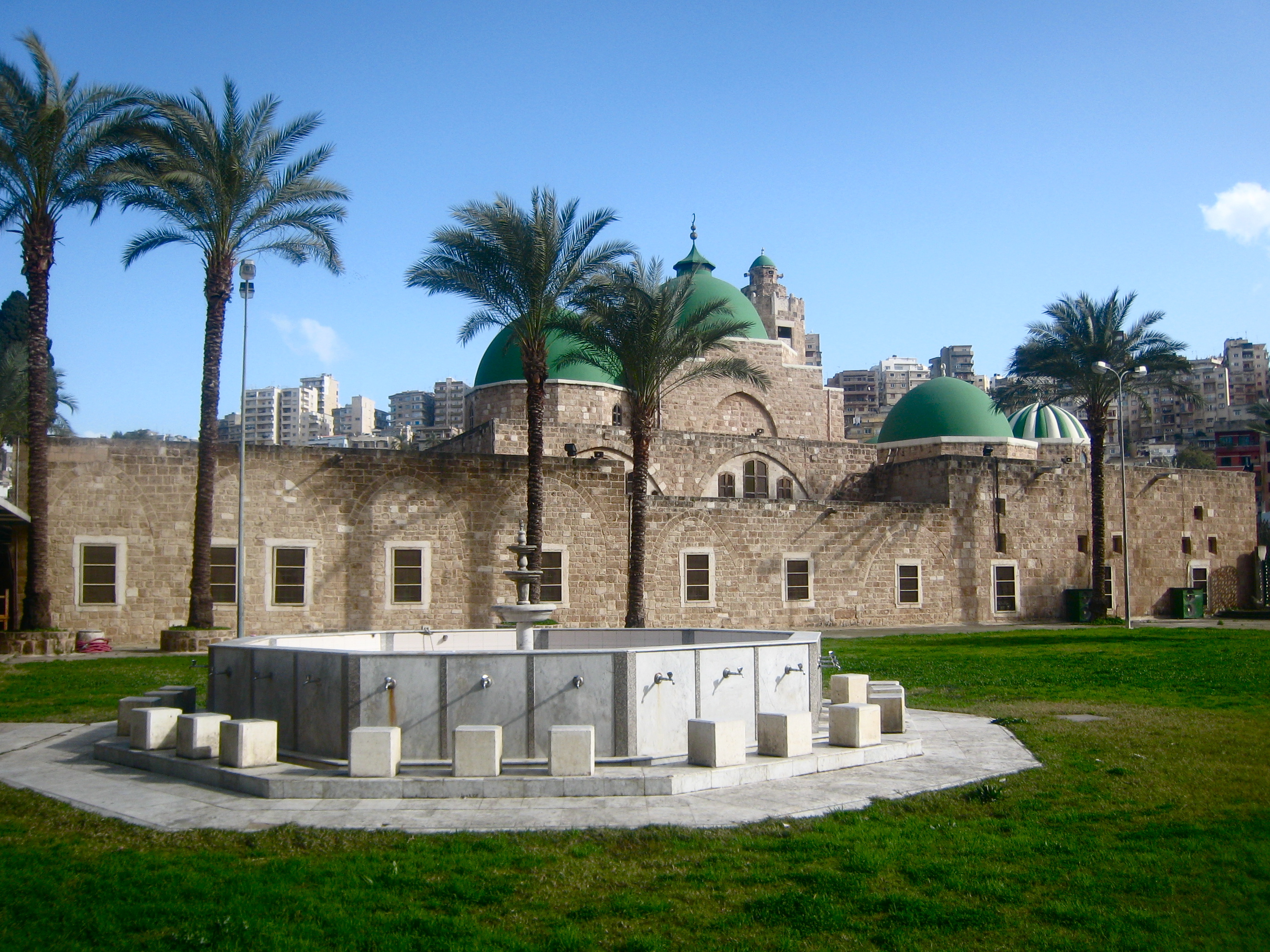
Taynal Mosque
The columns do not belong here. Four granite shafts topped with Corinthian capitals rise from the floor of the Taynal Mosque in Tripoli, Lebanon, holding up Mamluk-era domes in a building that dates to the fourteenth century. The capitals are Roman. The columns may have stood in a temple to Zeus before a Carmelite church was built over the ruins during the Crusader period. The Mamluks then built their mosque over the church. Three civilizations deep, the Taynal Mosque is an architectural palimpsest where each layer left something behind that the next could not erase.
Black, White, and Ancient
The mosque sits on the left bank of the Kadisha River, near the Bab al-Raml cemetery, in an area that was once orchards. Its layout is unusual: two consecutive halls, the second accessible only through the first, as if the builders were stacking one sacred space behind another. The first hall is entered through a portal with a large pointed arch sheltering a doorway built in ablaq, the signature Mamluk technique of alternating black and white stone. Inside, four columns arranged in a square divide the space into three unequal aisles. The central aisle is covered by two large domes resting on corner squinches, the second dome taller than the first. The floor beneath them is patterned in black and white marble, geometric designs from the Mamluk era that feel both austere and opulent at once.
The Inner Sanctum
Passing through a second portal, this one entirely in ablaq masonry and crowned by a muqarnas canopy of honeycomb vaulting, visitors enter the mosque's more intimate second hall. A large sunken court dominates the center, covered by a dome supported by four heavy corner pillars. A gallery runs around the perimeter under cross-vaults. In the southern section, a smaller but more ornate dome marks the approach to the mihrab, the niche indicating the direction of Mecca. The mihrab itself is modest, flanked by two marble colonettes. Beside it stands the wooden minbar, completed in June or July of 1336 by a master carpenter named Muhammad al-Safadi. His inscription survives on the pulpit, and so does his craftsmanship: the minbar's geometric motifs are among the finest surviving examples of Mamluk woodworking, their interlocking patterns as precise as mathematics.
A Tower with Twin Stairs
The minaret attached to the second section of the mosque has its own eccentricities. A square shaft supports a slightly wider octagonal section braced by buttresses, topped by a balcony with a small cylindrical turret at its center. Most unusual of all, twin spiral staircases wind through the tower's interior, one accessible from inside the mosque and the other from outside, allowing the muezzin to ascend without passing through the prayer hall. The design is practical, but it also gives the minaret the feeling of a building within a building, a vertical maze set atop an already layered structure. When the traveler al-Nabulsi visited in 1700, he noted the mosque's lovely appearance but found its layout strange. Three centuries later, the strangeness remains part of the appeal.
Shelter and Survival
In the twentieth century, the Taynal Mosque took on a role its Mamluk builders could not have anticipated. For roughly fifteen years, the building served as a shelter for Palestinian refugees, its halls housing displaced families where worshippers once prayed. The mosque survived that chapter, as it has survived earthquakes, the erosion of centuries, and the general turbulence of life in northern Lebanon. Standing in the first hall, looking up at the Roman columns holding Mamluk domes above a floor that may cover the foundations of a temple to Zeus, you are reminded that this place has always been about adaptation. Each builder used what came before. Each generation found a reason to keep the walls standing.
From the Air
Located at 34.431°N, 35.838°E on the left bank of the Kadisha River in Tripoli, Lebanon, near the Bab al-Raml cemetery. The mosque is within the historic Mamluk quarter southwest of the Citadel of Tripoli. Tripoli Air Base lies approximately 3 km to the north. From altitude, the mosque's distinctive double-dome roofline and square minaret are identifiable among the dense old-city fabric. Best viewed at 2,000-3,000 ft AGL.