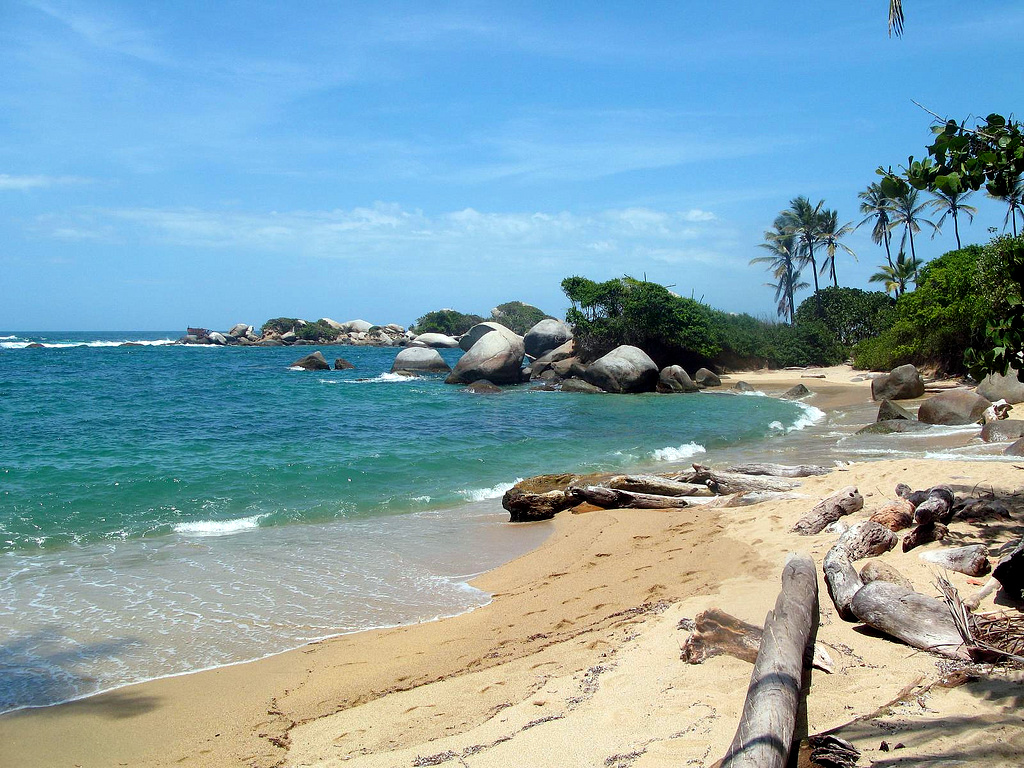
Tayrona National Natural Park
Somewhere between the snow-capped peaks of the Sierra Nevada de Santa Marta and the warm Caribbean, the jungle simply refuses to stop. It tumbles down mountain slopes, crashes through river gorges, and doesn't quit until it hits the sand. This is Tayrona National Natural Park, 150 square kilometers of Colombian coastline where the world's tallest coastal mountain range meets the sea, and where the boundaries between forest, reef, and beach blur into something that feels less like a national park and more like a fever dream of biodiversity. In 2022, more than 545,000 visitors came to see it for themselves -- making Tayrona the second most visited national park in Colombia.
Mountains That Touch the Sea
Geography shapes everything here. The Sierra Nevada de Santa Marta rises to over 5,700 meters just 42 kilometers from the coast, creating one of the steepest ecological gradients on Earth. Within the park's boundaries, elevations range from sea level to 900 meters, compressing multiple climate zones into a narrow coastal strip. The result is a landscape of almost absurd variety: arid scrublands give way to dense tropical forest within a few hundred meters, and rivers born in distant snowfields cut through the canopy on their way to the Caribbean. The Piedras River, the Cañaveral, and the Gairaca creek all carve their paths through the park, feeding freshwater into a marine zone that extends 30 square kilometers offshore. Coral reefs flourish in these waters -- Tayrona is one of only three national parks in the Colombian Caribbean that protect living reef systems, alongside Old Providence McBean Lagoon and the Rosario and San Bernardo Corals.
A Census of the Wild
The numbers alone tell a story of staggering richness. Scientists have catalogued roughly 108 mammal species in the park, from mantled howler monkeys whose dawn chorus shakes the canopy to oncillas -- small, secretive wild cats rarely seen even by researchers. More than 70 bat species hunt through the twilight. Three hundred bird species have been recorded, among them the montane solitary eagle, the military macaw, and the lance-tailed manakin, whose elaborate courtship dances play out on low forest branches. Beneath the surface, the diversity only intensifies: 110 coral species, 700 species of molluscs, 471 crustacean species, and 401 species of fish inhabit the park's waters. On land, more than 770 plant species and 350 types of algae round out an ecosystem that seems determined to fill every available niche. Even the cotton-top tamarin, critically endangered and found nowhere else on the planet, clings to survival in these forests.
Stones the Tairona Left Behind
Long before this became a national park, it was home. Archaeological evidence traces human settlement in the Tayrona area back centuries, with the most prominent remains belonging to the Tairona civilization that flourished here before the Spanish arrival in the 16th century. The Archaeologic Museum of Chairama, situated at the Cañaveral site near the mouth of the Piedras River, houses artifacts from these ancient communities. Nearby, the ruins of El Pueblito once drew hikers along a popular trail through the jungle to stone terraces and foundations that hint at a sophisticated settlement pattern. Since 2019, however, that trail has been closed at the request of the indigenous communities who still consider this land sacred. The Kogui people, direct descendants of the Tairona, continue to live in the Sierra Nevada and view the park not as a tourist destination but as a living part of their spiritual geography.
Where the Trails Lead
For those who do come, Tayrona offers a coastline that alternates between accessible and wild. Cabo San Juan is among the most popular swimming areas -- a horseshoe bay backed by boulders and palms where hammocks swing over the surf. Playa Brava earns its name with rougher waters and a wilder feel. Beaches like Neguanje, Gayraca, and Cinto line the coast between rocky headlands, each reachable by jungle trails that wind past howler monkeys and iridescent butterflies. Offshore, the protected reefs draw scuba divers to shallow training areas and deeper sites with currents suited for drift diving. The park's trails connect these worlds -- Los Naranjos Path leads through dense forest, while Castilletes Beach opens onto one of the broader stretches of sand. The heat is constant, with temperatures hovering around 27 degrees Celsius at sea level, and the tropical air carries the weight of humidity that the Sierra Nevada's snowmelt can't quite cool.
From the Air
Located at 11.28°N, 74.18°W along Colombia's northern Caribbean coast. The park is visually striking from altitude: look for the dramatic transition where the green slopes of the Sierra Nevada de Santa Marta drop abruptly into turquoise Caribbean waters. The coastline is scalloped with small bays and rocky headlands. Nearest major airport is Simón Bolívar International Airport (SKSM) in Santa Marta, approximately 34 km southwest. Best viewed below 10,000 feet for reef and beach detail. The Sierra Nevada's snow-capped peaks rising behind the coast make an unmistakable landmark.