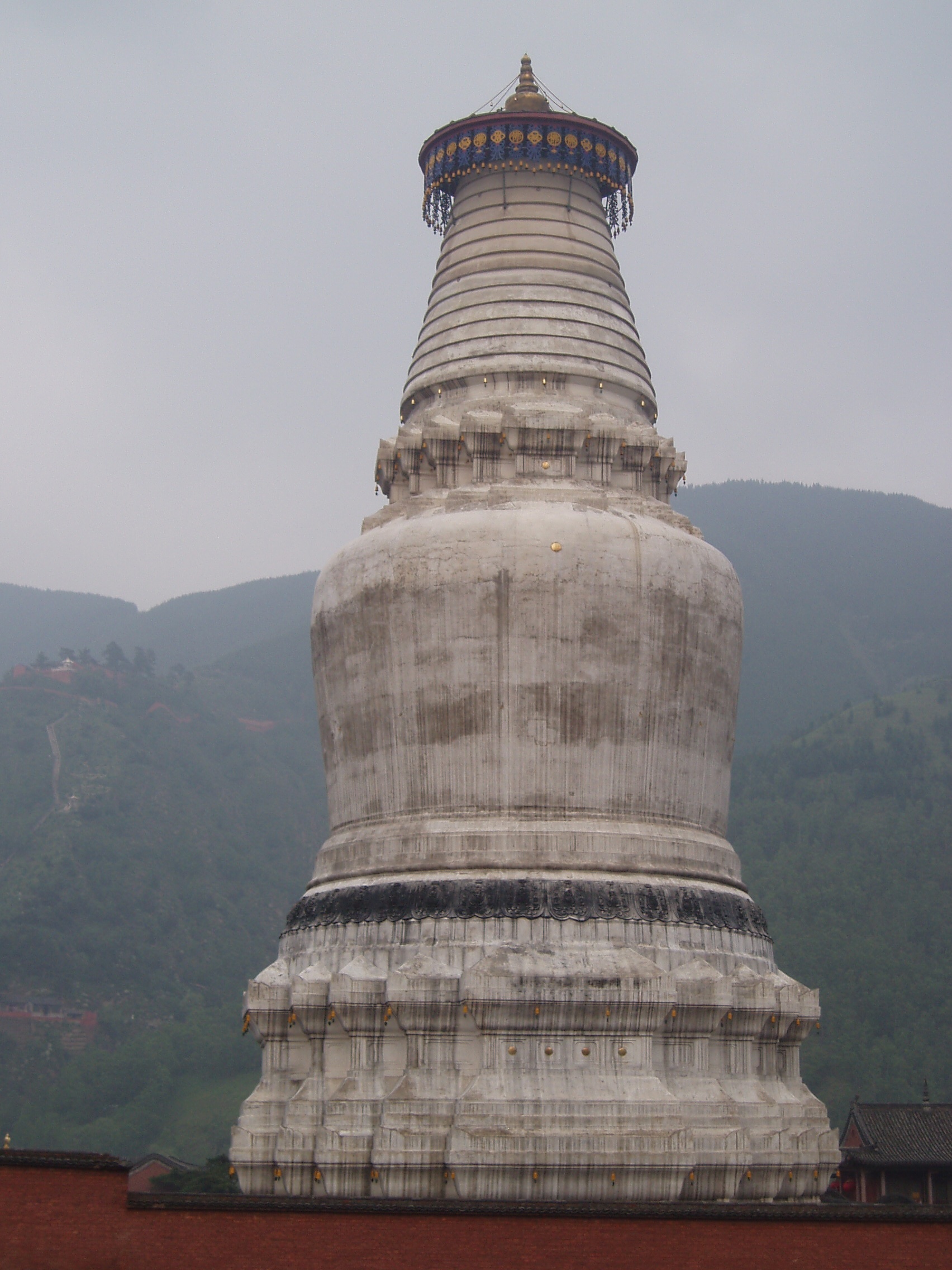
Tayuan Temple
When wind-bells ring from the Great White Pagoda at Tayuan Temple, the sound carries across the entire Taihuai valley. The pagoda stands 75.3 meters tall -- a Tibetan-style stupa coated in white lime that towers above every other structure on Mount Wutai, its bronze spires and copper canopy catching the light. This single white tower, visible from nearly every point in the temple complex, has become the symbol of the mountain itself. If Mount Wutai has a center, this is it.
From Stupa to Temple
Tayuan Temple began as something smaller: a stupa belonging to the adjacent Xiantong Temple. The original structure, the Great White Pagoda, was constructed in 1302 during the Yuan dynasty. In 1407, during the Yongle reign of the Ming dynasty, the site was expanded into a full temple complex and given the name Tayuan -- literally "Pagoda Courtyard." The expansion transformed a single devotional monument into one of Mount Wutai's most important monasteries, recognized as one of the five great temples for practicing Chan Buddhism and one of the ten famous temples for accommodating monks on the mountain.
The Library of Twenty Thousand Sutras
Behind the Great White Pagoda stands the Cangjing Mansion, a scripture library that houses one of the most remarkable text collections in Chinese Buddhist history. Twenty layers of wooden rotating wheels fill the structure, each holding scriptures that total more than 20,000 Buddhist sutras written in Chinese, Mongolian, and Tibetan characters. Among them are over 2,000 complete sutras written between the Song dynasty and the Qianlong reign of the Qing dynasty. The trilingual collection reflects Mount Wutai's position at the crossroads of Chinese, Mongolian, and Tibetan Buddhist traditions -- a place where these three literary and devotional cultures converged and cross-pollinated for centuries.
Bells in the Wind
The Great White Pagoda sits on a rectangular base, constructed of brick with the lime coating that gives it its color. Its tower spires, trays, and the pearl at its crown are all cast in bronze. Wind-bells hang between the tiers of the pagoda and along the canopy, and when the mountain breezes stir them, the resulting cascade of metallic sound has been described for centuries as one of the defining sensory experiences of Mount Wutai. To the east of the Great White Pagoda stands a smaller companion: the Manjushri Hair Pagoda. Legend holds that it contains golden hairs shed by the bodhisattva Manjushri when he appeared to worshippers on earth -- a relic that would make this the most sacred spot on an already sacred mountain.
Axis of the Sacred
Tayuan Temple covers 15,000 square meters and contains over 130 halls and houses. Its central axis moves through screen walls, stone tablets, arches, stairways, gates, drum towers, Tianwang Hall, Daci Yanshou Hall, the Cangjing Mansion, and the Shanhai Mansion. Three exquisite wooden-arch structures from the Ming dynasty's Wanli reign survive intact: Shakyamuni Buddha Hall at the front, the Cangjing Mansion at the rear, and the Great White Pagoda between them. Designated a National Key Buddhist Temple in Han Chinese Area in 1983, Tayuan Temple today carries the same gravity it has held for seven centuries -- the place where architecture, devotion, and the mountain landscape converge into something greater than any single element.
From the Air
Located at 39.01N, 113.59E in the central area of Taihuai Town on Mount Wutai, Shanxi Province, China. The 75.3-meter Great White Pagoda is the dominant visual landmark of the entire temple complex and is unmistakable from the air -- a tall white tower surrounded by traditional Chinese rooftops in a mountain valley. Elevation approximately 1,700 meters. Nearest airports: Wutai Mountain Airport (ZBWT) at roughly 50 km and Taiyuan Wusu International Airport (ZBYN) approximately 230 km southwest. Recommend 2,000-4,000 feet AGL for best viewing of the pagoda and surrounding temple grounds.