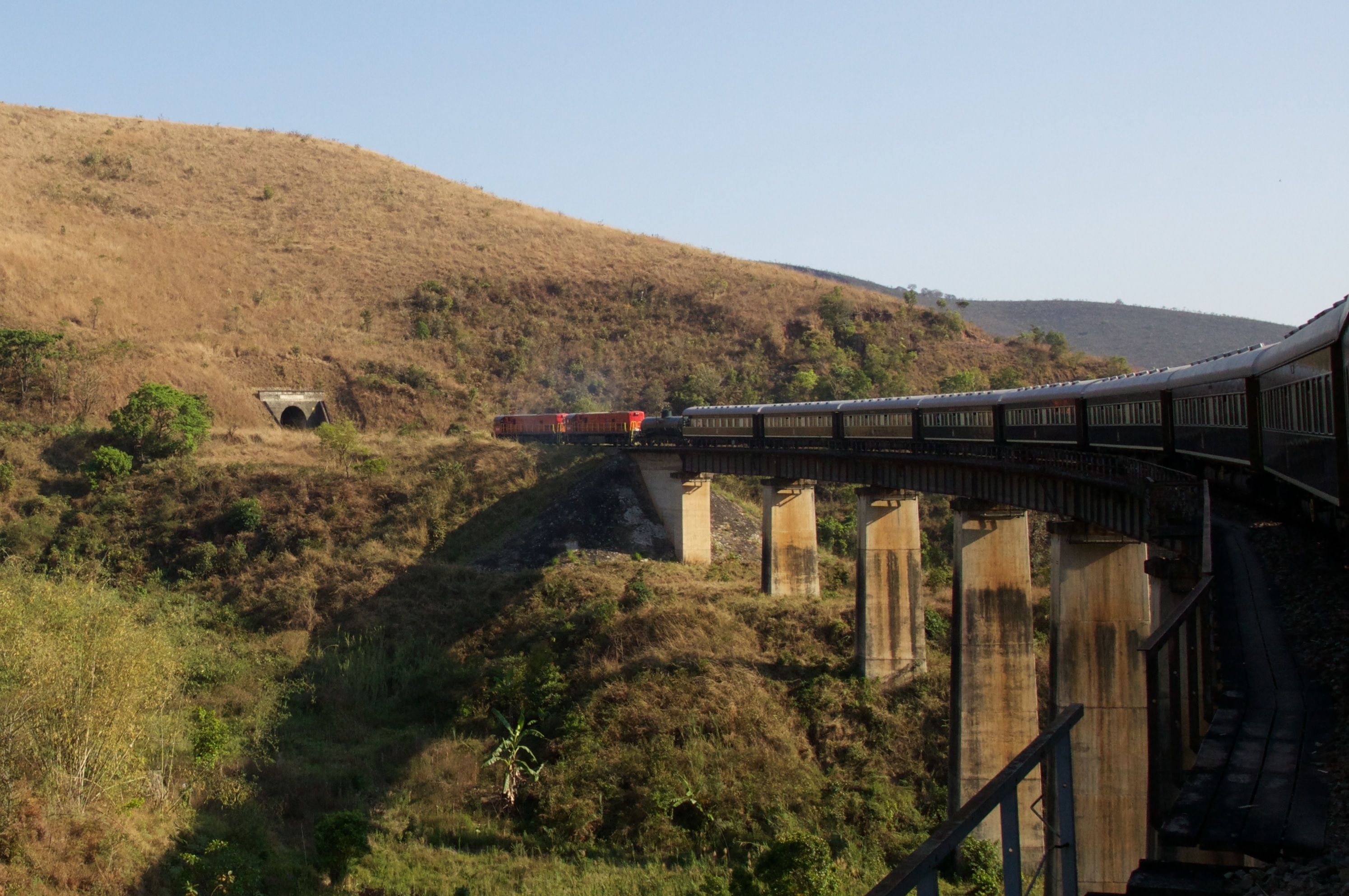
TAZARA Railway
The conductor is just as likely to ask you for a cigarette as he is to check your ticket. That single detail tells you everything about the TAZARA Railway, the 1,860-kilometre line connecting Kapiri Mposhi in central Zambia to Dar es Salaam on the Tanzanian coast. Built by China between 1970 and 1975, the railway was a Cold War-era infrastructure project that required moving 330,000 tons of rail and 89 million cubic metres of earth and rock, constructing 93 stations, 320 bridges, 22 tunnels, and 2,225 culverts. Virtually all building materials, equipment, and significant quantities of food and medical supplies were shipped from China. The first passenger train arrived in Dar es Salaam on 24 October 1975. Half a century later, the wagons are old, the beds are spongy, and the train runs when it runs. That is precisely the point.
Cold War Steel Through the Savannah
The idea of a railway into the heart of southern Africa had circulated since the late nineteenth century, mostly in British imperial circles. Nothing happened until independence changed the calculus. Tanzania under Julius Nyerere (independent in 1961) and Zambia under Kenneth Kaunda (1964) needed a railway to develop their remote agricultural southwest and northeast, respectively. Zambia had an additional urgency: landlocked and dependent on rail routes through white-ruled Rhodesia and Portuguese Mozambique, it needed an alternative export corridor. Western nations and the World Bank declined to fund the project. China, seeking influence in the region, stepped in. At its peak, fifteen thousand Chinese workers laboured alongside an equal number of Africans. The line they built crosses some of the most sparsely populated terrain on the continent, threading through miombo woodland, savannah, and the edges of game reserves where elephants still cross the tracks -- sometimes fatally, for the elephants, and always at the cost of several hours' delay.
The Train Leaves When It Leaves
Riding the TAZARA is an exercise in surrendering the illusion of control. There is a published schedule, but it serves more as a statement of aspiration than a commitment. The journey might take three days. It might take five. The train stops at villages so remote that children gather to trade bananas and whatever else they have for the glass bottles passengers discard. Rolling down the window is not just permitted but encouraged -- the air carries the smell of woodsmoke and red earth, and at night the sounds of the savannah press in close. Food is available from vendors along the way, though travellers are advised to bring their own provisions. The regional staple is ugali, a dense maize porridge. If you get beans with your ugali, consider yourself fortunate. The dining situation improves slightly if you stock up before departure -- in Dar es Salaam, or in Lusaka if heading east, since Kapiri Mposhi itself offers next to nothing.
The Charm of Controlled Disorder
Experienced TAZARA travellers recommend buying an entire cabin rather than individual berths. The reasoning is practical: you control who enters your space, you can sell extra beds to travellers you trust, and your belongings are more secure. Theft is a real concern for foreign passengers, whose accents and appearance mark them as targets. The mathematics of poverty apply without malice -- an unattended bag represents opportunity. Solo travellers in shared accommodation learn quickly to stay with their things or make reliable friends. The bathrooms offer a striking view of the tracks receding into the distance, though not much else to recommend extended visits. When the train arrives at its terminus -- Kapiri Mposhi or Dar es Salaam -- passengers are unceremoniously ejected regardless of the hour. A three-in-the-morning arrival means joining locals bedding down in the station until dawn brings taxis and sense.
The Last Great African Train Ride
As of 2023, negotiations are underway with China about upgrading the TAZARA line. The proposed modernization would bring air-conditioned cars and express service, transforming what is currently a gruelling multiday adventure into something more efficient and far less memorable. Kenya's "Lunatic Express" underwent a similar transformation, gaining speed and comfort at the cost of its legendary character. For the communities along the line, modernization would be an unqualified good -- faster connections to markets, better access to services, economic development for some of the most isolated areas on the continent. For the traveller who came for the experience of the journey itself, the window is closing. The TAZARA remains, for now, the quintessential long-distance African train ride: slow, unpredictable, occasionally uncomfortable, and utterly irreplaceable. The savannah rolls past the open window. The elephants call in the night. The conductor asks for a cigarette. Get it while you can.
From the Air
The TAZARA railway runs approximately 1,860 km from Kapiri Mposhi, Zambia (approximately 14.97S, 28.68E) to Dar es Salaam, Tanzania (approximately 6.82S, 39.28E). The coordinates given (9.32S, 32.76E) place the reference point in the remote section of the line in southwestern Tanzania. From altitude, the railway line is visible as a thin corridor through otherwise roadless miombo woodland and savannah. Major airports along or near the route include Dar es Salaam (HTDA), Lusaka (FLLS, with ground transfer to Kapiri Mposhi), and Mbeya (HTMB) in Tanzania's Southern Highlands near the route.