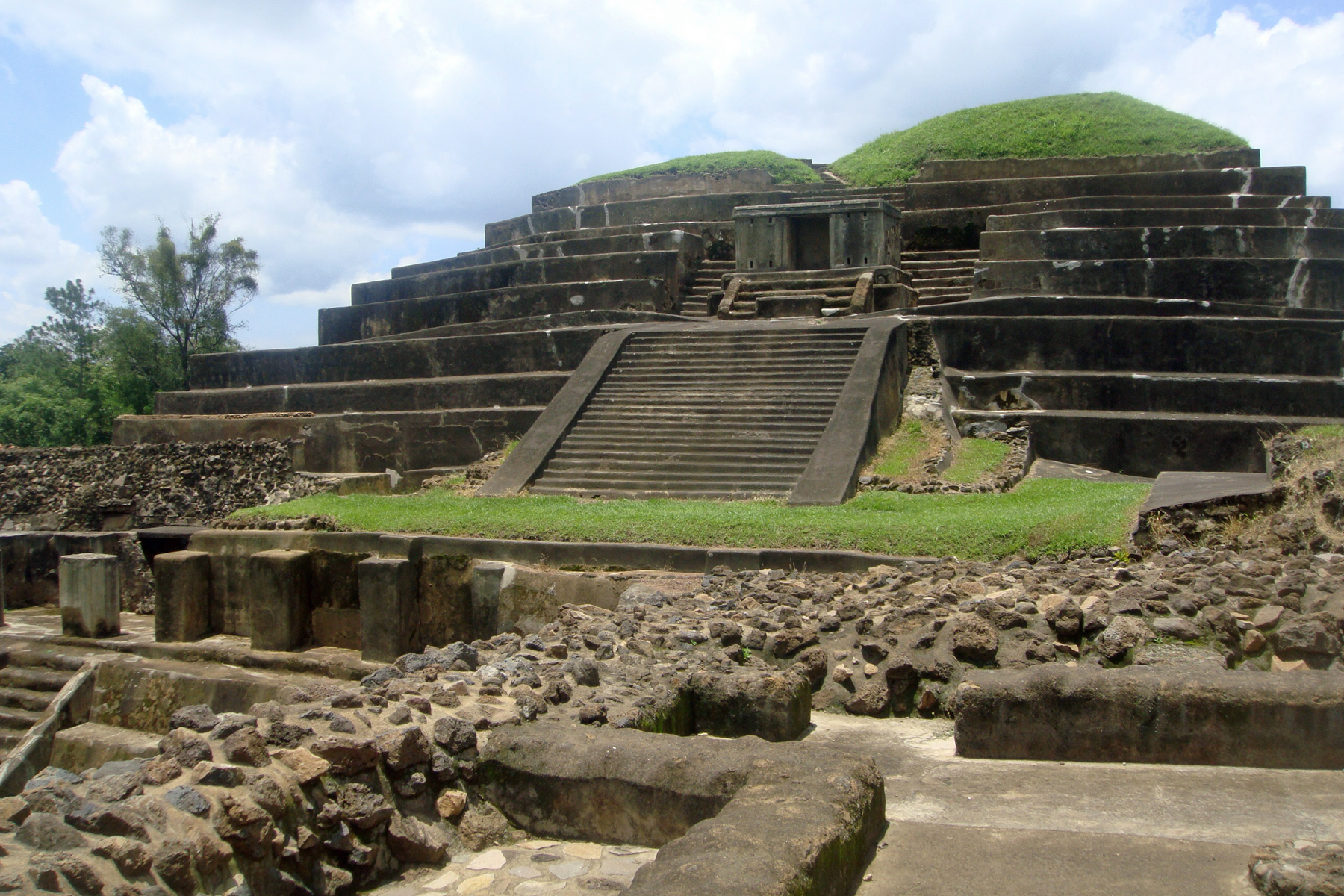
Tazumal
In the K'iche' language, Tazumal means "pyramid where the victims were burned." The name has outlasted the ceremonies it once described, and the pyramid still dominates the town of Chalchuapa in western El Salvador -- 24 meters of layered stone rising from a site that was occupied, abandoned, rebuilt, and reoccupied across more than a millennium. When archaeologist Stanley Boggs began excavating in the 1940s, he found something unusual for a site this far south: evidence of connections stretching to Teotihuacan in central Mexico, to Copan in Honduras, to Chichen Itza on the Yucatan Peninsula, and to Kaminaljuyu in the Guatemalan highlands. Tazumal was not a provincial outpost. It was a crossroads.
A Volcano Interrupts
Chalchuapa was already ancient when Tazumal's builders began their work. The broader archaeological zone shows massive construction from the Preclassic period, evidence of a city that once rivaled its neighbors in scale and ambition. Then the Ilopango volcano, 75 kilometers to the east, erupted catastrophically. The blast blanketed the region in ash and brought construction to a halt for what may have been several generations. When activity resumed during the Early to Middle Classic period, the city never fully recovered its former energy. But Tazumal came closest. Its principal structures date to the Classic period, roughly AD 200 to 900, and by the Late Classic it had become an important ceremonial complex -- the place where Chalchuapa concentrated whatever power and purpose remained after the volcanic devastation.
Trade Routes in Stone
The artifacts tell a story of reach. Green obsidian found at Tazumal could only have come from central Mexico. Ceramics and architectural styles echo Copan, the great Maya city in western Honduras. Sculptures of Xipe Totec, the central Mexican deity of spring and renewal, and chacmool figures characteristic of Toltec and Maya traditions turned up in the excavations. Three gold ornaments, created using the lost-wax casting method and tentatively dated to the eighth century AD, point to contacts with lower Central America -- making them among the earliest metal artifacts reported anywhere in Mesoamerica. The Pipil people, who spoke Nahuatl and shared cultural roots with the Aztecs, left their mark here too, though scholars debate whether their influence came through direct settlement or through trade with neighboring Pipil communities.
The Pyramid Rebuilt and Rebuilt Again
Structure B1-1, the principal pyramid, underwent at least four major phases of construction. Each generation built over the last, expanding the footprint and adding height. The earliest phase stood 4.7 meters tall with three stepped levels. Successive builders raised it to five levels and 6.5 meters before the Temple of the Columns was added on its western platform -- a structure with square columns and twin chambers that may have served as the pyramid's main ceremonial facade. All buildings at Tazumal face west, an orientation consistent across the complex. An I-shaped ballcourt, discovered through test pits in the early 2000s, speaks to the ritual life that surrounded the pyramid. In October 2004, the south side of the structure collapsed, undermined by cedar roots that had penetrated six meters into walls made brittle by Boggs's 1950s restoration, which had coated the ancient stone in modern cement that trapped water inside.
What the Dead Carried
Beneath the platforms, burials tell quieter stories. Workers excavating the eastern platform of B1-1 reported finding many graves, though Boggs never documented them in his reports -- a gap that frustrates modern archaeologists. One burial that was properly recorded, found under the western facade of Structure B1-2, contained the remains of a child, accompanied by ceramic pieces and ashes. Radiocarbon dating placed it between AD 770 and 1000, the transition from Late Classic to Early Postclassic. The ceramic sequence at Tazumal continues uninterrupted from the Classic period through approximately AD 1200, meaning the site was active for a thousand years. Today, Tazumal sits within walking distance of downtown Chalchuapa, its pyramid visible above the rooftops -- a monument to the civilizations that built, burned, buried, and rebuilt in this volcanic corner of Central America.
From the Air
Located at 13.98N, 89.67W within the municipality of Chalchuapa in the Santa Ana department of western El Salvador. From altitude, the pyramid complex is visible as a cleared archaeological zone within the modern town grid. The site sits in the Rio Paz drainage basin, approximately 120 km from the ruins of Kaminaljuyu in Guatemala. Nearest major airport is El Salvador International (MSLP), roughly 80 km southeast. The Santa Ana Volcano is a prominent landmark to the south. The town of Chalchuapa and surrounding agricultural land provide contrast to the cleared archaeological precinct.