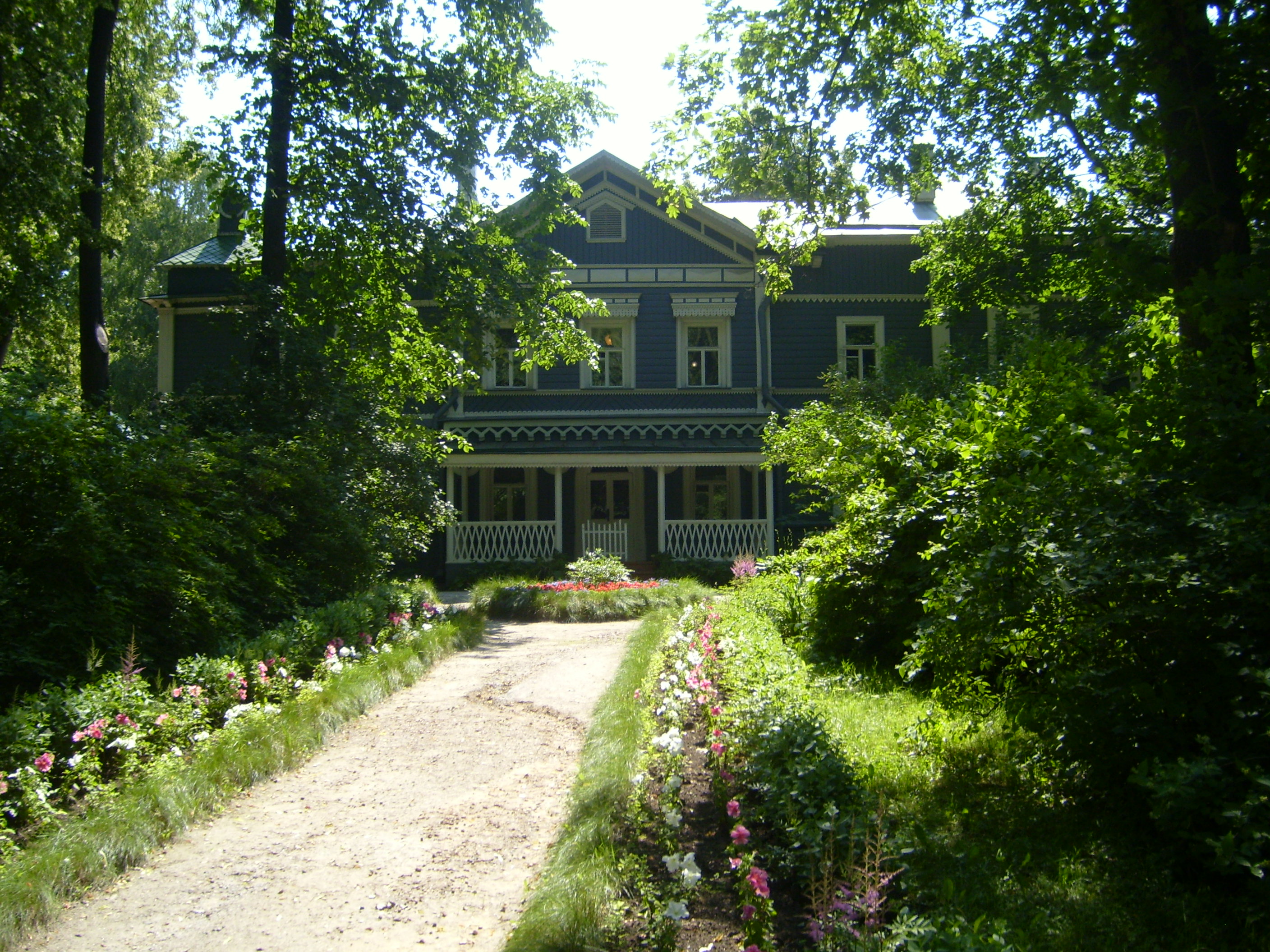
Tchaikovsky State House-Museum
On a plain, unpainted table made of Karelian birch by village workers, overlooking a garden that was more idealized forest than manicured lawn, Pyotr Ilyich Tchaikovsky composed his Sixth Symphony, the Pathetique. He finished the work in this house in the small town of Klin, 85 kilometers northwest of Moscow. On October 7, 1893, he left for Saint Petersburg to conduct the premiere. Eighteen days later he was dead, at the age of 53. The house remains almost exactly as he left it, its rooms frozen in the routines and possessions of a man who needed silence, solitude, and the Russian countryside to create some of the most performed music in the Western canon.
A Composer in Search of Quiet
Tchaikovsky's relationship with Klin began in 1885, when he rented a small house in the nearby village of Maidanovo. He wrote to his friend and patron Nadezhda von Meck: "I dream of settling in a village not far from Moscow. I can't wander any longer." The Maidanovo house sat on the bank of the Sestra River, surrounded by an overgrown park with ponds and old lime trees, close enough to the railway for trips to Moscow and Saint Petersburg but far enough to discourage casual visitors. There he rewrote his 1874 opera Vakula the Smith into the new opera Cherevichki, composed the Manfred Symphony, and established the daily habits that would define his creative life. But vacationers and admirers found him even there, so he moved first to Frolovskoye and then, in May 1892, to the Sakharov house in Klin that would become his final home.
The Rituals of Creation
Tchaikovsky's brother Modest described a routine that was monastic in its discipline. He rose between seven and eight each morning. After tea and reading came a solitary walk of about an hour. If he spoke to anyone at breakfast, or walked in company, he would not compose that day, turning instead to instrumentation, corrections, or correspondence. After dinner, another walk, alone and in any weather. "Solitude during walks was as necessary for him as it was during work," Modest wrote. "In those moments he thought over the main musical themes and formed the ideas of future compositions." The evenings brought reading, piano for guests, and duets with visiting musicians. He never performed piano publicly in a concert hall, reserving that intimacy for the people who came to his house.
Rooms That Still Speak
The house was built in the 1870s by V.S. Sakharov on land granted by Emperor Nicholas I. Tchaikovsky lived upstairs; his servant Alexei Sofronov and family occupied the ground floor. The largest room, serving as both reception room and study, holds his Becker grand piano, given to him by the Saint Petersburg firm in 1885. Above his writing desk hangs a portrait of Anton Rubinstein, founder of the Saint Petersburg Conservatory and his first teacher of composition. Below Rubinstein is Beethoven. The walls are covered with family photographs, the bookcases filled with Russian and foreign literature and bound sets of magazines. Among the gifts displayed in cabinets is an inkwell shaped like the Statue of Liberty, presented during his 1891 visit to New York. Through a curtained doorway lies the bedroom where he composed on that birch table, the last surface his pen touched before he left Klin forever.
Lilies of the Valley and Oak Trees
Tchaikovsky adored his garden, which he kept deliberately untidy, more forest path than formal arrangement, with a winding trail leading to a gazebo at the far end. He loved wildflowers above all, especially the lily of the valley, for which he wrote a poem. After his death, Modest planted beds of lilies of the valley throughout the grounds, along with violets, forget-me-nots, and bluebells. The garden still contains roses, begonias, gillyflowers, phloxes, and sweet tobacco, the same varieties Tchaikovsky knew. A more modern tradition has layered onto the old: beginning in 1958, winners of the International Tchaikovsky Competition, including Van Cliburn, Mikhail Pletnev, and Boris Berezovsky, have been invited to Klin to play the composer's piano. Competition musicians plant oak trees in the garden, so the landscape grows alongside the legacy.
Surviving Revolution and Occupation
Russia's first musical memorial museum almost did not survive its first decades. After Tchaikovsky's death, Modest and the composer's nephew Vladimir Davydov established the museum, preserving the house and creating an archive of scores and manuscripts. When Modest died in 1916, he willed the property to the Russian Musical Society with instructions to follow the model of the Mozart Museum in Salzburg. A year later, the Bolshevik revolution brought an anarchist named Doroshenko, who moved his family into the museum and reportedly shot at a portrait of Pope Innocent. He was arrested in 1918, and the Soviet state declared the house a protected site. The German occupation during the Battle of Moscow in 1941-42 was worse: soldiers used the ground floor as a motorcycle garage and the upper floor as a barracks. The collection had been evacuated to Votkinsk, Tchaikovsky's birthplace, and was returned in 1944. The museum reopened on May 6, 1945, the eve of the composer's birthday. Vladimir Horowitz was among the pianists given the honor of playing Tchaikovsky's own grand piano in the years that followed.
From the Air
Located at 56.33°N, 36.75°E in Klin, Moscow Oblast, approximately 85 km northwest of central Moscow. The town of Klin sits along the Moscow-Saint Petersburg highway and railway corridor. Nearest major airport is Sheremetyevo (UUEE), approximately 60 km to the southeast. The museum is a small estate property not easily distinguishable from the air; identify by the town of Klin on the Sestra River. Flat to gently rolling terrain with mixed forest.