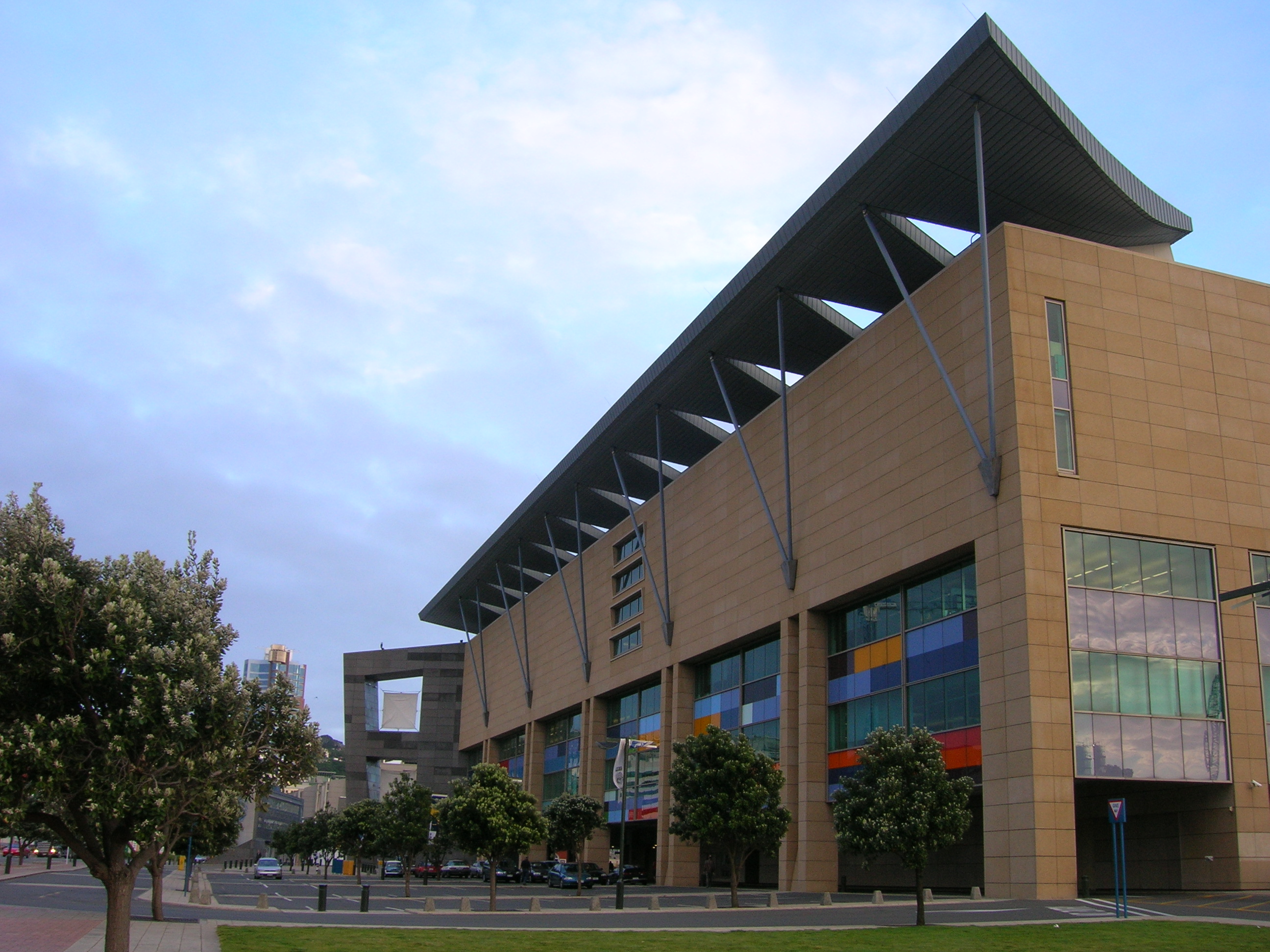
Te Papa
Before the museum could be built, a hotel had to be moved. Over five months in 1993, a modern five-storey hotel on Cable Street was jacked off its foundations, loaded onto rail bogies, and transported 200 meters down and across the road to a new site, where it became the Museum Hotel. Then the real work began. The soft reclaimed land -- it had once been Wellington Harbour -- was compacted by dropping weights of up to 30 tonnes from heights of 30 metres, more than 50,000 times, in a criss-cross pattern across the site. The noise shook neighboring buildings for weeks. What rose from that pummeled earth was Te Papa Tongarewa, the Museum of New Zealand -- a name that translates from Maori as "container of treasured things and people that spring from mother Earth here in New Zealand." It opened on 14 February 1998, and more than a million people have visited every year since.
A Museum Born Twice
Te Papa's roots reach back to 1865, when Sir James Hector founded the Colonial Museum on Museum Street in Wellington's Thorndon neighborhood. That first institution prioritized scientific collections but accepted whatever came through the door -- prints, paintings, ethnographic objects, antiquities. By 1907 it was renamed the Dominion Museum and gained a broader mandate. The National Art Gallery moved into the same building in 1934 after Parliament passed the National Art Gallery and Dominion Museum Act, and the two institutions shared a single board of trustees for decades. In 1936, they moved together into a purpose-built structure on Buckle Street beside the newly constructed National War Memorial. For more than fifty years, art and natural history cohabited uneasily in that building. Te Papa was established by an Act of Parliament in 1992 to merge the two institutions into something neither had been alone: a bicultural national museum that would give equal weight to Maori and European perspectives on New Zealand's identity.
Built on Shaky Ground, by Design
Designing a national museum on reclaimed land beside one of the world's most active fault lines required nerve and engineering in equal measure. Jasmax Architects designed the building and Fletcher Construction built it, at a cost of NZ$300 million. The 36,000 square-metre structure uses base isolation technology -- the same approach used in New Zealand's Parliament Buildings -- which allows the building to move independently of the ground during an earthquake. The design process itself followed bicultural principles based on the Treaty of Waitangi, led by artist Cliff Whiting working alongside founding CEO Cheryll Sotheran and designer Ken Gorbey. Six floors contain exhibitions, cafes, and gift shops. Outdoor areas incorporate artificial caves, native bush, and wetlands. A separate building on Tory Street houses scientific research facilities and archives that stretch back to James Hector's original collections from 1865. The siting has drawn criticism -- why place irreplaceable taonga at the water's edge on unstable ground? -- but the engineering has held, and the location on the Wellington waterfront gives the museum a dramatic presence that a safer inland site could not match.
The Squid and the Stamps
Te Papa's collections span the improbable to the intimate. The museum holds the world's largest specimen of the colossal squid, Mesonychoteuthis hamiltoni, weighing 495 kilograms and measuring 4.2 meters long. It arrived in March 2007 after being captured by New Zealand fishers in the Ross Sea off Antarctica. At the other end of the scale, the New Zealand Post Archive contains around 20,000 stamps and related objects, and the Pacific Collection holds about 13,000 historic and contemporary items from across the Pacific Islands. The herbarium stores approximately 250,000 dried plant specimens. There are 70,000 specimens of New Zealand birds. The Elgar Collection preserves English and French furniture and paintings dating to the seventeenth century, bequeathed from the Fernside Homestead. And in the archives on Tory Street, researchers can find the diary of Captain E.P. Cox from Gallipoli, battle plans from the First World War, and the papers of artists like Toss Woollaston and Lois White. What connects a deep-sea squid to a Gallipoli diary is the museum's founding philosophy: everything that helps explain New Zealand belongs here.
The Living Marae
At the heart of Te Papa sits Rongomaraeroa, a contemporary marae -- a Maori meeting ground -- with a wharenui (meeting house) called Te Hono ki Hawaiki. The carvings inside are unusual, blending traditional whakairo techniques with modern artistic expression. This is not a relic behind glass. The marae is a functioning cultural space where ceremonies are held, visitors are welcomed with formal powhiri, and the museum's bicultural philosophy takes physical form. Te Papa was the first national museum in the world to operate under an explicit bicultural framework, giving Maori co-leadership of the institution through the position of Kaihautu, a Maori co-leader who works alongside the CEO. The museum's very name became a point of cultural negotiation: the Ngati Whakaue iwi had bestowed the name Kuru Tongarerewa, but the museum adopted a modified version, Te Papa Tongarewa, a decision that caused lasting friction. The tension is real, and Te Papa does not pretend it is resolved.
Controversy as a Design Feature
Te Papa has courted and weathered controversy since opening month, when Tania Kovats' statuette Virgin in a Condom sparked protests from Christian communities. The museum refused to remove it, arguing that stimulating debate was part of its mission. Critic Hamish Keith, a member of the board that established the museum, has at various times called it a "theme park" and "the cultural equivalent to a fast-food outlet." In 2019, the restructuring that made the Collection Manager of Molluscs redundant drew international condemnation from scientists. That same year, a display bottle of brown-dyed water labeled as "water from a typical farm stream" infuriated the farming community. In December 2023, protesters damaged a Treaty of Waitangi display panel with spray paint and an angle grinder. Te Papa left the damaged panel on display. The pattern is consistent: the museum provokes, absorbs the reaction, and refuses to retreat into safe neutrality. Whether this constitutes courage or recklessness depends on whom you ask. What is clear is that a museum built to explore national identity will inevitably find that identity is contested ground.
From the Air
Located at -41.2906, 174.7819 on Wellington's waterfront along Cable Street. The large, angular building is prominent on the harbor edge, east of the CBD. Look for the distinctive modernist structure with outdoor terraces stepping toward the water. Nearest airport is Wellington International (NZWN), approximately 5 km southeast. Te Papa sits between the ferry terminal and Courtenay Place. Best viewed at 2,000-4,000 feet from a harbor approach.