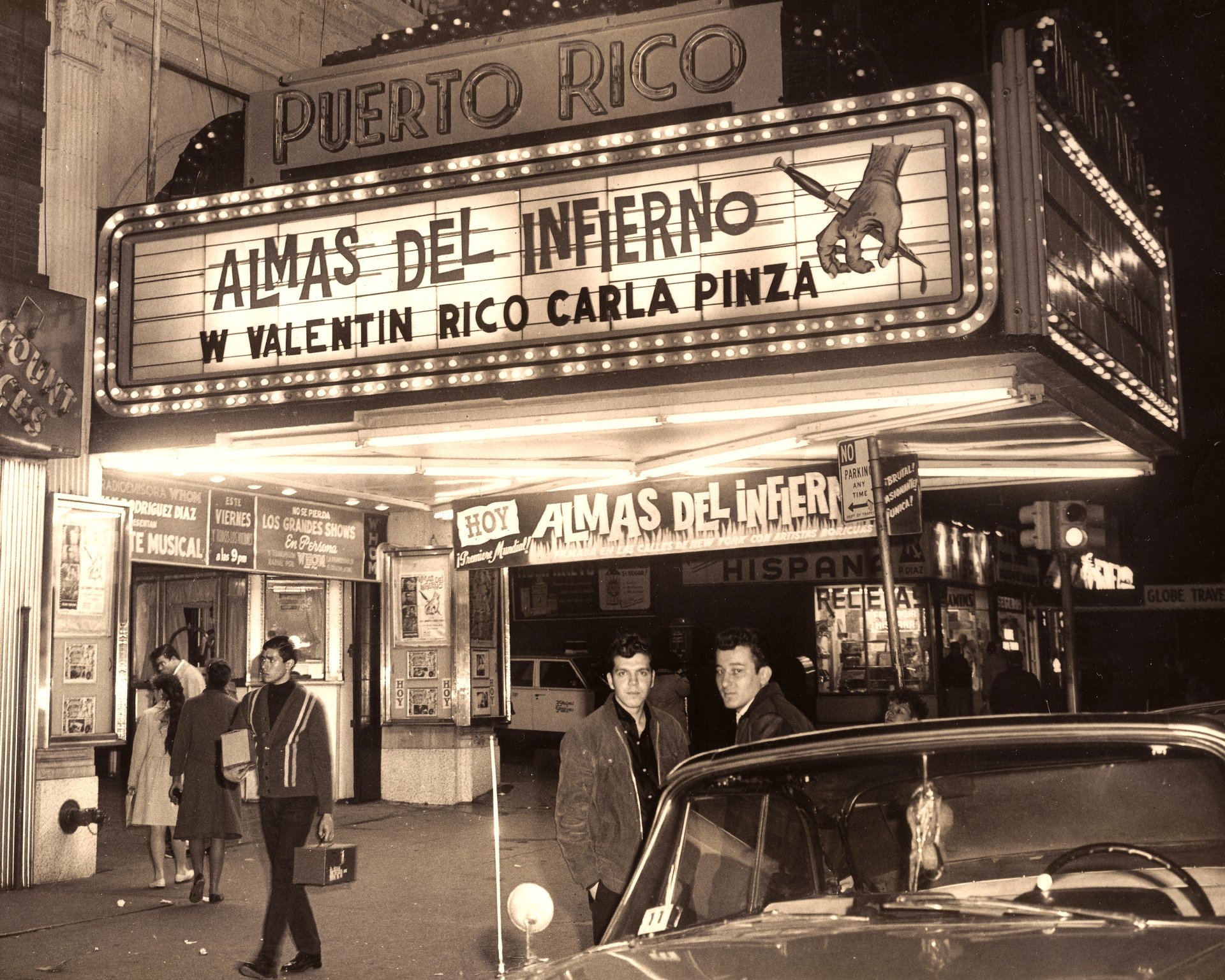
Teatro Puerto Rico
On a Saturday night in the early 1950s, you could walk into 490 East 138th Street in Mott Haven and hear the entire diaspora singing. The Teatro Puerto Rico -- a cavernous 2,300-seat hall at the corner of 138th and Brown Place in the South Bronx -- was the one place where Puerto Rican families from every borough of New York City gathered to celebrate the culture they had carried across the ocean. It opened in 1923 as the Forum Theater, a standard neighborhood movie palace. By 1948, rechristened Teatro Puerto Rico, it had become something far more vital: the main stage for Latino performers in New York, a vaudeville-style showcase of music, comedy, and film that drew stars from across Latin America and gave a displaced community a place that felt, for a few hours, like home.
La Farandula
The shows were called la farandula -- a Spanish term for the traveling world of entertainment -- and they combined live music, comedy skits, and one or two Spanish-language films, primarily Mexican, into a single evening. Puerto Rican music flourished on the Teatro's stage. Rafael Hernandez and Pedro Flores, who had formed the Trio Borincano, gained city-wide recognition through their performances. Myrta Silva, who joined Hernandez's Cuarteto Victoria, built her fame as a singer after the group played to packed houses. Felipe "La Voz" Rodriguez, whose boleros could fill every one of those 2,300 seats, was a regular headliner. In the winter of 1953, the comedian Ramon "Diplo" Rivero brought his troupe from the island to perform "El Tremendo Hotel" -- and sold out the Teatro for three consecutive weeks.
Nine-Year-Old on Stage
Two child prodigies launched their careers from the Teatro's boards. Jose Feliciano's family had moved from Lares, Puerto Rico, to El Barrio in 1950. In 1954, at the age of nine, the blind guitarist made his debut at the Teatro Puerto Rico -- the beginning of a career that would eventually bring him ten Grammy Awards and global fame. The theater's audience, drawn from communities across the five boroughs, served as both testing ground and launching pad. If you could hold the Teatro, you could hold anywhere. The hall's importance extended beyond Puerto Rican performers. Carlos Montalban, elder brother of actor Ricardo Montalban, leveraged his Hollywood connections to bring Mexican cinema celebrities to the stage. Cesar Romero, Cantinflas, Jorge Negrete, and Pedro Infante all appeared for comedy skits or conversations about their careers, drawing non-Puerto Rican Latino audiences from across the greater New York area.
The Barrios Take Root
The Teatro's rise tracked the great Puerto Rican migration of the postwar years. World War II had opened mainland factory jobs to island workers, and the advent of affordable air travel accelerated the flow. From 1946 to 1950, an estimated 31,000 Puerto Rican migrants settled in New York. The barrios of the South Bronx, Spanish Harlem, Manhattan's Lower East Side, and Brooklyn's Atlantic Avenue filled with bodegas and piragueros -- the shaved-ice vendors whose carts became sidewalk landmarks. These neighborhoods were economically precarious but culturally rich, and the Teatro Puerto Rico stood at their center, offering not just entertainment but a communal anchor. For families scattered across the city, a Saturday night at the Teatro was a reunion.
Curtain Call
By the late 1960s, the South Bronx was in steep decline. The Teatro closed its doors as the neighborhood hollowed out. In 1994, a real estate developer invested in renovations and briefly reopened the hall, but a political scandal involving misappropriated public funds forced its permanent closure after just two years. The building at 490 East 138th Street was sold to the Iglesia Universal del Reino de Dios, which converted part of the former theater into a television and radio station. On Sundays, Latin gospel music fills the space where Feliciano once played, accompanied by full jazz bands performing on the same stage. The marquee is gone, but the room remembers.
From the Air
Located at 40.808N, 73.919W at the corner of East 138th Street and Brown Place in Mott Haven, South Bronx. The building sits in a dense residential grid south of the Major Deegan Expressway. Nearby airports include KLGA (LaGuardia, 4 nm east) and KJFK (JFK, 14 nm southeast). Best viewed at 1,500-2,500 ft AGL. Look for the South Bronx neighborhood just east of the Harlem River, with Yankee Stadium visible to the northwest.